Introduction
Thank you for the invitation to participate in this year’s program. This conference is notable for blending top-notch economic analysis with a unique and stunning setting. It is a combination that has also worked well for the Kansas City Fed, and we look forward to hosting Governor Jónsson at our annual Jackson Hole Economic Symposium this summer. Thank you to the hosts for their gracious hospitality and for this opportunity to become more familiar with such a beautiful and friendly country. And thank you to Stephanie Flanders for moderating this discussion.
Regionalism in Monetary Policy
Today I will discuss a topic getting increased attention: the importance of regionalism in central banking. I will speak to how regionalism defines my role as President of the Kansas City Fed and forms the basis of my approach to monetary policy. I will then give examples of how local inputs have helped shape my views on three important global issues: oil, artificial intelligence (AI), and demographics.
But first, what does it mean to be a regional Fed president? To answer this, let me start with a little background. The United States was somewhat late in settling on a central bank, despite, or perhaps because of, two earlier failed attempts. Taking lessons from these experiences, the Federal Reserve System as created by Congress in 1913 consists of the Board of Governors in Washington, D.C., and 12 geographically defined district banks, including the Kansas City Fed. The Federal Reserve System has proven extraordinarily successful and durable, in part because it was designed to align with America’s regional composition. The Fed is a system of distributed rather than concentrated power. Hence the “Federal” in Federal Reserve. There is an understanding that decisions on monetary policy are too important to be left to Washington, D.C., and Wall Street alone.
Much of the popular support for the creation of the Fed arose in the region of the United States now represented by the Kansas City Fed. Farming is a credit-intensive industry, and farmers and agricultural bankers in the Midwest, and my region, desired a more elastic supply of liquidity than provided by money center banks in New York and Chicago. The provision of seasonal credit was an important function of the early Fed.
How does regionalism define my role today as the president of the Kansas City Fed? I view myself as being at the intersection of the two-way flow of information between my district and the Federal Open Market Committee (FOMC) in Washington. I am the voice of the region on the FOMC, and I am the voice of the FOMC in the region.
The Fed was designed to ensure that the views of a wide range of industries and communities are included in the nation’s monetary policy deliberations. In the weeks before each FOMC decision, my team and I meet with business and community leaders, including the 30 directors who sit on our boards of directors in Kansas City, Denver, Oklahoma City, and Omaha. We attend roundtables, visit factories and businesses, and conduct outreach across the district. Before every FOMC meeting we hear from hundreds of individuals. This is the input that informs my contributions at the FOMC table.
Each industry and community has a different way of understanding and expressing its interaction with the economy. This is true whether rural or urban, agriculture or healthcare, Kansas City or Denver. The function of the district bank is to understand each of these communities on its own terms. By being fluent in the district economy, the Kansas City Fed can ensure that the district is heard when it comes to monetary policy. This fluency comes from investing in expertise, but also from being deeply rooted in the community.
Let me offer some examples. Agriculture is important in the Kansas City Fed’s region. To communicate the interests and concerns of the agricultural sector, our Reserve Bank must invest in understanding the issues, challenges, and, perhaps most important, the vocabulary that shapes the sector’s economic discourse. This understanding provides the rationale for the Kansas City Fed’s newly inaugurated Center for Agriculture and the Economy. The Center will provide an anchor for the District’s research on important issues in the agricultural and rural economies and will further our outreach in these areas.
Community banking is another industry that distinguishes the Kansas City Fed district. Almost 650 of the country’s 3,800 banks are based in our seven-state region. Kansas alone has just about as many commercial banks as California and Florida combined. Understanding the concerns and needs of these banks requires fluency in their operations and the economic environment in which they operate.
Talking with community banks not only gives us insight into the economy but also informs the operational side of the Fed’s mission. The Fed has a public interest mission to promote the safety and efficiency of payments. The launch of FedNow, the Fed’s instant payments rail, was in part based on discussions with community banks and a desire to promote broad access to instant payment capabilities. As the payments system continues to evolve, both domestically and globally, it will be important that the voice of local community banks continues to be heard. In part, this will be the responsibility of the Kansas City Fed.
Importantly, our connection to the district runs deeper than the expertise of our economists. The connection that allows us to speak for the region extends throughout the Bank. I was born, raised, and made my career in the district. The same is true for my first vice president, general counsel, head of banking supervision, CIO, general auditor, and the head of bank operations. This is not to say that you must be from the 10th district to effectively serve the 10th district, but regionalism has many points of contact within an institution. In addition to engaging with the economy of our region, the connection our 2,000 employees have to our district and the sense of purpose they show in serving their region provide significant benefits for our operational work, whether it’s helping distribute cash, examining a local bank or providing an IT solution in support of the nation’s payment system.
Why am I talking about this at a monetary policy conference? Partly because I think these are issues of importance to all central banks, but at the same time are issues that are largely overlooked in the academic discussion around monetary policy. While most of the literature on central bank communication is about how monetary policymakers talk to the public, my belief is that central banks spend as much time thinking about how to best listen to the public. This important aspect of central banking is all but ignored by academics, yet key to understanding the structure of the Fed and the value of investing in regionalism.
The Economic Outlook: Oil
Now, I would like to turn to the economic outlook and what I see as the current big three topics of conversation, in the United States and worldwide, and among both policymakers and the public: oil, AI, and demographics.
Starting with oil. Of the 12 Federal Reserve districts, the Kansas City Fed has the second-largest energy footprint after Dallas. The current energy secretary, Chris Wright, was a valued member of our Denver Branch board of directors before stepping into his current role. Our region has deep energy expertise, and recent events have given us a lot to talk about.
We are living through the largest disruption to global oil markets on record. Between diminished traffic in the Strait of Hormuz and threats to oil infrastructure in the Middle East, it has been estimated that around 10 percent of global oil production has been impacted. This exceeds all previous disruptions, including those in the 1970s, which left a notable and lasting imprint on the global psyche.
Unsurprisingly, prices have reacted. However, the increase so far, at least in the United States, could be viewed as relatively moderate compared with historical experience. Even so, the sharp rise in oil prices has triggered a wave of anxiety, especially given that large oil price shocks have been associated with recession in the past.
A primary channel for oil prices to affect growth is the impact of gasoline prices on household budgets. In the United States, consumers purchase about 375 million gallons of gasoline every day. Every $1 increase per gallon shifts almost half a billion dollars daily into Americans’ gas tanks and away from spending on other goods and services. While this number is large, and certainly is being felt by U.S. motorists, we must consider it in the context of a $30 trillion economy.
Overall, the United States is much less energy intensive than in the past. For example, we use about the same amount of gasoline today as we did three decades ago, despite an economy that is twice as large and a 40 percent increase in the number of miles driven a year. In the 1970s, it took roughly 12,000 BTUs of energy to produce one dollar of GDP. Now, it takes 3,000 BTUs. Oil is less important, and we are more efficient in using it.
Another development buffering the U.S. economy, and rooted in the Kansas City district, is the tremendous increase in domestic oil production following the shale revolution. The United States has shifted from being the world’s largest oil importer to being an oil exporter. When the United States was a large importer, higher oil prices were a deterioration in the nation’s terms of trade and a drain on domestic spending power. Today there is still a transfer of wealth, but it is happening within the country. U.S. consumers are paying more, but U.S. producers are earning more. Of course, there remain distributional consequences that should not be overlooked.
Higher oil prices could incentivize U.S. producers to increase investment. However, my discussions with firms in my region suggest a high degree of caution. Over the past decade, my contacts have moved toward far greater capital discipline and are reluctant to increase production while prices remain so uncertain.
While the effect of oil prices on economic activity may be unclear, what is clear is that higher prices are contributing to higher inflation. CPI prices increased 3.8 percent in the 12 months ending in April, and higher gasoline prices were a big part of this. But not the only part. Excluding energy, inflation is also running hot, with prices increasing 2.8 percent over the past year.
There is an active discussion, among academics and policymakers, about how monetary policy should respond to relative price changes, such as the recent surge in oil prices. Textbooks suggest that central bankers should “look through” such price changes. But there is also a realization that inflation can become embedded and persistent. With inflation running above the Fed’s 2 percent definition of price stability for over five years, now is not the time to let down our guard. We must continue to signal our commitment to price stability and our willingness to take the actions necessary to achieve our mandate.
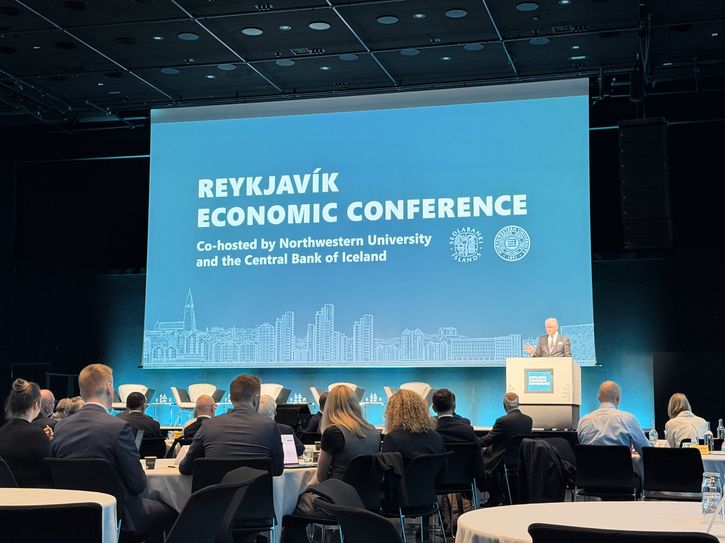
Kansas City Fed President Schmid delivers remarks at the Reykjavik Economic Conference in Reykjavik, Iceland
The Economic Outlook: AI
One word I hear repeatedly travelling my district is “resilience.” Despite unprecedented shocks to global trade and oil markets, most economic indicators suggest continued steady growth. Many commentators attribute this resilience to the ongoing massive buildout of AI infrastructure, which brings me to my second topic. On the surface, tech investment appeared to account for about ¾ of GDP growth in the first quarter. But AI investment relies significantly on imports, and imports of tech-related capital equipment subtracted considerably from growth in the quarter. On net, the importance of AI for growth is undisputable, but the contribution is likely a bit less than it first appears.
Outside of growth, the discussion of AI disruptions to the labor market has reached a fevered intensity. A key motivating fact has been the weakness of employment growth. Over the past 12 months, the economy added 250,000 jobs, the slowest pace outside of a recession. The question on many people’s minds: Is AI replacing workers? From my district reports, that is not the sense I am getting. Is AI depressing hiring? Here the anecdotal evidence is more supportive. Many firms are excited about the possibility of expanding production without expanding headcount.
The reality is that most industries have seen a decline in headcount over the past year, independent of their rate of AI adoption.
This suggests a more general phenomenon behind the weakness of hiring. One possibility is that we are seeing the aftereffects of the labor hoarding that swept through the economy in 2022. Then, with labor market churn at record levels, employers were hiring all available workers. There was bound to be some rebalancing as this urgency dissipated.
Another explanation for slow hiring is that we are seeing the passthrough of a steep decline in labor force growth. The U.S. working age population showed almost no increase last year, something that has never happened outside of war or pandemic. A sharp falloff in immigration and the accelerating retirement of the baby boom generation have weighed on the working age population. Fewer workers require fewer jobs, explaining both the slow pace of employment growth and the relatively low and stable unemployment rate.
The Economic Outlook: Demographics and Healthcare
This brings me to my final topic, demographics and healthcare. This issue has gained attention at the Kansas City Fed, due in part to what I hear from contacts in our region, including executives in the healthcare industry. The fact is that an aging population has contributed to growth in the one industry that has been adding a lot of jobs recently: healthcare. The healthcare and social assistance sector added 650,000 new jobs over the past 12 months, significantly more than the 250,000 total, implying that non-healthcare employment has shrunk.
The aging of the population is a driving factor. We tend to think of demographics as a slow-moving trend, but in reality, the United States is now at a relatively sharp inflection point. The proportion of the population aged 75 and older, an age associated with a step up in health care spending, is increasing rapidly. Over the two decades from 2020 to 2040, the share of the population aged 75 plus is set to double from 6 percent to 12 percent.
Recent work by the Kansas City Fed staff looking at state-level data reveals a tight correlation between the growth of the over-75 population and employment in healthcare._ Even more striking has been the increase in the number of care aides: that is, home health aides and care assistants for the elderly. This sector has been adding about 300,000 jobs a year recently, making it one of the brightest spots in the labor market. The importance of care aides for overall healthcare employment has been on a steep upward trajectory over the past decade and now accounts for about 17 percent of overall healthcare employment.
With the transition to an older population just starting in the United States, healthcare will likely be a steady source of employment growth in the years to come. The bigger question is whether the workers will be there to fill these roles. One might expect that the pull of the care aide sector could boost wages and costs across industries that draw from the same labor pool. An obvious source of such workers is childcare, likely increasing costs in an already stressed sector. This raises the unfortunate linkage that an aging society could further raise the already high cost of having and raising children, initiating a sort of demographic downward spiral.
A more optimistic alternative is increased productivity in the elder care sector, perhaps driven by AI. Given the tremendous projected growth in the elderly population, not only in the United States but around the globe, it is almost hard to imagine the numbers adding up without the help of AI, robotics, and increases in productivity.
Wrapping Up
I covered a number of topics today, all of which touch on the Fed’s dual mandate for full employment and price stability and therefore contribute to shaping the outlook for monetary policy. To synthesize, I believe the labor market is in balance, notwithstanding the potential, though yet unrealized, disruptions of AI. I expect healthcare to be a steady source of employment growth and a source of labor market stability. My primary concern is inflation, which is too hot and has been above target for too long. I place little stock in assuming that the most recent runup in prices is transitory within an acceptable time horizon. As such, my focus remains on inflation in setting the correct course for policy.
Endnotes
-
1 Elior Cohen. “Can Healthcare Labor Supply Keep Up with Aging-Driven Demand?” Kansas City Fed Economic Bulletin. May 1, 2026.
The views expressed are those of the authors and do not necessarily reflect the positions of the Federal Reserve Bank of Kansas City or the Federal Reserve System.
Author