
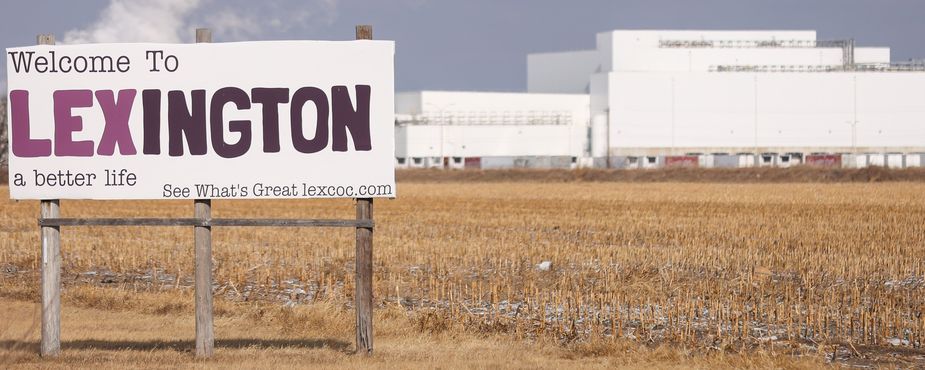
When news first spread through Lexington, Neb., that Tyson Foods would close its beef plant in January 2026, many residents were skeptical. Perhaps it was a rumor? Why would the city’s largest employer abruptly shut down?
It didn’t make sense to Rocio Casonova.
“It was a huge surprise,” said Casonova, youth librarian for the city of Lexington.
It wasn’t a rumor. Tyson said it was closing the Lexington facility as part of an effort to downsize its beef segment, which the company said had lost more than $1 billion in 2025. In a town of around 10,000, some 3,200 people would be laid off.
Casonova said, “My first thought was, what am I going to do to help everyone who works there?”

Rocio Casonova
Local leaders step up
Casonova has lived in Lexington for 25 years. Because she’s so well known in the community, people looked to her for help.
“I began receiving numerous phone calls, including one from Telemundo Nebraska,” she said. “People started gathering at the Catholic Church, while others came to the library where I work. Suddenly, I found myself as the go-to person for assistance and support.”
The laid-off workers were asking Casonova: What will happen with my health insurance? How do I pay my bills? How do I put food on my table? She and others started answering questions however they could.
Nuria Lemus is the co-owner of local restaurant Taqueria Max. After hearing about the Tyson closure, she said there was a state of anxiety, panic and disconnect in Lexington.
“Everybody went into shock,” she said. “It felt dark in the community, gloomy.”
Soon, the Lexington Emergency Relief Fund was established by the Lexington Community Foundation and an anonymous donor. Lutheran Family Services helped distribute the money to eligible workers. It was designed to help them fill the gap between the layoff and their next job.
“The relief fund was created to help with bills, food vouchers, etc.,” Lemus said. “It’s a boost to help those affected. It wasn’t going to be a long-term solution.”
“We conducted training sessions at Lutheran Family Services, the community college, the Lexington Public Library and the Dawson County Extension Office,” Casonova added. “We are committed to ensuring that our town is not perceived as a community abandoned by a major employer.”
Disproportionate disruption: ripples from a ‘major event’
John McCoy, associate economist for the Federal Reserve Bank of Kansas City, decided to study the issue from an economic perspective. His Economic Bulletin External Link“Mass Layoffs Can Disproportionately Disrupt Small Communities” explores the effects of layoffs such as Tyson’s, which it calls “one of the most substantial layoff events in the past 25 years after accounting for the size of the local community.”
“It was clearly going to be a major event for the Lexington community, and we were curious about understanding how big the ripples might be,” he explained. “The research shows that mass layoffs can have severe negative consequences, and they increase in magnitude for smaller communities that are less economically diversified.”

John McCoy, associate economist
McCoy said mass layoffs affect the individuals who lose their jobs and income, but negative consequences spill out into the community as well. Those who were let go from Tyson have limited means of spending on goods and services in the community, meaning more jobs losses in other industries could occur as a result.
“As the size of the layoff increases relative to the size of the local population, this effect is magnified,” McCoy said. “Based on findings from this literature, I estimate that unemployment in Dawson County might rise from 3% in October 2025 to 27% within three years, given the size of the layoff (3,200 people) and county (~24,000).”
The repercussions spread farther out. According to an External Linkanalysis by the University of Nebraska’s Center for Agricultural Profitability, the plant had the capacity to slaughter 5,000 cattle per day — approximately 4.8% of total daily U.S. beef slaughter. It estimates the annual statewide economic impact of the plant closure to be more than $3 billion. The analysis adds that losses in state personal income tax revenues are estimated at $23 million, while state sales tax revenues are projected to decline by $10 million per year.
As McCoy writes in his Fed bulletin: “Although the specific statistical effect of the mass layoff in Lexington is uncertain at this time, unemployment is expected to rise, the labor force is expected to contract and net out-migration is expected to increase.”

Moving or staying?
Alejandro Gutierrez is from Guadalajara, Mexico. He came to Lexington when he was 14 years old and his father worked at Tyson. For the past 10 years, Alejandro also worked at the processing plant, helping with the cattle schedules in the cooler, counting and keeping track of how many cattle were run each day.
“I felt so sad the day we got the notice,” he said. “I remember the first thing I did was hug my wife and kid and started crying. I was telling myself, ‘What are we going to do?’ My dad has been working there since 2002 and he never thought Tyson was going to close, no matter what.”
Gutierrez is also an assistant soccer coach for the Lexington High School boys’ soccer team, which provides him with a small stipend to get by in the meantime. He doesn’t want to leave the community he has lived in for so long. But he may not have a choice.
“I really don’t want to move from this town, since I came here from Mexico in 2011. I’ve been here half my life,” he said.

Alejandro Gutierrez, former Tyson employee.
He said many of his friends and former co-workers had already moved to find jobs elsewhere. Others were waiting for the school year to be over, to avoid disrupting their children’s academics. For some, hope remained that another business would take over the plant, that people wouldn’t have to uproot their families.
“I have a lot of friends who had to move to Columbus, Nebraska, and others to Garden City, Kansas,” he said. “I talk to them, and they are still hoping the (former Tyson) plant will re-open with something else, but I feel little by little the town is going to start going downhill if there are no jobs around.”
Lexington after Tyson
During a forum this spring in Kearney on issues facing Nebraska, put on by the Flatwater Free Press, McCoy, Casonova and Lemus took part in a panel called “Lexington After Tyson.” They talked about the Tyson closure and took questions from the audience. One thing they all agreed on was the closure’s significant impact on the community.
“Many individuals who moved here with the hope of raising a family in a peaceful environment are now facing the stress of finding ways to pay their bills,” Casonova said. “This often involves commuting to other communities for work, resulting in extended periods away from their children. Lexington is a vibrant community that values neighborly connections, and witnessing residents relocate has been challenging for everyone involved.”
McCoy said that layoffs at this scale are rare but can yield monumental effects, particularly in rural areas.

(L-R) Flatwater's Natalia Alamdari, panelists Rocio Casonova, Nuria Lemus and John McCoy.
“Most mass layoffs occur in more populous areas and, while certainly challenging for individuals who are directly affected by the loss of employment, are less likely to severely impact the broader community,” he said. “Larger areas tend to be more diversified and have more opportunities for unemployed people to find re-employment.”
With the high school season over, Guiterrez is again looking ahead. He said he might apply at the Sustainable Beef plant in North Platte. He may move to another state. He wasn’t sure yet.
“I really love this town. It’s given me all I want, but I might have to move as life needs to continue.”
Casonova and other local leaders are working hard to bring resources to support their community and, they hope, provide a place to remain.
“We are resilient and hardworking people,” she said, “and Tyson is now part of our past.”
copyright Omaha World-Herald
Casonova and other Lexington residents helped collect close to 1,000 signatures supporting the Worker Adjustment and Retraining Notification Act. The legislation, signed into law in April 2026, amends existing statute by requiring employers with more than 100 employees to provide 90 days’ notice of business closings and mass layoffs.
The views expressed are those of the authors and do not necessarily reflect the positions of the Federal Reserve Bank of Kansas City or the Federal Reserve System.
Author