
Alex and Brianna Augsburger own Swift Auto Repair in Calhan, Co., east of Colorado Springs. When they were just starting out, they needed a small loan but found it difficult to attract a bank. A friend suggested the Augsburgers reach out to Colorado Enterprise Fund (CEF).
CEF is a statewide nonprofit small business lender. As a certified Community Development Financial Institution (CDFI) under the U.S. Treasury, CEF provides capital access to small businesses that fall outside conventional lending criteria.

Brianna and Alex Augsburger (and Goose, the dog), owners of Swift Auto Repair in Calhan, Colorado. When banks were reluctant to provide a small loan, they reached out to Colorado Enterprise Fund for help.
When Brianna contacted CEF, she found a comprehensive support system tailored to their small business requirements. “The experience with CEF felt like having a personal business consultant,” she said, “with ongoing support before we secured the loan and after the loan with a monthly business check-in.” CEF financing helped the Augsburgers acquire a car lift and provided working capital. "Our funds stay in the community,” Brianna said. “We live here, work here, and source parts exclusively from locally owned NAPA stores and dealerships."
In Albuquerque, N.M., Abby Boling had resigned herself to never owning a home, until she learned about Homewise. The Santa Fe-based nonprofit affordable housing CDFI transformed Boling’s housing trajectory through its comprehensive approach.
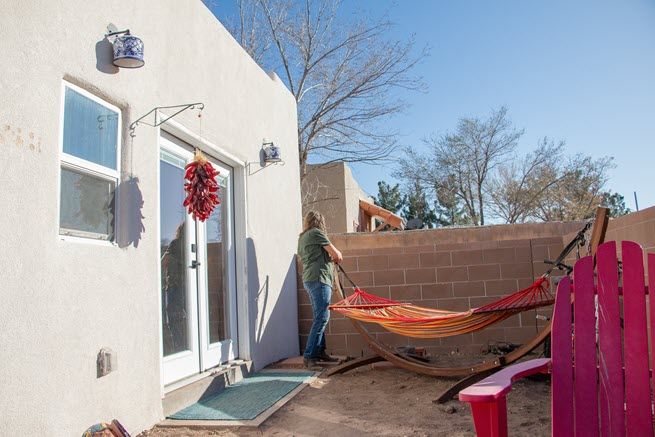
Abby Boling enjoying her garden in her first home. She used Homewise's homebuyer education and personalized financial coaching to help her purchase the home in downtown Albuquerque, N.M.
Homewise operates many housing developments, but Boling went a different route. She found a home for sale in downtown Albuquerque in a neighborhood she loved, but never thought she could afford. For years, Boling had worked three jobs, saving money to buy a home. The Homewise team helped her build on her savings. They identified and secured homebuyer assistance options that aligned with Boling’s financial parameters.
Then, through Homewise's structured first-time homebuyer education and personalized financial coaching programs, Boling acquired knowledge and confidence for her homeownership journey. "When I found out about the classes, it just took all of that worry away," Boling said about the experience.
CDFIs create economic and social benefits
CDFIs fill important gaps in the financial system. They help entrepreneurs by providing loans and business advice, while also supporting stable neighborhoods through homebuyer education and mortgage programs.
As key financial partners in their communities, CDFIs create economic and social benefits that spread throughout neighborhoods. They go beyond traditional lending by opening doors to economic opportunity for those who may have difficulty obtaining traditional bank financing.
2025 CDFI survey shows organizations facing challenges
The recently released 2025 Federal Reserve CDFI Survey shows these organizations face major challenges. According to the survey, CDFIs struggle with the same financial pressures that states and cities face: less federal funding, uncertain economic conditions, and changing policies that make planning difficult.
This financial uncertainty makes it hard for CDFIs to plan when they need stable funding to run effective programs. Despite these challenges, more people than ever said they need CDFI services. The survey shows CDFIs urgently need additional funding and support to serve more low- and moderate-income communities.
The survey reveals a basic problem: while demand for CDFI help is growing, limited resources prevent CDFIs from making their full economic and social impact in vulnerable communities across the country.
Leaders from Homewise and CEF respond to the CDFI survey
Strong demand persisted for CDFIs
Most CDFIs saw rising demand for their products across all business lines in 2024. Increased demand was largely driven by new customers seeking consumer, small business, and residential real estate development loans.
Sarah Rulfs is resource development director at Homewise, the New Mexico-based CDFI that helped Abby Boling. She said the organization sets ambitious annual goals for its work. “The primary metric we track is how many homeowners Homewise creates,” she said. The metric includes clients who have used any or all Homewise services and purchased a home. Homewise set an internal fiscal YTD goal of 320 homeowners created. “As of December 2025,” Rulfs said, “we have created 332 homeowners, a 10% increase over this time last year, when we had created 302 homeowners.”
Nim Patel is chief operating officer at CEF, the Colorado-based CDFI that helped the Augsburgers. He said, “Our lending was up over 20% year over year from fiscal year 2024 to fiscal year 2025.” CEF has an average loan size of $100,000, attributed to higher capital needs businesses are facing, and continues to provide loans as low as $25,000. The CDFI survey period ended in mid-June 2025. Since then, Patel said, loan demand has slowed due to uncertainty and unpredictability with tariffs and the economics faced by the markets their businesses serve.
Federal funds enabled CDFIs to reach more borrowers
CDFIs identified their unique value add as the ability to reach otherwise financially underserved borrowers with flexible underwriting and loan terms. Three-quarters of survey respondents also said that federal funding streams were critical to providing the underwriting and loan terms needed to reach underserved borrowers.
Rulfs said that federal funds and funds leveraged by CDFI certification (e.g. CRA funds from banks) remained valuable to their operating model. “CRA investment is the financial engine of our operations,” she said. “Federal funds allow Homewise to reach deeper into affordability, serving homeowners below 80% of the Area Median Income.”
Patel agreed with the importance of federal funds for their operations and how organizations of all types are affected by the trickle-down effect from federal, state and municipal funding cuts.
Respondents cite staffing, technology, and capital as challenges
Staffing and technology were the challenges most widely experienced across all respondents, while loan funds pointed to lending and operational capital as acute challenges. CDFIs were specifically challenged by a lack of qualified candidates to fill open positions, limited ability to bridge skills gaps through training, and the high costs associated with technology and new debt capital.
CEF is the largest small-business CDFI in Colorado, with a strong management team and staff, along with advanced technology platforms and the ability to raise capital, Patel said. He did express concerns, based on conversations with others in the industry, that smaller CDFIs are facing staffing, technology and capital constraints.
Respondents split on economic outlook. The ability to meet growing demand hinges on sustaining funding levels.
Historically, CDFIs have been critical lenders in weaker economic environments. Therefore, while more than half were pessimistic about the overall economy, many expected demands for their products and services to grow through 2025. Almost all respondents expect to grow their customer base and their level of financing through 2030. Demand growth could outpace funding if capital sources dry up, especially for loan funds.
Rulfs said Homewise continued to monitor changes to federal funding and the overall economic landscape. A significant economic downturn could affect interest in homebuying, but could also potentially create opportunities in refinancing or home improvement lending.
More information:
External LinkCRA OneSource - Federal Reserve Bank of Kansas City to find CDFIs lending in our district.
The views expressed are those of the authors and do not necessarily reflect the positions of the Federal Reserve Bank of Kansas City or the Federal Reserve System.
Author