
In America’s heartland, the nearly three million people who call Kansas home contribute significantly to the U.S. economy through the state’s strong agriculture, food production, transportation, manufacturing and energy sectors, among others.
Assistant Vice President and Regional Executive Jeremy Hill, who serves as the Kansas City Fed’s regional economist for Kansas and western Missouri, frequently visits businesses, industry leaders and community partners throughout Kansas to gather ground-level insights about the state’s economy.
Hill’s connections to the state and his understanding of Kansas’ economy run deep. Prior to joining the Fed in 2024, he spent 15 years as the director of Wichita State University’s Center for Economic Development and Business Research. In that role, he engaged with developers, business and civic leaders on economic issues affecting Kansas. That experience laid the foundation of his economic outreach work for the Kansas City Fed.

Hill leads an economic roundtable event with the Board of the Wichita AeroClub during a recent visit to Wichita in May. The AeroClub is an organization of executives in the Wichita aerospace manufacturing community that focuses on promoting and supporting the aviation industry.
“Over the years, I have learned that understanding an economy starts with understanding its people,” Hill said. “The relationships that I have built with business leaders and communities across Kansas have provided insights you simply cannot find in a dataset alone, revealing the opportunities, challenges and forces shaping industries from aerospace to food manufacturing.”

Jeremy Hill discusses local economic conditions at the Wichita headquarters of Village Travel, a recreational bus rental and touring company and full-service travel agency.
"Having the Federal Reserve Bank out of Kansas City visit Wichita, and visiting our company in particular, was really interesting and gave us some good insight, and it also allowed us the opportunity ... to share our experiences with an agency that is meaningful and does impact the economy," said Jeff Arensdorf, chief executive officer of Village Travel.
Where Wheat Combines and Conveyor Belts Meet Monetary Policy
“Economic conditions are constantly evolving, which is why staying connected to business executives is essential,” Hill said. “These conversations help me identify emerging trends, understand critical pain points and gain a clearer picture of how economic shifts are affecting businesses and households in real time.”
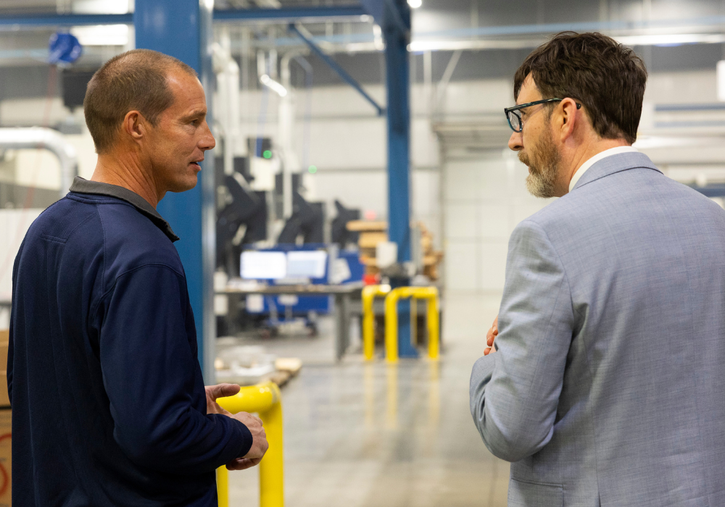
Hill tours C.E. Machine, a full-service aerospace manufacturer, during a recent visit to Wichita in May.
The sum of this information serves multiple purposes. Highlights from conversations about key topics such as labor markets, prices, consumer spending, real estate and industry activity inform the Tenth District’s section of the External LinkBeige Book. That report, published eight times a year (typically coinciding with External LinkFederal Open Market Committee meetings), contains anecdotal information from each Reserve Bank about economic conditions within its District. Voting members of the Committee use the Beige Book, among other materials, to deliberate on policy.
Hill also shares economic findings from Kansas businesses and community leaders directly with President and Chief Executive Officer Jeff Schmid, who was an FOMC voting member in 2025. Even in their nonvoting years on the FOMC rotation, all Reserve Bank presidents attend meetings and participate in the discussions.
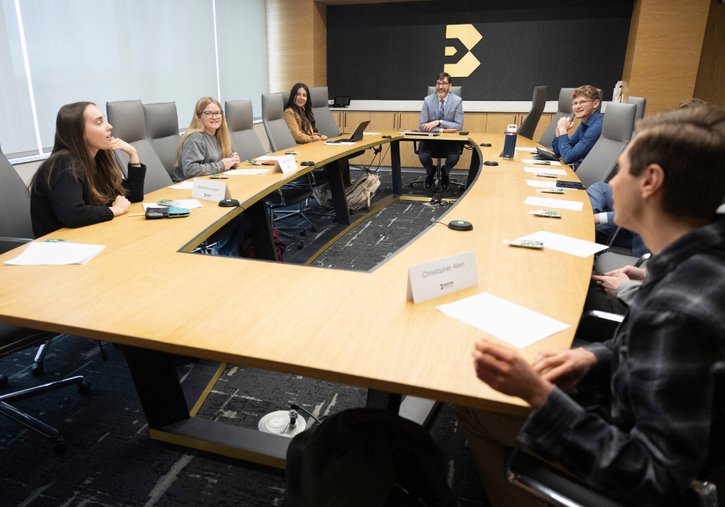
Hill presents to Wichita State University's Student Managed Investment Fund club during a visit in May, offering economic insights and advice for students with an interest in finance and economics.
It is because of the Federal Reserve System’s unique regional structure that conversations conducted on a rippling Kansas wheat field or a whirring factory floor ultimately influence one of the most impactful events held by the nation’s central bank.
Beige Book 101
Learn how the Federal Reserve collects information for the Beige Book, what's collected, how it's used and why it matters to you.
Key Sectors of the Kansas Economy
- The manufacturing sector represents 11.5% of the state’s workforce, employing more than 173,400 Kansans and accounting for 14.5% of the state’s gross domestic product.
- Kansas is the top producer of wheat and sorghum in the country and ranks third in cattle production and beef processing.
- Wichita, Kansas, is known as the air capital of the world, with the third-largest concentration of aviation workers in the country. The state exports $2.25 billion in aerospace materials annually.
- Kansas ranks among the top five U.S. states in total wind-energy generation.
The views expressed are those of the authors and do not necessarily reflect the positions of the Federal Reserve Bank of Kansas City or the Federal Reserve System.
Author