
Chapter Summaries
Introduction
Route-based tourism uses what makes small towns special to enchant visitors and boost prosperity.
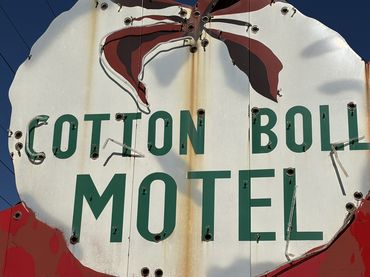
The Cotton Boll Motel sign in Canute, Oklahoma, is glowing again thanks to repairs since this photo was taken.
Why is the Kansas City Fed writing this report?
The Kansas City Fed territory includes four of the eight states that Route 66 traverses on its path from Chicago to Los Angeles. The Route 66 Centennial in 2026 was the catalyst for this report. Route-based tourism is well suited for small towns and rural areas. While Route 66 is legendary, it is, like any byway, a connector between communities.
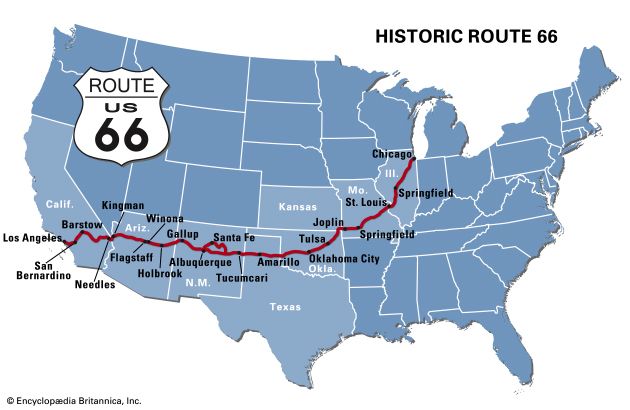
Courtesy of Encyclopaedia Britannica, Inc., copyright 2010; used with permission.
Our research found ten main themes to strengthen or start a byway
We asked national experts and people doing the work along byways for their advice on pursuing byways as an economic development strategy. Ten themes stood out.
Back roads, byways journeys are America at its best
Byways link places that matter to people. This is the story of the beloved Blue Whale of Catoosa, how it was nearly lost and how it was saved.
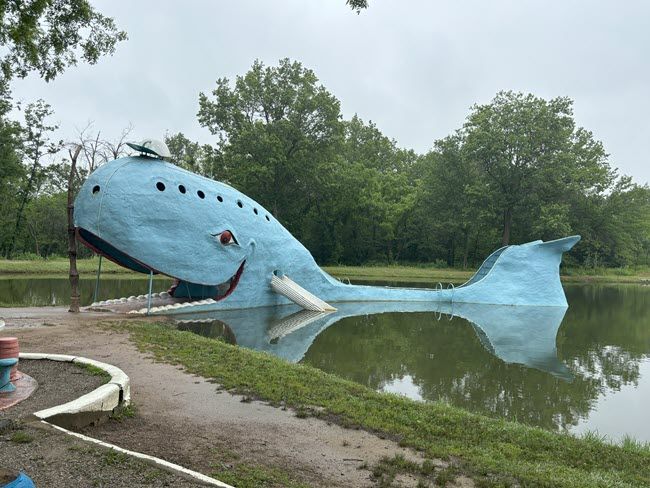
The Blue Whale of Catoosa is a beloved site along Route 66, home to many idiosyncratic attractions.
Byways can be designated nationally or at the state and local levels
The nationally designated byways program is called America’s Byways, but most byways are designated at the state or local level, or by tribal governments.
Tourism is serious economic development for rural areas
Maree Forbes Gaughan has worked on or advised nearly 450 of America’s 1,100-plus byways. She shares the typical economic impact of a byway, and one major – but surmountable – barrier to rural tourism.
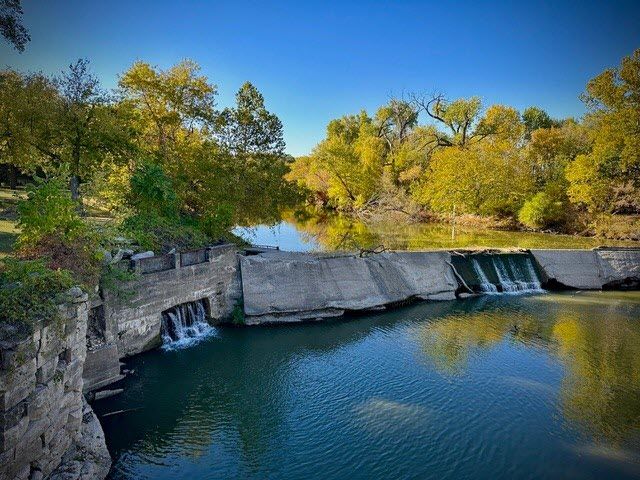
The Flint Hills Scenic Byway in Kansas includes three registered agritourism businesses. Photo of Cottonwood Falls by Donnie Morehouse.
Rural development hubs can pull the region together
Janet Topolsky shares an asset-based approach to rural development that helps rural areas leverage assets to meet and create progressively greater opportunity over time. Rural development hubs are key.
Small towns build and deploy their own philanthropic funds
The Nebraska Community Foundation works with communities to build unrestricted endowments. Red Cloud, Nebraska, home of Pulitzer Prize winning author Willa Cather, used its endowment to study heritage tourism.
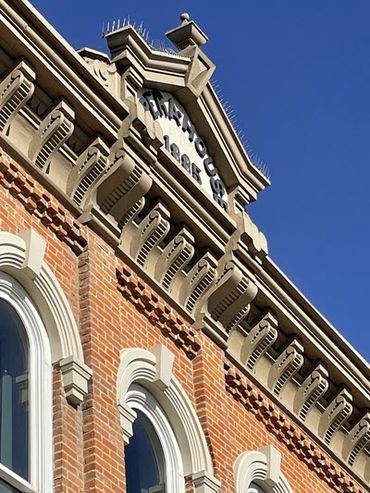
The Red Cloud Opera House was built in 1885 and restored in 2003.
The byway that bluegrass built
When mining jobs disappeared, southwest Virginia created a 19-county, 333-mile music trail built around Appalachian music. The Crooked Road Music Trail pulls visitors from around the globe.
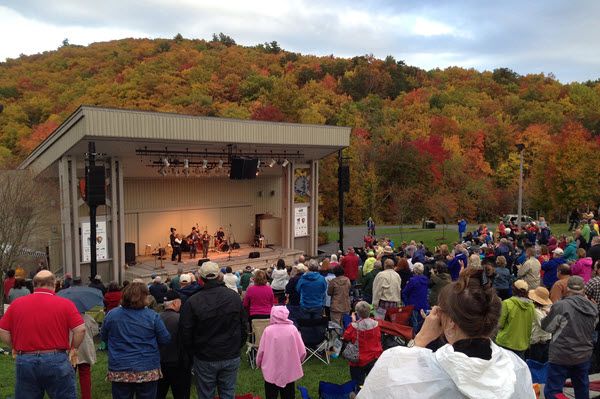
The Blue Ridge Music Center is one stop on the Crooked Road Music Trail, which has helped southwest Virginia recover from the loss of coal mining jobs.
Destination marketing organizations help byways build (and sell) the visitor experience
The DMO’s job is to say, if you have this attraction, here is what you need to best serve your visitors. Sharon Strouse of the National Scenic Byway Association shares marketing advice.
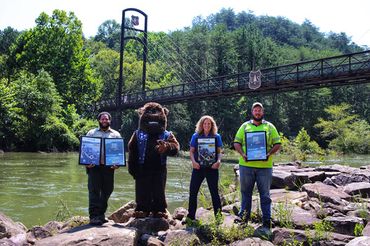
The Ocoee Scenic Byway is a past winner of the National Scenic Byway Association's Byway Community Award for its "Nobody Trashes Tennessee" campaign.
Route 66 an epic, quirky trip into America’s past
Traveling Route 66 means navigating a road that no longer officially exists and meeting people who are preserving history, building businesses and strengthening community along the way.
To understand why people care about Route 66, start with the history
Route 66 was a shining ribbon of possibility during some of the most daunting and vivid decades in American history. Rutgers University studies show the lasting economic impact of the Mother Road, and where communities are leaving money on the table.
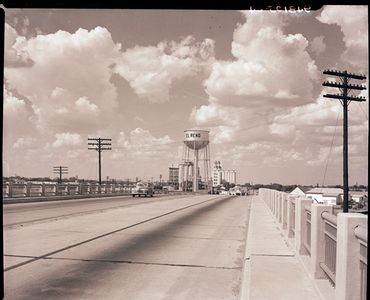
The approach to El Reno, Oklahoma, on Route 66. Image courtesy the Oklahoma Historical Society.
More miles, more love for Route 66 in Oklahoma
Led by the lieutenant governor, Oklahoma legislators embrace tourism as economic development, devoting a $6.6 million annual revolving fund to revitalize and preserve the Mother Road. The Centennial kick-off event celebrates Andy Payne, the Cherokee Nation citizen who won the 1928 “bunion derby.”
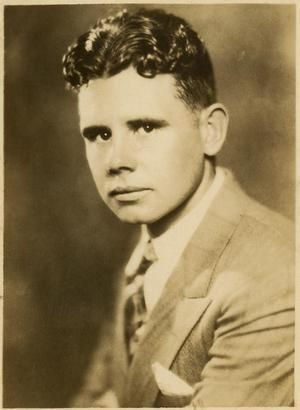
Andy Payne in 1928. Photo courtesy of the Oklahoma Historical Society.
Miami: Preserve the past to secure your future
At 19, Eli Chenoweth paid $23,000 for the 1929 Marathon filling station. He and his wife Tori are just getting started. Friends of the Coleman volunteers preserve the ornate, massive Coleman Theatre. Main Street America helps preserve historic downtowns, because “you don’t run the parade through your industrial park.”
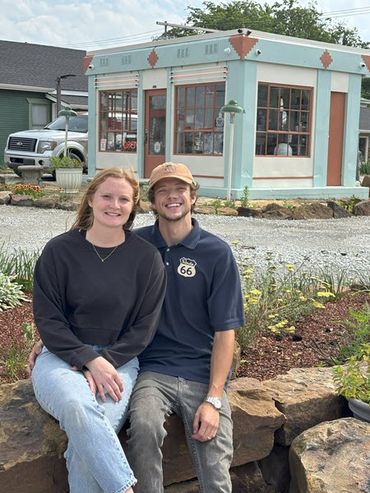
Tori and Eli Chenoweth have restored two 1920s service stations. This is the Hudson station, which houses their shaved ice business, the Frozen Elephant.
Vinita: The Cherokee Nation story is intertwined with Route 66
As Principal Chief Chuck Hoskin, Jr., said, “The road weaves through communities that remain Cherokee communities.” In 2008, the Cherokee Nation identified cultural tourism as an important economic development tool. In 2022, the Nation opened its $5 million Cherokee Nation Anna Mitchell Cultural and Welcome Center on Route 66 in Vinita.
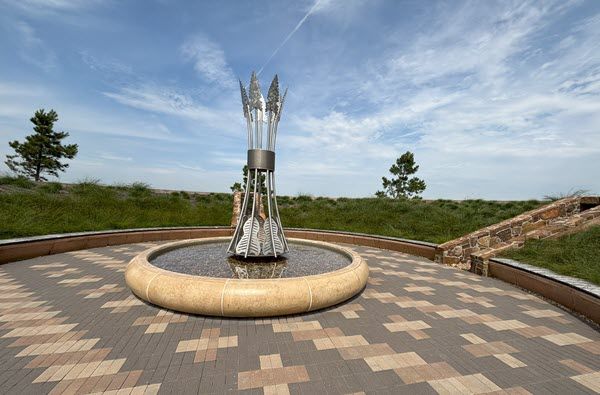
The Cherokee Nation Anna Mitchell Cultural and Welcome Center fountain offers a panoramic view of the surrounding countryside.
Vinita: Be like the Hi-Way Café, and create an experience
Beth and Alan Hilburn use giants, neon, a spot in the Guinness Book of World Records, and ties to the local community and to businesses up and down Route 66 to help travelers create treasured memories.
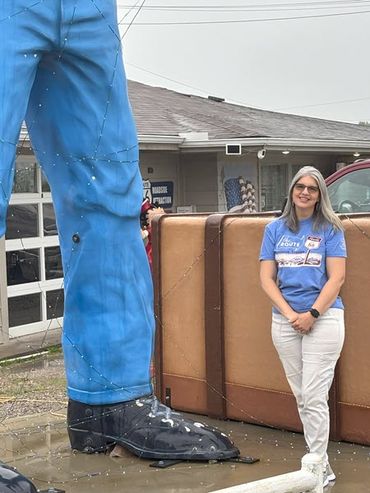
Beth Hilburn stands by Big Bill, a Muffler Man who hangs out by the Hilburn's restaurant and motel outside Vinita, Oklahoma. Big Bill is one of three giants on the property.
Clinton: This is how you pass the torch
The West OK Co-op is reinvigorating Clinton, Oklahoma, by strengthening its connection to the Mother Road and winning over long-time residents. Oklahoma’s Route 66 Commission granted the group nearly $1 million for the Hub City Gateway project, to be built over a 400-foot stretch of the original 1926 road base.
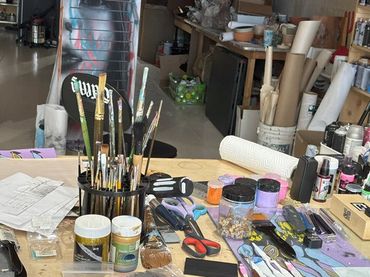
The West OK Co-op is a home for creative types in Clinton, Oklahoma, and a platform for reinvigorating the town's connections to Route 66.
Threatt filling station a safe haven during Jim Crow days
Once considered endangered, the Threatt filling station is restored and moving closer to telling the story of travel for Black Americans during the era of Jim Crow laws, which enforced racial segregation.
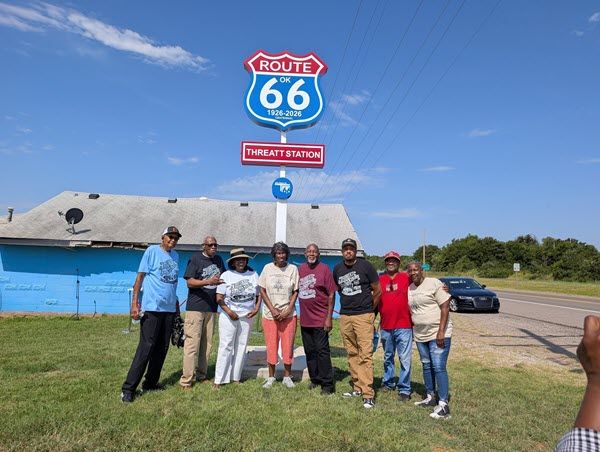
Members of the Threatt family gather by the new Route 66 Monument sign, marking the only known Black-owned filling station on Route 66 during Jim Crow, which lasted through the mid-1960s. Photo by Rhys Martin.
Clinton: Encourage the volunteers. They bring passion, skill and pride to byways.
When Arcadia’s famed Round Barn collapsed, an army of volunteers calling itself the Over-the-Hill Gang rebuilt it. Its leader is among those enshrined in the Oklahoma Route 66 Hall of Fame at the Oklahoma Route 66 Museum in Clinton. Rhys Martin, president of the Oklahoma Route 66 Association, energizes volunteers along Route 66.
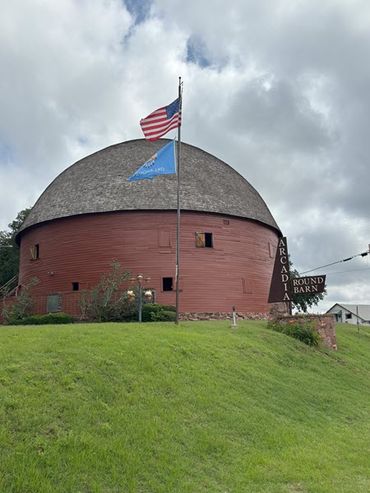
The Round Barn of Arcadia was restored thanks to Luke Robison, a retired carpenter, and the Over-the-Hill Gang of volunteers. Robison was inducted into the Oklahoma Route 66 Hall of Fame in 2008.
El Reno visitor center benefits travelers and local residents
The renovated mid-century fuel station is now a Convention and Visitor’s Bureau office and visitor’s center, with a hot-rod museum and mural by a local artist.
America shifts from east to west just past Oklahoma City
In the middle of the state, you understand why “Red Dirt” describes what is uniquely Oklahoman. A little farther west, trees and people thin out and the sky expands.
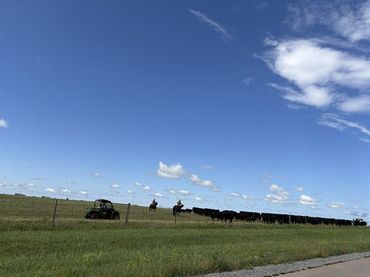
Sixty miles west of Chandler, near El Reno, the landscape shifts from east to west. The sky expands until you can see the curve of the horizon.
Sayre: Even a little support can make a huge difference
Suzanne Hylton led creation of the Rivers Edge Arts Society to promote the arts in Sayre. She says state funding for Route 66 revitalization grants and the Route 66 Passport program has helped boost economic development.
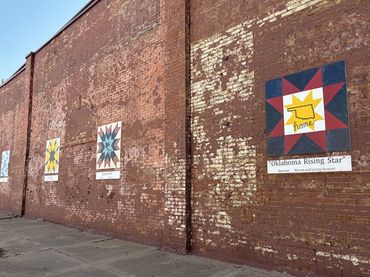
The River's Edge Arts Society uses the arts for economic development in Sayre, Oklahoma. It invited businesses to sponsor barn quilts hanging on walls downtown.
Conclusion
If these stories spark anything, we hope they encourage an appreciative look at the history, beauty, culture and people in America’s small towns. No matter what your position, there is a role for you in building an exciting new scenic journey.
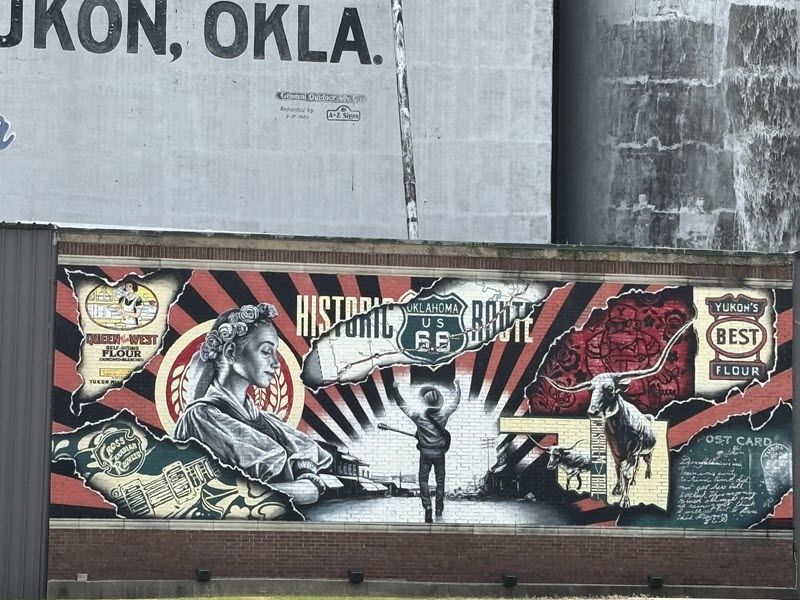
The Yukon's Best Flour silo is home to a mural commemorating historic Route 66.
The views expressed are those of the authors and do not necessarily reflect the positions of the Federal Reserve Bank of Kansas City or the Federal Reserve System.