
You know Jenga, the tumbling-towers favorite at game nights? Moving blocks around causes instability, but ultimately the pieces fit together, so the tower grows until it’s too tall and collapses. Imagine what it might feel like to play that same game, but the wooden blocks are different sizes, or magnetized to repel one another. It would be a whole new level of frustration.
Assembling funds for a housing development sometimes feels like playing a huge game of Jenga. In market rate development, the pieces are all the same size. They build on each other but eventually grow unstable. Affordable housing is the version of the game where the pieces are not uniform. There might be more pieces and smaller pieces, with rules that say blue and red blocks cannot be used in the same tower without green, and some cannot be placed together at all.
It’s messy.
This is increasingly what the process for building a “capital stack” for affordable housing development looks like in communities across the Kansas City Fed’s seven-state district. We recently hosted a series of roundtables with affordable housing developers to better understand the challenges they face in building capital stacks for projects.
What did our research include?
A project lives and dies based on whether a developer is willing to do it. Recognizing the foundational role they play in the affordable housing system, we started our conversation with housing developers. From July through December 2025, community development staff at the Federal Reserve Bank of Kansas City heard from affordable housing developers working across the District to understand the challenges they face in developing new and rehabbing existing housing. We invited both for-profit and not-for-profit affordable housing developers to roundtables hosted by the Bank in Albuquerque, Denver, Oklahoma City, Omaha, and Wichita, with additional one-on-one conversations held in Kansas City. In total, 43 affordable housing developers provided input on the challenges and opportunities affecting affordable housing and development of capital stacks.
These conversations help us understand how current economic conditions affect the supply of affordable housing, specifically by unpacking the various components of the capital stack.
How does affordable housing work?
In a market-rate rental housing development, the developer generates enough operating income through rents and other revenue sources, such as parking, laundry service fees, or commercial rents, to service the project’s permanent debt. Because of that, it requires no form of development subsidy. Operating revenue ultimately drives the total amount of permanent debt a housing development project can carry.
This is not the case with an affordable housing rental development. Rent figures are calculated based on the income of households that will rent the units, traditionally at or below 80% of the area median income. Rents paid often are not enough to cover operating costs, so subsidies are required to make up the difference. The subsidies can come in a variety of forms: federal, state, or local grants (or “soft financing”); philanthropy; or tax-credit equity. These subsidy sources fill the gap between the total development costs and the amount of permanent debt a project can support based on operating revenue.
The operating pro forma and the capital stack convey the financial realities of an affordable housing development. The pro forma is a financial projection of a project’s future operating performance. It includes the project’s operating revenue, operating expenses, net operating income, debt service capacity, and return on investment. It conveys assumptions about how the development will perform once completed, considering anticipated vacancy rates and future increases in both rents and operating expenses. Developers start with the operating pro forma because it establishes how much debt a project can carry, an important element of the capital stack.
A capital stack is a complicated thing. It’s a combination of soft and hard financing, equity, grants (sometimes), and tax credits — elements that don’t necessarily work well together. It’s a reflection of economic trends and a mirror for available resources in a specific location for affordable housing development.
What did affordable housing developers tell us?
We grouped the findings into key themes and innovations. Below is a high-level overview.
Key themes
Roundtable respondents identified several important trends and challenges: funding pressures, increasing administrative complexity, and rising input costs.
Funding pressures
Funds available for affordable housing development are shrinking, and housing developers reported increased competition for existing funding. They also shared that while new funding sources have been created to support development, some funds merely replace existing funds. As one participant said, "New resources … are supplanting previous funding streams without making a substantial impact."
The post-COVID fiscal environment has created what participants described as a "cliff effect." Communities have transitioned from an unprecedented surge in pandemic-related funding to not only losing those temporary resources but also experiencing cuts to established funding streams.
One of the common tools for affordable housing development is Low Income Housing Tax Credits (LIHTC). LIHTC is a federal program, and each state receives an allocation of 4% and 9% tax credits based on population. Developers are awarded credits through a competitive application process, and some are funded through public bonds. Each state's housing authority administers the LIHTC program and awards the tax credits. Developers then sell the credits to investors.
Roundtable participants reported a decline in the amount investors are willing to pay for LIHTCs. Tax credit equity pricing_ has decreased significantly._ Participants reported decreases as large as $0.10-$0.15, from the low to mid-$0.90s to the low to mid-$0.80s, representing a substantial drop in available equity dollars. This decrease, which began in 2025, is already creating significant funding gaps, especially for projects that forecasted higher tax credit equity prices before pricing began to drop. While developers can anticipate lower pricing for future projects, the outcome is still a sizable funding gap for projects.
In addition to the decreasing value of tax credits, developers also said that in some cases syndicators_ are requiring more developer equity in the project. One developer said that a syndicator they regularly work with had increased the minimum amount of developer equity from $500,000 to $1 million.
Tax credit challenges continue beyond pricing to availability, specifically as it relates to preserving projects coming out of their initial affordability period. LIHTC-funded projects generally have a 30-year affordability period before the owner can convert them to market-rate rents. "There are not enough resources to support preservation,” one participant said. “There isn't a good mechanism to resyndicate and preserve those units."
Administrative complexity
Roundtable participants said that funding programs often operate on disparate timelines with increasingly complex and burdensome paperwork requirements. A particular funding source often must be secured before accompanying subsidy sources will commit to a project. Each often has a separate application process, leading to significant time lags that increase holding costs associated with a project.
Similarly, participants said that multiple layers of regulations and compliance are affecting housing development. The regulatory landscape for affordable housing has become increasingly complex. Developers described navigating "12 sources of financing for one project," with requirements that frequently conflicted with one another. This regulatory complexity drives up costs.
Developers also cited federal regulations as sources of administrative complexity. Prevailing wage requirements associated with the Davis-Bacon_ and Related Acts add additional complexity for rural affordable housing projects, effectively making portions of federal funding inaccessible to them. New federal energy efficiency and resilience standards, while beneficial long term, also increase upfront costs.
Local approval processes pose additional barriers. Participants reported substantial delays in permitting, with one developer noting they "currently have enough funds to build 20 units but can't get the city to move things through the planning department." Zoning restrictions, particularly around parking requirements and density in urban areas, can also constrain development.
Rising input costs
Increasing hard and soft costs emerged as a concern across all roundtables. Hard costs, direct expenses like construction material and labor costs, continue to rise. One developer reported a 200% increase in construction materials. Participants also noted increased labor costs, at least partially due to a scarcity of workers. This issue seems to be more problematic in rural areas and in specialized trades.
The construction workforce has contracted significantly. "A plumber that used to show up with five or six workers now only has one," explained a developer. "That drags out the construction timeline, which lengthens the term of the loan and increases construction finance costs."
Several participants linked labor shortages to immigration policies, noting, "The lack of a migrant workforce is impacting construction capacity. It's not about documentation status."
Licensing requirements also increase costs. In some states, contractors that earn more than $600 per year must be licensed in that state, which can add 30% to labor costs, developers said. A developer from another state also shared that state regulations require all contractors working with public funds to be registered with the secretary of state; some contractors walk away from such projects.
Material costs and availability continue to present challenges, particularly with the implementation of the Buy America, Build America Act (BABAA). Developers cited the challenges of sourcing 95% of materials domestically, as the law requires. Some needed materials for residential development are simply not produced domestically, they said, while other materials are not produced in quantities sufficient to meet demand.
Beyond the cost increases for materials, participants also mentioned increasing infrastructure costs for greenfield development. Greenfield developments typically require water and utility lines and curbs and sidewalks. One participant said that those costs have more than doubled, from "$10,000 to $25,000 per lot just to get started.”
Soft costs have risen, too. Soft costs are indirect expenses such as administrative, professional and regulatory expenses that aren’t physically part of the home. Operational expenses, particularly insurance costs, have risen to concerning levels, the roundtables indicated. One participant reported a 35% increase in ongoing insurance costs in one year, from what was initially budgeted in the operating pro forma. They cannot increase future rents to cover the increase, creating a significant funding challenge for that development.
Interest rate increases have also increased the cost of financing housing projects, reducing the amount of permanent debt a project can support.
Innovations
Cross-sector collaboration
Roundtable participants pointed to cross-sector partnerships as examples of what is working well to address these challenges and inspire innovative solutions. One developer highlighted the success of collaboration between developers and social service agencies with active housing portfolios. The social service agency provides wrap-around services onsite for residents, maximizing specialized expertise without duplicating overhead costs.
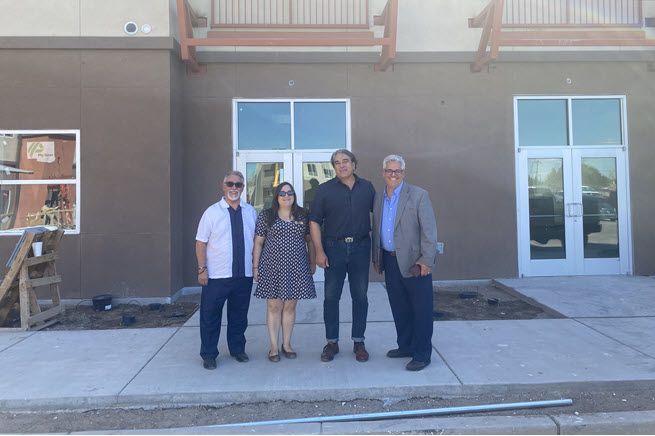
YES Housing, Inc., in Albuquerque, N.M., develops affordable housing. Kansas City Fed staff members visited to learn more about a mixed-use, mixed-income development being built with multiple funding sources. Left to right: Chris Baca, president / CEO; Rachael Surmick, Kansas City Fed; Enrico Gradi, senior vice president of planning and economic development; Ariel Cisneros, Kansas City Fed.
Other cross-sector collaborations lower acquisition costs and, therefore, total development cost. In Shawnee, Okla., housing leaders work with the local hospital authority to release liens against properties for medical debt, creating more affordable property acquisition opportunities for future development and housing rehabilitation projects. Releasing liens reduces the cost of site acquisition by ensuring a clean title for the developer to build new construction or to rehabilitate the existing property.
Partnerships with educational institutions, both secondary and post-secondary, can address housing needs and workforce development challenges. Across multiple roundtable discussions, participants mentioned community college partnerships that provide training in the construction trades, addressing the construction labor force challenges cited by many developers. One example came from the roundtable in Albuquerque, where participants pointed to a $60 million investment in a high-school construction training program, funded by a three-way partnership among government, industry, and philanthropic sources.
Philanthropic engagement
Developers also said philanthropies have become more active in supporting affordable housing. This support comes through grant dollars to fill gaps in development costs and through program-related investments (PRI). Unlike traditional grants (with no repayment expectations), PRI support is repaid, extricating the philanthropy from the housing deal long term. PRI is often structured as a below-market loan, equity stake, or guarantee for another financing source. Philanthropy can support affordable housing through other investment as well. For example, multiple foundations in Omaha, Neb., seeded the creation of a revolving loan fund that provides pre-development, acquisition/bridge, construction, mini-permanent, and permanent loans and gap financing in Douglas and Sarpy Counties, Neb. and Council Bluffs, Iowa.
Funding mechanisms
In any housing conversation, it’s common to hear “We can’t just build our way out of this affordable housing challenge,” alluding to the fact that preserving affordable housing is just as important as bringing new units online. One of Ventana Fund’s lending products helps to fill this gap. Ventana Fund is a community development financial institution that includes lending for rehabilitation of smaller housing complexes. Notably, its Threshold Loan targets projects with 49 or fewer units, creating access to capital for smaller developers. These lending products facilitate high-quality improvements and ultimately preserve existing affordable stock.
In Omaha, the city, an anonymous funder, and a local nonprofit are translating a $40 million investment into affordable housing development. The anonymous funder is buying $40 million in city bonds that will be repaid from tax-increment financing revenue generated by the Omaha streetcar project. The local nonprofit, Front Porch Investments, will distribute the $40 million for the development and preservation of affordable housing in Omaha’s urban core.
Creative building solutions
Roundtable participants shared their perspectives on new approaches to housing construction, particularly moving away from site-built, stick-built approaches to off-site modular construction, which can reduce construction time and labor requirements. Modular homes are also required to meet the same building standards as stick-built housing. Often confused with manufactured housing, modular housing is built off-site and assembled on-site but is a permanent structure that does not require a chassis. Current appraisals guidelines effectively treat modular housing value as similar to that of traditional stick-built housing.
Policy innovations
Developers cited local reforms to create a policy environment that better supports housing development. Regulatory reforms that increase density and allow for mixed-use development surfaced frequently as opportunities to support housing development. These policies allow housing to be developed in more locations and configurations, often at lower cost.
What comes next?
Through these conversations, we heard about challenges facing affordable housing developers and their efforts to pull together funding for new housing. We also learned how developers and communities are embracing different policy tools, construction approaches, and other strategies to reduce cost, increase funding, and ultimately bring new housing to market.
We will explore a handful of topics in detail, combining outreach to industry stakeholders with research and quantitative data. On the challenges side, these include the decrease in LIHTC pricing and increasing input costs.
We also plan to dive into how modular housing can reduce costs, positively affecting the capital stack. And, for all the challenges to rural affordable housing development, there is a plethora of funding programs that states throughout the 10th District have introduced to address these problems. We’ll explore these, too.
Research and outreach on the capital stack continue. If you would like to connect on any of these topics, please contact Rachael Surmick at Rachael.Surmick@kc.frb.org.
Endnotes
-
1 Participants spoke mostly to shifts in LIHTC pricing. However, additional tax credit programs also come into play. The Historic Tax Credit, for example, supports housing development. States throughout the District have also implemented their own tax credit programs, like the Kansas Housing Investor Credit.
-
2 Exploration of the “why” for the decrease will be discussed in a future publication.
-
3 Tax credit syndicators raise funds from interested tax credit investors, creating investment funds. These funds are used to purchase tax credits, and then offer various levels of return to their investors.
-
4 The Davis-Bacon and Related Acts apply to contractors and subcontractors performing on federally funded or assisted contracts in excess of $2,000 for the construction, alteration, or repair (including painting and decorating) of public buildings or public works. Davis-Bacon Act and Related Act contractors and subcontractors must pay their laborers and mechanics employed under the contract no less than the locally prevailing wages and fringe benefits for corresponding work on similar projects in the area. (U.S. Department of Labor)
The views expressed are those of the authors and do not necessarily reflect the positions of the Federal Reserve Bank of Kansas City or the Federal Reserve System.
Author