The Pawnee Nation of Oklahoma faces a variety of health challenges within their community, such as diabetes, heart disease and substance abuse. “When people are dealing with addiction, they often have other health problems,” Brian Kirk said. Kirk is the program manager at the Pawnee Nation Behavioral Health Center. While an Indian Health Service facility provides medical care, the tribe lacked a place for behavioral health and substance use care. “We wanted to build a facility that was more than just a brick-and-mortar structure. We wanted it to be a place that people were passionate about and saw as a trusted resource that would benefit our community.”
The Pawnee Nation is a federally recognized, sovereign tribal government in the rural, north-central region of Oklahoma. Tribal nations are recognized by the U.S. Constitution as distinct governmental entities with inherent rights to govern and regulate their own affairs. Sovereignty provides tribal nations with tools and resources to grow and govern their own capacity-building initiatives.
The Pawnee Nation financed the Pawnee Nation Behavioral Health Center using an innovative and grassroots approach to address significant community health issues. The process included building a “capital stack,” combining multiple funding sources to pay for construction. This article explores the foundational groundwork that included the use of tribal sovereignty, community engagement, a consulting firm, capital entities, and tax credits.
Pawnee Nation begins by listening to its citizens
Before the Pawnee Nation could start financing the center, it needed to gather information. That journey began with a feasibility study. The Pawnee Nation spent two years conducting surveys, focus groups, and town hall meetings to gather different perspectives, activities funded by a Health Resources and Services Administration grant. They collected feedback from more than 200 individuals who lived close to the center site.

Brian Kirk, program manager, Pawnee Nation Behavioral Health Center
“The community expressed a clear need for a behavioral health center to provide inpatient care and wraparound services for the families,” Kirk said. “Many people were traveling long distances for care or experiencing long waiting lists. When someone needs behavioral health care, they need it immediately.” During the center’s development, Kirk held the role of executive affairs director of the Pawnee Nation.
Weaving the multi-layered capital stack
To finance facilities like the behavioral health center, organizers often utilize a “capital stack” composed of various forms of capital woven into layers with differing risk levels, returns, and repayment priorities.
Building the capital stack was difficult, Kirk said. “The Pawnee Nation’s capital stack was unique, involving six different funding sources to raise over $20 million, with the tribe contributing $1 million. These sources, often with their own complex requirements and timelines, made the process challenging.” The Nation then needed to manage funding requirements and timelines, like the qualifying complexity of the New Market Tax Credits and Opportunity Zones. “The funding cycles were complicated,” Kirk said. “Some federal funding cycles didn’t align. Grants would end before others began, which prolonged contracting and funding opportunities.”
The Pawnee Nation decided to build the facility on trust property. Trust property refers to assets like land, mineral, and land rights that the United States Department of the Interior holds in trust for tribal nations. The Bureau of Trust Funds Administration manages all financial assets held in trust. Building on trust property offers economic benefits through federal tax credits and federal and state tax exemptions available due to the Nations’ Internal Revenue Code (IRC) 7871, a tax-exempt status. Under the IRC 7871, the Indian Tribal Governmental Tax Status Act allows sovereign tribal governments to receive tax-exempt status and operate as charitable, not-for-profit government organizations. In addition, tribal-owned businesses may be eligible for tax advantages like employment tax, property tax, and goods-and-services tax exemptions.
Consulting firm connects Pawnee Nation to Native American Bank
Kirk said the Pawnee Nation began by reaching out to Baker Tilly, a consulting firm experienced in capital sourcing and finance advisory services for tribal nations. The firm introduced the Pawnee Nation to Native American Bank. Then the bank assisted with tax credit allocations by linking the Pawnee Nation to a unique capital funding structure involving companies, including other CDFIs and CDEs certified by the U.S. Treasury.
Native American Bank is a federally chartered, Native-owned community development bank and certified community development financial institution (CDFI) headquartered in Denver, Colorado. It focuses on addressing the lack of access to financial capital and services in Native communities. A Community Development Entity (CDE), the bank is experienced in the New Market Tax Credits, a federal program that aims to stimulate investment in low-income communities.
CDEs, acting as intermediaries, apply and receive New Market Tax Credit allocations from the CDFI Fund. Investors interested in the New Market Tax Credits provide capital to CDEs, like Native American Bank, in exchange for credit against federal tax obligations.
The Pawnee Nation project included NMTC investments from Wells Fargo and an allocation from Clearing House CDFI. Two Native CDFI non-profits served as co-lenders, but most of the loans came from Native American Bank with a backstop loan guarantee from the U.S. Department of Agriculture (USDA).
NMTCs don’t need to be paid back and don’t require a bank loan, Joel Smith said. Smith is the president of community development at Native American Bank. “Some tribes use the tax credit without borrowing, relying on their own equity to supplement the funding from NMTCs. Each tribe is different and may start their capital stack with a grant or with their own money, like savings or general funds.”
For the Pawnee Nation, starting with the consulting firm, Baker Tilly, was helpful. Baker Tilly helped the Nation navigate the process and find the resources they needed, Kirk said. “They helped us find ways to offset debt while we researched federal funding options, including construction and programming funding. Since federal construction funding is limited, we had to use every opportunity.”
Four strategic steps help the Pawnee Nation weave its capital stack
To weave their capital stack, the Pawnee Nation took four strategic steps.
First, the Nation needed approval from the Bureau of Indian Affairs under the Helping Expedite and Advance Responsible Tribal Homeownership (HEARTH) Act. The Act makes it easier for tribal nations to lease their own lands through sovereignty, as it lets tribes negotiate and approve leases without needing approval from the Secretary of the Interior. The Nation learned how a leasehold mortgage aids in financing construction on tribal land and how to comply with the Bureau of Indian Affairs guidelines. “We used the lease as collateral,” Kirk said, “because you can’t use trust property owned by tribal nations for collateral.”
Second, the Pawnee Nation applied for more grants through the USDA and U.S. Economic Development Administration, which supports health initiatives. They used their Title V Compacting status under the Indian Self-Determination Education Assistance Act (ISDEAA). “Self-governance lets us provide services ourselves rather than relying on the federal government,” Kirk said.
The ISDEAA enables federally recognized sovereign tribal nations to manage and administer federal programs and services previously provided by the federal government and establishes the government-to-government relationship between the Tribes and IHS. Tribal nations formally notify IHS of their intent to enter into the Self-Governance Compact and a funding agreement, allowing them to take over full or partial funding and control over programs and functions that would otherwise be provided by the Indian Health Service. This promotes sovereignty through self-determination over health services and through reducing federal oversight.
Third, Smith said, the project used the 105 Lease, a program specific to tribes. The 105 Lease provides funds for operational costs, a provision of ISDEAA which enables tribal nations to be reimbursed for the delivery of federal programs in a tribal facility. It is not a traditional lease, like landlord-to-tenant agreement, but an agreement to reimburse for facility cost related to operating federal programs. “We recommend looking into this early in the process since it can assist with the underwriting and strength of the grant,” Smith said. The 105 Lease is available through the Indian Health Service and U.S. Department of the Interior Office of Tribal Leases, which can provide technical assistance.
Fourth, the Pawnee Nation utilized a bridge loan in the capital stack. A bridge loan is a short-term bridge-the-gap loan often used as a temporary financial tool within a capital stack. It provides short-term, often high-risk, capital until long-term financing is secured or made available. “The bridge loan was used to secure funding until the Pawnee Nation was able to utilize a grant that provided funding for the facility after completion,” Smith said.
Smith and Kirk share challenges and recommendations
When asked about challenges regarding lending and capital weaving for tribal nations’ economic development, Smith said, “Lenders are becoming increasingly open to lending to tribes, especially in Oklahoma. Also, lenders now include many Native American-owned banks and tribally owned banks.” Kirk added that more education is needed for financial institutions about trust vs. non-trust land lending and tribes’ unique tax-exempt status, including their ability to receive philanthropic donations.
Smith and Kirk offered recommendations for tribal nations and communities looking to build their capital stacks.
- Obtain self-determination through ISDEAA.
- Get your data. Data is key to feasibility and for funding assessments. For this project, data included lack of access to care, population census, calculated project growth, community needs, construction budget, location, projected facility size, and projected income statement to highlight sustainability.
- Talk to banks early in the process regarding lending, as not all applicants qualify for the New Market Tax Credit.
- Be mindful of timelines, as federal resources and lending sources each have specific steps and deadlines.
- Utilize resources like the Health Resources and Services Administration, USDA, and Economic Development Administration grants, 105 Leasing, bridge loans, tribal equity, and Federal and State Tax Credits. Others to consider include Bureau of Indian Affairs loans and Community Development Block Grants.
- Have a team with experience in lending in Indian Country throughout the entire journey. This is key.
The Pawnee Nation builds the stack and opens the center
In May 2025, the Pawnee Nation of Oklahoma opened the Pawnee Nation Behavioral Health Center, at a cost of approximately $23 million. The center provides comprehensive inpatient and outpatient services for behavioral health and substance use disorders, serving both adults and youth. It emphasizes holistic treatment aimed at healing, resilience, and long-term wellness.
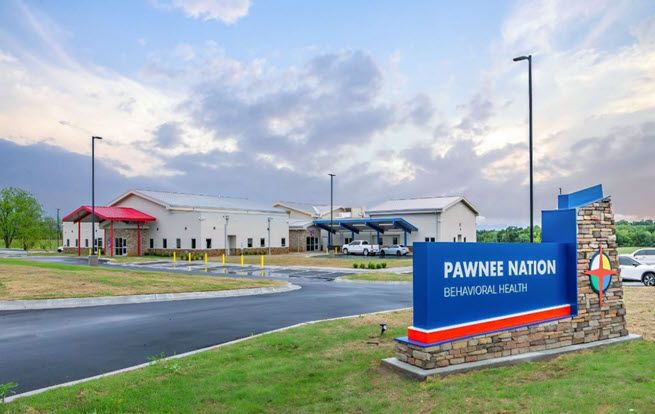
The Pawnee Nation of Oklahoma opened the $23 million Pawnee Nation Behavioral Health Center in May 2025.
Projections based on a 10-year analysis indicate that the facility will generate an economic impact of approximately $64-$172 million. This impact includes savings for Oklahoma through the provision of mental health and substance use disorder services, reductions in mortality rates, enhanced child and family services, improved education outcomes, and increased work productivity, Kirk said.
The center exemplifies the power of community-driven initiatives and innovative financing. By leveraging a diverse capital stack and engaging with the community, the Pawnee Nation created a vital resource of behavioral health and substance use treatment, benefiting not only their rural community but also extending its positive impact beyond.
The views expressed are those of the authors and do not necessarily reflect the positions of the Federal Reserve Bank of Kansas City or the Federal Reserve System.
Author