
Wyoming thrives on open country.
It’s the 10th‑largest state by land area and draws millions of tourists each year to Yellowstone and Grand Teton National Parks.
That same boundless landscape underpins Wyoming’s ranching heritage and shapes an economy centered on mining, coal, oil and natural gas extraction.
It’s also a distinctive economic landscape to explore—something Federal Reserve Bank of Kansas City Branch Executive and Economist Nick Sly looks forward to doing during the Bank’s regular visits to the state.
“Without coming to Wyoming, you’re not going to get an understanding of how varied and complex its economy is, and how its people and businesses experience it,” Sly said. “We stay connected to the communities we serve, which makes us uniquely able to represent them.”
Sly’s June visit to Casper, where he engaged with auto dealers, candy makers and business leaders, further underscored the significance of the Kansas City Fed’s enduring and meaningful relationship with the state.
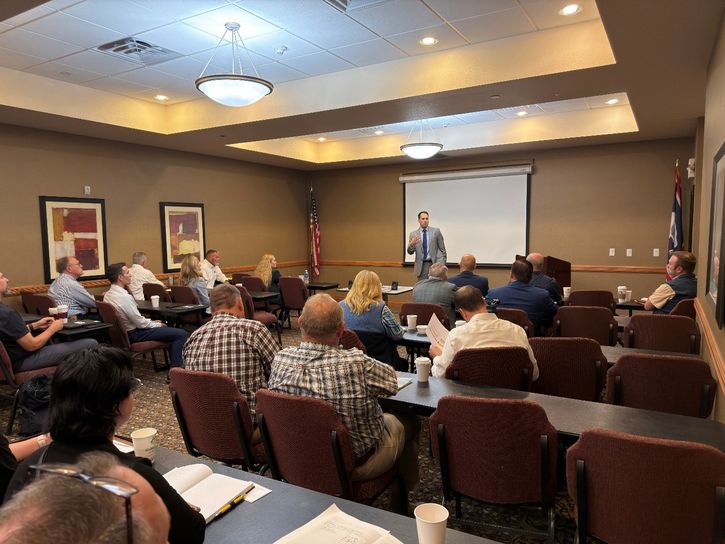
Kansas City Fed Economist and Branch Executive Nick Sly meets with the Wyoming Auto Dealer Association.
Auto dealers share economic realities and Fed outreach in Wyoming
The Kansas City Fed’s Casper trip this June started with a stop at the Wyoming Auto Dealer Association meeting, where dozens of dealers gathered to discuss common industry needs and opportunities. Sly provided the group with an economic outlook and discussed topics such as a potential artificial intelligence (AI) bubble, the labor supply and the Fed’s dual mandate of pursuing maximum employment and price stability.
Given that auto dealerships are on the front lines of interest- rate fluctuations and market dips, Sly wanted to understand dealers’ challenges and customers' attitudes.
Arin Emmert, CEO and dealer principal of Fremont Motor Companies, shared challenges she was seeing statewide. She said her industry deals heavily in subprime lending, which recently has led customers to request lower payments or hoping to trade for more affordable vehicles.
"On the flip side, consumers are saying, 'I'm going to keep my vehicle right now because I have some household constraints.' It's a large geographic state, so we rely a lot on transportation,” Emmert said. “When you see fuel prices go up, that impacts Wyoming in particular—more than other, more metro areas."
Emmert serves as a Denver Branch Board Director and said outreach like the visit to the Wyoming Auto Dealer Association is just as important for community members as it is for the Fed.
“I think the majority of people do not understand what the Fed does,” she said. “The typical person just says, ‘It’s interest rates,’ without looking at all the intricacies of the economy or the big picture. Having the chance to hear Nick Sly put monetary policy concepts into words that people understand and connect with is powerful.”
Local voices and data: how the Kansas City Fed’s Services Survey shapes regional insights
In addition to outreach, Federal Reserve Banks rely on a variety of datasets to inform their research and policymaking. A tool unique to the Kansas City Fed is the Bank’s Services Survey, a monthly questionnaire sent to business owners and representatives across the seven-state Tenth District. The answers help track changes across categories such as how much businesses are selling, how much money they make, how many people they hire and how much they spend on equipment. They also help to gauge variations in the costs of materials and the prices that businesses charge customers.
"I can’t tell you how important those surveys are for me as an economist, helping me understand what’s happening in the region,” Sly said. “To hear from the same businesses over and over each month really helps us understand how things are changing in real time. We see the data immediately, and respondents become trusted partners for sharing information with us."
One such partner is Mike Stepp, owner of Donells Candies in downtown Casper, who has taken the survey for over a year. The family-owned confectionery has been featured on national podcasts and is beloved by locals. Sly spent time visiting with Stepp, touring his store and hearing about the 70-year-old business. The space leans into its folksy charm. The walls are decorated with classic tongue-in-cheek signs (“You don’t have to be crazy to work here … but it helps”) and yellowed Post-its with reminders, doodles and sweet messages (“I love you, dad”).
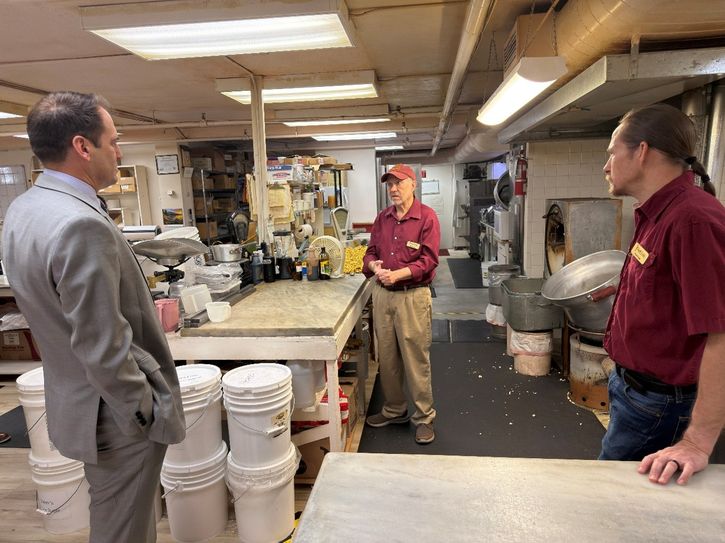
Sly (left) speaks with Donells Candies owner Mike Stepp (center) and his son Ryan Stepp about the family-owned candy shop.
As hot toffee bubbled in a heavy copper pot nearby, Stepp said that survey responses can inform his business choices and that completing the survey is beneficial in itself.
"The survey forces you to think about your business and the long term and short term on a monthly basis, when all of our instinct is to deal with what's in front of us right now rather than consider the overall spectrum of a year, a quarter or several years," Stepp said.
He added that the Services Survey helps him understand what’s happening in other parts of the country, which he values as both reassurance and a way to gain new perspectives. Stepp looks at the published results less to see similarities with his own business than to compare what he’s experiencing with what others in the region report.
“Wyoming is kind of on an island because we’re so based on tourism and minerals extraction, and also because we’re the least-populous state in the nation,” Stepp explained. “But the survey gives you a broader information base and helps us research national trends we wouldn’t necessarily think of."
"If it's asking me questions I can't answer, I'd better look that up. It's a good tool."
Stepp also spoke with Sly about how national economic trends such as supply-chain issues have affected his business. Chocolate costs, he said, had skyrocketed recently, requiring the business to switch to a vendor that sold a larger volume of the product at a cheaper price. That presented a new problem for the small shop: where to store thousands of pounds of chocolate in a climate-controlled environment.
“When you’re in a small business, you tend to learn things you didn’t want to know,” said Stepp. “I have to know about air conditioning, for crying out loud. That’s been true for a long time because we have a product that can melt.”
Local perspectives reveal Wyoming's unique economic challenges
Because Wyoming has no income tax and relies heavily on proceeds from energy, Sly said, the state’s economic trends are directly tied to how the oil and gas industry performs. The resulting conditions can be difficult to capture in a spreadsheet — which is why the Fed regularly holds roundtables across its district These open discussions help economists identify blind spots in their data.
The last stop on this Casper trip was a business roundtable that included representatives from the energy, commercial construction and aviation industries.
Glenn S. Januka, airport director of the Casper-Natrona County International Airport, was one of the participants. The Casper Airport was established in 1942 as the Casper Army Air Base, where some 18,000 B-17 and B-24 bomber crews trained. Although the facility shifted to commercial operations in the decade following the war, dozens of its original buildings still stand intact on the grounds and house a variety of businesses.
Januka explained that Casper's airport—which plays a vital role in handling cargo, medical supplies and essential goods—faces unique challenges and opportunities unlike those of most other airports nationwide. It’s a narrative the data alone can’t convey.
“When you’ve seen one airport, you’ve seen one airport,” Januka said. “Aviation and airports become very critical for tying small communities in large states to the rest of the economy.”
Januka said the Fed’s data releases, as well as events such as the roundtable, help him connect the dots between his industry and other sectors.
“We’re always looking at years and years down the road for investments,” Jankua said. “So having the information available from the Fed in terms of what’s happening in the economy and what we can expect from industries like oil and gas really helps us out.”
Wyoming’s interconnected economy: local realities informing national policy
Whether it’s a car dealership, a regional airport or a candy store, a Wyoming business’s proximity to the oil and gas sector inherently connects it to that segment of the economy. And Wyoming businesses share another commonality: the state’s vastness.
But that’s only where the story begins. Can a local business invest in hiring a new employee? How much are households paying for groceries? Are jobs available for those who want them? Those are the questions the Kansas City Fed is asking and will continue to ask across the half-million-square-mile region.
In places such as Casper, industry and nature shape not just the geography but also the very spirit of economic opportunity. By engaging thoughtfully and listening deeply, the Bank ensures that voices from even the most remote areas inform national decisions, strengthening the connection between local realities and broader policy outcomes.
At the Auto Dealers Association meeting, Emmert considered the Bank’s visit. The gold and green prairie grasses moved softly in the breeze behind her, with Casper Mountain visible in the distance.
“You can look at datasets, you can look at spreadsheets and things like that,” she said, “but the voice and the feelings from Wyoming constituents and business owners is invaluable.”
Since Sly’s June trip, he and the Bank’s team have been back to the state several times and plan to continue doing so. They’re looking forward to their next visit, where they’ll ask new questions, grow relationships already in place and build new connections along the way.
What’s the Services Survey?
The Federal Reserve Bank of Kansas City conducts the Services Survey to gather timely economic data for monetary policy. Survey results are released monthly, offering businesses insights for decision-making. Here are five things to know about the Bank’s Services Survey.
1. It tracks key indicators of regional business activity.
The survey reveals month‑to‑month changes in sales, revenue, employment, capital spending and both input and selling prices — offering a clear snapshot of how service‑sector conditions are shifting.
2. Its results help identify longer‑term economic trends.
By accumulating data over time, the survey supports deeper analysis of evolving business conditions across the Tenth District, highlighting patterns that may not be visible in a single month’s responses.
3. It runs on a reliable schedule.
The survey is open five days each month, from the third Wednesday through the following Monday.
4. It covers the Federal Reserve’s Tenth District.
Firms from Colorado, Kansas, Nebraska, Oklahoma, Wyoming, northern New Mexico and western Missouri participate, making it a comprehensive reflection of the region’s service economy.
5. It represents a wide variety of service industries.
Respondents include businesses across retail, wholesale, auto sales, transportation, information, high‑tech and professional services, real estate, education, restaurants, health services, tourism and other service sectors.
Are you interested in participating? Contact our team to see if your organization would be a good fit for the survey.
The views expressed are those of the authors and do not necessarily reflect the positions of the Federal Reserve Bank of Kansas City or the Federal Reserve System.