Talk to the people involved in the Kansas City Federal Reserve’s outreach efforts, and you’ll hear proof of a strong connection between the central bank and its constituents.
“A lot of times we see urban policy shrunk down for rural communities, but the Federal Reserve makes sure rural perspectives are included in broader economic conversations,” said Shelley Free, superintendent of Kiamichi Technology Centers, a career and technical education network in the state, following a recent Tenth District business roundtable in Atoka, Okla. “The Fed really listened to the needs of southeast Oklahoma.”
The Fed’s visit to the Sooner state, which also included an Oklahoma City Branch Board of Directors meeting, was part of the Bank's ongoing efforts to connect with the communities of the Tenth District.
Kansas City Fed President Jeff Schmid put it this way during the visit: “You can't really do your job effectively, especially when it comes to things like monetary policy or monetary operations, without connecting with people and businesses in communities around your district. What challenges are they facing, and what’s the market doing? That informs what I need to do from a policymaking standpoint when I go to Washington, so it is critically important.”
For Assistant Vice President and Oklahoma City Branch Executive Cortney Cowley, the visit was notable for the dramatic changes she has seen in the area where she grew up.
“I'm from Ada, in southeastern Oklahoma, and so this felt a bit like a homecoming for me. Outreach like this helps us understand the economy in our state and recognize that not all parts of our state are the same, in terms of what drives the economy,” Cowley said.
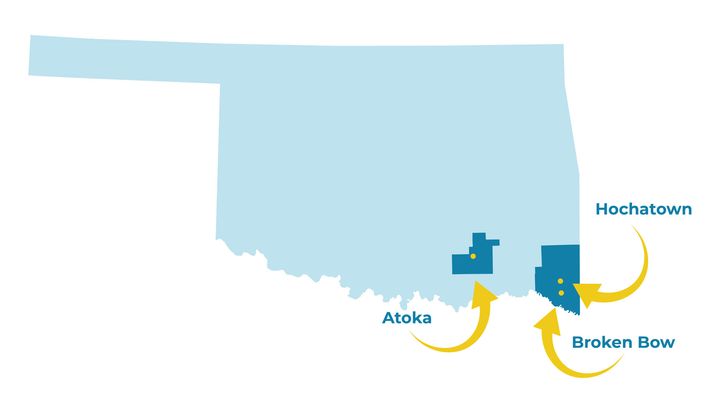
The KC Fed's outreach visit to southeast Oklahoma included these cities.
Where Oklahoma’s economy outpaces national trends
The Bank conducted its outreach visit shortly after recent research from the Oklahoma City Branch suggested relative strength in the state’s labor market.
Oklahoma’s labor-force participation rate exceeded the national average in 2023 for the first time in more than three decades, primarily driven by Native American job gains in tribal-related industries. In April 2026, the state’s labor-force participation rate was 62%, compared with the 61.8% national average.
Oklahoma’s unemployment rate, usually lower than the U.S. average thanks to a tight labor market, hit 4% earlier this year, slightly below the national 4.3% rate.
Many communities in the tribal southeastern quadrant of the state are two to three times more concentrated in government and/or leisure and hospitality than elsewhere in the state and have seen above-average GDP growth in the past 15 years.
Employment, workforce development and inflation in southeast Oklahoma
The Atoka branch of FirstBank, headquartered in Antlers, Okla., hosted the outreach visit’s first event, a business roundtable.
“The Native American tribes such as the Choctaw Nation, what they’ve done, have been a steady economic driver here,” said Mark Burrage, FirstBank’s CEO and a member of the Oklahoma City Branch Board of Directors.
Gary Batton, chief of the 237,000-member Choctaw Nation, participated in the roundtable.
“We have 13,500 employees,” he said. “We have 151 businesses that fund our 171 different programs, and we have to compete in the private sector to raise money to fund our government. How the Fed handles inflation impacts us in workforce development, so our conversation with the Fed helps us think more strategically.”
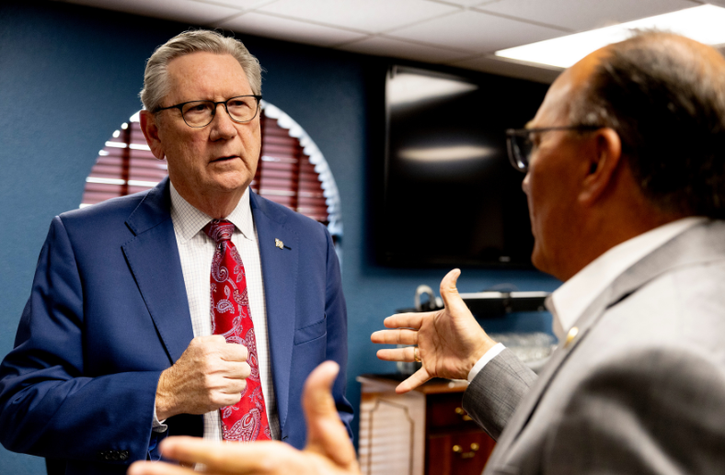
Gary Batton (right), chief of the Choctaw Nation, talked with KC Fed President Jeff Schmid before the business roundtable.
“There are unique workforce challenges in rural communities,” said Free, the Kiamichi superintendent. She said the region’s diverse economic base—including healthcare, manufacturing, transportation, construction, energy, agriculture, public service and small business—depends on a strong local workforce.
“The relationship that we have with the Fed allows us to look at labor market demands and what employers are needing, which helps us so that we're not training for what was five years ago but instead focused on training for the future,” Free said.
In the heart of Oklahoma’s ‘wood basket’ is Huber
Oklahoma boasts some 12 million acres of forest, covering about 27% of its landscape, according to the most recent U.S. Department of Agriculture data. Southeast Oklahoma’s considerable share of this natural wealth means that the region is known as the state’s “wood basket.” Products made from that timber are among the leading economic drivers here.
In 2022, External Linkaccording to Oklahoma State University, the state’s forest sector had a total economic impact of $6.9 billion, with $1.2 billion in payroll across more than 19,000 jobs.
About 2 million acres of the state’s forest land is usable by Huber Engineered Woods, in Broken Bow, which turns timber into building materials such as subflooring and water-resistant sheathing. It’s part of the J.M. Huber Corporation’s wide-reaching international portfolio.
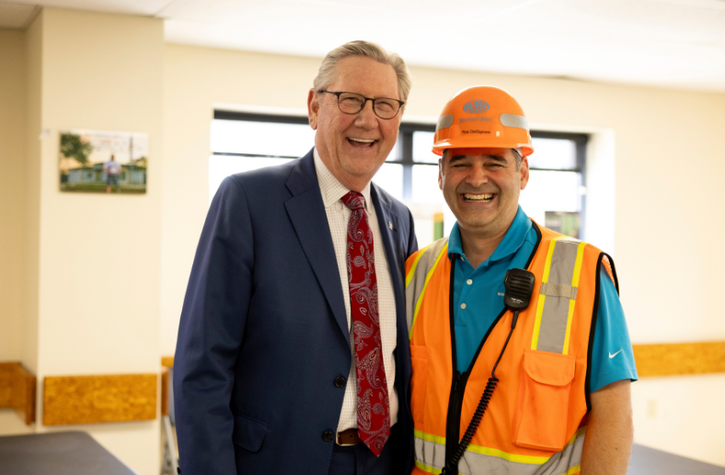
Kansas City Fed President Jeff Schmid met employees at Huber Engineered Woods in Broken Bow.
The Bank’s visit included Huber employees, who outlined the family-owned, privately held company’s history and products.
- The company hauls in 700 truckloads of lumber a week, 60% of it felled in Oklahoma and most of that from within a 100-mile radius of the plant.
- That adds up to a million tons of wood a year, processed in a facility that runs 24 hours a day and employs 160 workers over four shifts.
- Huber turns out 600 million square feet of product a year.
- The company said it turns over less than 5% of its Oklahoma employees annually and is working with area vocational educators toward training next-generation workers.
Southeast Oklahoma leading a statewide leisure boom
Oklahoma is known for its energy production, but tourism is also a strong driver of its economy, said Rhonda Hooper, chair of the Kansas City Fed’s Oklahoma Branch Board of Directors and president and CEO of Jordan Advertising in Oklahoma City.
“This part of the state, the southeast part of the state—Hochatown, Beaver's Bend, Broken Bow—is really doing extremely well because it attracts not only Oklahomans but also North Texans. It’s a getaway that lets visitors commune with nature but have the major assets of a metro,” Hooper said.
Cabin fever in Hochatown
McCurtain County, home to Hochatown and Broken Bow, has seen annual growth in tourist spending. A good measure of this is the 3% county lodging tax, which voters made permanent in 2012. Eighty-five percent of that money goes back to the county tourism authority to bolster the area’s leisure-spending surge.
External LinkHochatown is the epicenter of that boom, according to Dian Jordan, the municipality’s first mayor and now a trustee there, who delivered a presentation to Board members during the outreach visit. About 2.8 million people a year visit the community, she said.
“We have about 4,000 cabins now, with owners from 30 states,” Jordan said. She added that more construction is underway. “There’s been astronomical growth in development and a lot of new building over the past ten years,” she said.
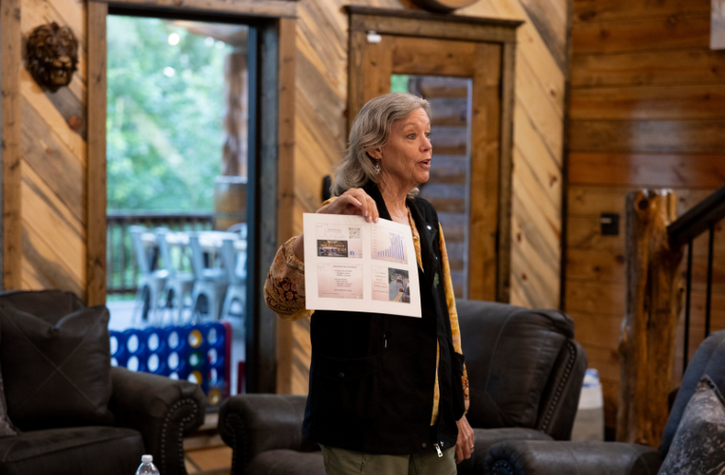
Dian Jordan, Hochatown's first mayor and now a trustee there, spoke to the Kansas City Fed and Oklahoma City Branch Board of Directors leaders about her community.
Part of the attraction, Jordan explained, is that high-speed fiber came relatively early to Hochatown. “People coming from the Dallas-Fort Worth metroplex run their businesses from here,” she said. “Of course, people also bring their kids. We sell a lot of marshmallows.”
Hochatown formally incorporated in 2022, an effort Jordan helped lead. It began collecting municipal lodging, use and sales taxes in 2023, revenue she said has amounted to more than $20 million through the just-ended 2026 fiscal year.
“I thought after COVID, we’d go back to steady but slower growth, but that hasn’t happened,” she said. “For the past three years, we’ve seen considerable annual tourism growth here.”
That’s meant slow-crawling lines of cars and trailers every weekend, traversing roads Jordan said are awaiting improvements. Yet few visitors talk about inconvenience.
“Yes, we get traffic jams, but then you’re here,” Jordan said. “And here, it’s not just about the cabins. It’s more about the trees. It’s about Broken Bow Lake and Mountain Fork River. It’s that simple.
“I have three kayaks in my garage and two pairs of hiking boots,” she added. “That’s what I want to do every day. I want to be in nature myself. We incorporated to make sure we could keep all of that to share and still have control over it, not overdevelop it. We have a comprehensive plan and building codes. We’re putting in what we need for long-term responsible development.”
Community members have the last word
Hochatown’s Choctaw Landing was the host location for the outreach visit’s final events, an Oklahoma City Branch Board of Directors meeting and a community economic forum afterward with Schmid and Burrage. The Choctaw Nation opened the resort hotel in 2024, and it’s helping to drive the area’s robust leisure market.
Schmid reiterated that visiting communities across the Kansas City Fed’s Tenth District is a high priority for the Bank.
“We want to understand how they're experiencing their economy and to help them understand how we see the economy,” Schmid said. “We’re really trying to make sure that we're building relationships and building trust in the nation's central bank, by just listening.”
Kansas City Fed visits southeast Oklahoma
The Kansas City Fed recently traveled to southeast Oklahoma to see the region's tourism boom and hear from area businesses.
The views expressed are those of the authors and do not necessarily reflect the positions of the Federal Reserve Bank of Kansas City or the Federal Reserve System.
Author