Against a national backdrop of rising costs but solid demand, the Kansas City–area economy is doing better than you might think.
As attendees of the Kansas City Fed’s 2026 Kansas City Economic Outlook Conference learned, that’s not the only unexpected feature of today’s economic landscape. Imports, energy prices and the labor market are behaving in unusual ways — making data, and discussion about that data, crucial for future business planning.
Economists and business executives speaking at the event External Linkshared information about why and where surprises are happening and what might be around the corner for consumers.
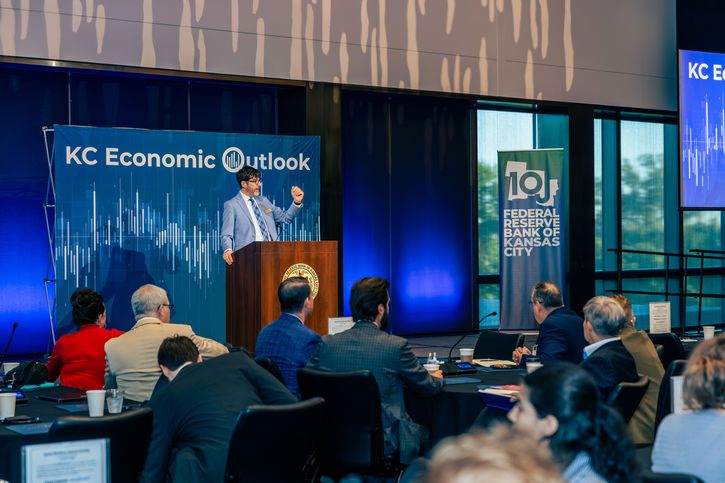
Jeremy Hill, regional executive for the Kansas City Fed, speaks at the KC Economic Outlook Conference.
Top economic takeaways for the Kansas City area
Federal Reserve and Mid-America Regional Council (MARC) research, along with on-the-ground industry experiences, powered several key insights.
1. Kansas City’s economic activity is outpacing U.S. growth.
- What to know: Kansas City’s non-farm employment recently grew by 5.1%, compared with 3.6% growth for the U.S in the same period. More than one-third of the increase stems from Kansas City’s goods-producing sector, which includes construction and manufacturing. The larger service sector of the economy is steadily increasing employment, too —perhaps not a surprise for a World Cup host city.
- Additional insights: Kansas and Missouri are also leading employment growth for the Tenth District. Aerospace and transportation manufacturing are areas in which employment is accelerating.
- Outlook for 2027: Maintaining this pace could be a challenge for the area, according to MARC data. Signals point to slowing activity, with growth becoming more concentrated. “The region’s ability to continue outperforming the nation depends on local efforts to promote and invest in sectors that are making important contributions to employment growth,” concluded Frank Lenk, MARC’s director of economic research. “KC Biohub and Critical Materials Crossroads are examples of forward-facing initiatives with wide community support that have the potential to amplify the region’s growth and economic competitiveness.”
2. Imports aren’t decreasing, but prices are increasing.
- What to know: Although tariffs are higher than they have been in 80 years, imports — largely driven by a need for AI-related components — have yet to come down.
- Additional insights: Johannes Matschke, senior economist at the Kansas City Fed, framed his research on imports and pricing by highlighting the long history of tariffs in raising revenue and protecting industries. Tariff revenues now account for 5% of the federal budget. Uncertainty around them in recent years has likely created a small drag on economic activity, he said, though most of the impact has been on prices.
- Outlook for 2027: With demand for imports remaining strong, firms are likely planning to pass on import costs, which could contribute to inflation.
3. Crude oil prices have risen less sharply than during most previous major geopolitical oil supply shocks.
- What to know: Energy supply disruptions from export losses have so far been absorbed partially by prewar oil surplus, increasing supply outside the Persian Gulf, rerouting around the conflict zone, drawing down emergency stocks and reducing oil consumption in some countries, such as China. U.S. crude exports jumped to help meet export demand, but that meant shrinking the strategic petroleum reserve, which is down by more than 30% since the start of the war.
- Additional insights: In tracking the economics of energy costs during earlier crises, Nida Çakır Melek, senior economist at the Kansas City Fed, found that the war with Iran had generated a 14% oil supply loss that led to a 69% crude price increase. Iraq’s 1990 invasion of Kuwait, in contrast, created an 8.5% supply loss but a 105% price increase.
- Outlook for 2027: Consumers could start facing pressure from spiking diesel costs, and the system may have fewer buffers for minimizing the impact of any future energy shortages. Conference attendee Danon Hare, senior manager of philanthropy, major gifts, at Harvesters, described the downstream effect of continued energy cost fluctuations on business operations. “Inflation changes are hitting hardest in the gas sector for a lot of people, and the cost to run our fleet at Harvesters has ballooned along with diesel prices,” he said. “It’s increasingly difficult to continue consistent services sustainably when we have more restraints from such a volatile economic standpoint.”
4. Kansas City businesses face persistent hiring challenges.
- What to know: With more employment opportunities in the region and a shrinking local labor market, employers struggle to fully staff their operations. More broadly, employers report that their hiring difficulties typically come down to a lack of qualified applicants, not having enough applicants and compensation mismatches.
- Additional insights: Joe Gruber, executive vice president and director of research at the Kansas City Fed, shared information on factors driving the loss of working-age population. More workers are retiring and fewer people are having children or immigrating to the U.S., forces that Kansas City Fed economist Yusuf Mercan explored in a 2025 article.
- Outlook for 2027: For tough-to-hire roles, more employers are exploring automation. Economic Outlook manufacturing panelists Drue Duncan, senior director at Pfizer, and Mike Stradinger, CEO of Holland 1916, spoke about continuing their companies’ efforts to reach deeper into the pipeline and show school-age children their career options in science and manufacturing.
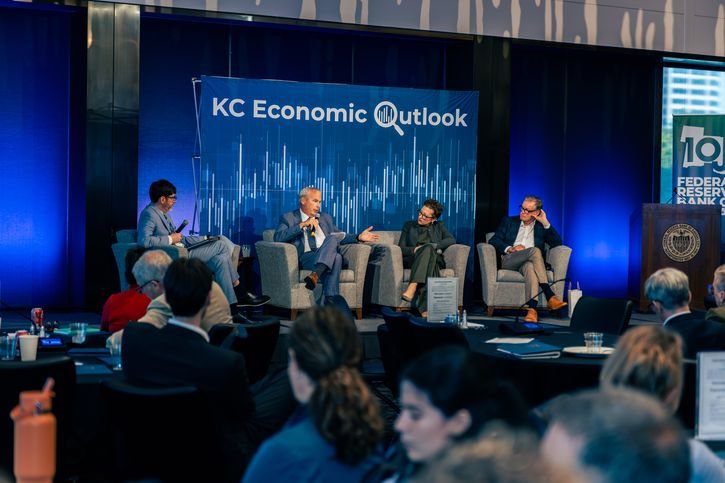
Drue Duncan, Senior Director, Pfizer; Gina Riekhof, General Counsel, Riega Foods; and Mike Strandinger, CEO, Holland 1916 talk about labor and manufacturing growth.
5. To make good decisions, you need good data.
- What to know: Making confident budgetary and hiring decisions for 2027 and beyond will require real-time economic data on energy, inflation and labor. Through community engagement events such as the Kansas City Economic Outlook, themes and stories around the data can reveal opportunities for action. Outlook attendees said what made the outlook conference stand out was the blend of Kansas City–specific outlook shared alongside national data.
- Additional insights: The Kansas City Fed’s economists produce a depth of research on the region and are a reliable source for information about economic trends and activity year-round. Businesses can review and participate in quarterly survey data for manufacturing, energy and services sectors in the Tenth District. Hill also recommends consulting the latest Tenth District Beige Book, which is published eight times a year and summarizes economic data alongside anecdotes from area businesses.
- Outlook for 2027: Economic data are urgent for calibrating strategic activities and finding the right partners. Hare put this in the context of Harvesters’ work: “In our strategic plan and our imperatives, we’re trying to address root-cause issues, and root-cause issues have to do with economic factors. They have to do with the neighborhood you live in, your access to healthcare, your access to education. Seeing things sliced up in a pie, kind of the way they were in a lot of these presentations, gives us a better road map in terms of how we can align with certain industries, corporations or organizations to create greater lasting impact on the communities we serve.”
What is the Kansas City Economic Outlook Conference?
The Kansas City Economic Outlook Conference brings together metro business and community leaders to discuss local economic opportunities and challenges.
“This event is an opportunity for businesspeople, especially leaders and people who are thinking about finances and strategy, to collect insight, even if it's not in their direct field or industry,” said Jeremy Hill, regional executive for the Kansas City Fed, “This is information that can help them plan year-round.”
The Federal Reserve Bank of Kansas City and the Mid-America Regional Council first collaborated on the event in 2025.
This year’s agenda featured a varied roster of experts covering a range of national and local topics: the role of District Banks in the Federal Reserve System, inflation and interest rates, tariffs, energy shocks and manufacturing in the Midwest.
Stay connected with the Kansas City Federal Reserve
To learn about community outreach opportunities, events and new research from the Kansas City Federal Reserve, subscribe to our newsletters and e-alerts.
A calendar of events is also available online.
Interested in attending the conference next year or requesting a meeting or business roundtable? Email community outreach specialist Chandler.Rhoades@kc.frb.org.
Get the data you need
Sign up to receive email updates about Kansas City Fed events, the latest research, and more.
The views expressed are those of the authors and do not necessarily reflect the positions of the Federal Reserve Bank of Kansas City or the Federal Reserve System.
Author