
Surveys reveal that inflation is the leading economic concern for many U.S. consumers (Adams, Allredge, and Kilroy 2025; Board of Governors of the Federal Reserve System 2026; Marist Poll 2025). For example, the most recent Survey of Household Economics and Decisionmaking (SHED), which was conducted in October 2025, found that around 57 percent of U.S. consumers felt financially worse off than they did a year ago due to inflation. The adverse financial effect of inflation appears to have been even more pervasive among the subset of U.S. consumers (around 28 percent) who were experiencing financial distress—that is, those who were struggling to meet their payment obligations._ Close to three-quarters of these consumers reported that inflation led to a deterioration in their financial situation, compounding their existing financial woes.
Many U.S. consumers have taken steps to manage the financial pressures stemming from inflation. The 2025 SHED asked respondents whether they have used the following strategies to cope with inflation in the past year: reduced spending, delayed a major purchase, reduced savings, increased borrowing, and increased income._ Around 77 percent of U.S. consumers have adopted at least one of these inflation coping strategies. Reduced spending is the most common strategy, with an adoption rate of around 70 percent, while increased borrowing is the least common, with an adoption rate of around 16 percent.
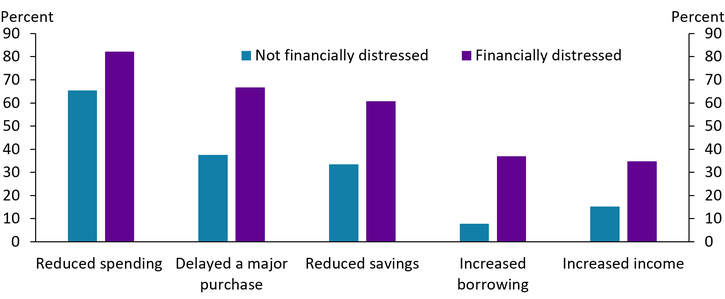
Chart 1 shows that the adoption of these inflation-coping strategies varies by consumers’ financial distress status. Financially distressed consumers (purple bars), who were more likely to be adversely affected by inflation, adopted all coping strategies at higher rates than non-financially distressed consumers (blue bars). However, the difference in the shares of consumers in each group who increased borrowing is especially stark. The share of financially distressed consumers who increased borrowing is almost five times larger than the share of non-financially distressed consumers (37.0 percent versus 7.8 percent).
Chart 1: Consumers adopted strategies to cope with inflation
Sources: Board of Governors of the Federal Reserve System and author’s calculations.
Financially distressed consumers were not only more likely to increase borrowing to cope with inflation but also to do so by using high-cost credit, such as loans from alternative financial services (AFS) providers and bank overdrafts. Chart 2 shows the shares of consumers who used AFS credit and overdrafts among those who increased their borrowing separated by financial status. Financially distressed individuals who took on additional debt (purple bars) used AFS credit and overdrafts at substantially higher rates than their non-financially distressed counterparts (blue bars). The share of financially distressed consumers who used AFS credit is about four times larger than the share of non-financially distressed consumers (29.7 percent versus 7.8 percent), while the share of financially distressed consumers who used overdrafts is more than twice as large (38.9 percent versus 16.8 percent). Overall, 50.4 percent of financially distressed consumers who increased their borrowing used AFS credit or overdrafts, compared with 20.8 percent of their non-financially distressed counterparts._
Chart 2: Financially distressed consumers were more likely to have increased their borrowing using high-cost credit products
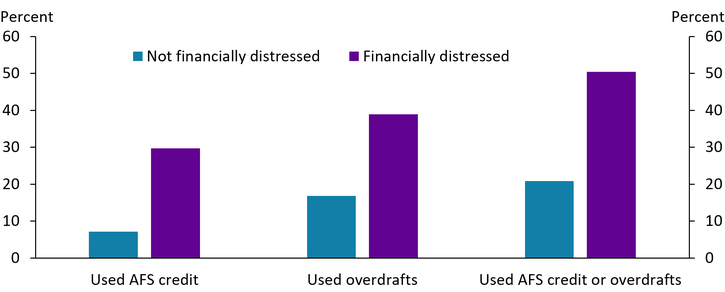
Note: Only consumers who increased their borrowing to cope with inflation are included in the calculations for this chart.
Sources: Board of Governors of the Federal Reserve System and author’s calculations.
My analysis shows that around half (50.4 percent) of the 37 percent of financially distressed consumers who increased borrowing to cope with inflation may have relied on high-cost credit, which means that inflation may have compelled almost one-fifth (50.4 percent times 37 percent = 18.6 percent) of financially distressed consumers to take out high-cost credit to manage rising expenses in 2025. These consumers’ reliance on high-cost credit may not only be unsustainable but could also compound their financial hardship.
U.S. consumers likely faced additional financial strain from higher prices this year as inflation picked up, driven by higher energy costs. Additionally, changes to federal financial assistance programs implemented this year have adversely affected some consumers’ ability to obtain financial aid (Berry 2026). Thus, we may expect to see increases in both the share of U.S. consumers who are financially distressed and the share of financially distressed consumers who turn to high-cost credit to cope with their expenses this year.
Endnotes
-
1 Financial distress occurs when a consumer’s financial resources are insufficient for meeting their financial obligations (Mori 2026). In this briefing, I consider a consumer to be financially distressed if they did not pay or had difficulties paying all their bills in full over the previous month.
-
2 The 2025 SHED includes eight different inflation coping strategies. To streamline my analysis, I combine “switched to cheaper products” and “used less or stopped using products” into “reduced spending” and combine “worked more or got another job” and “asked for a raise” into “increased income.”
-
3 The heavier reliance on high-cost credit by consumers in the financially distressed group likely reflects their poorer access to low-cost mainstream credit. Roughly equal shares (between 54 and 55 percent) of consumers who increased borrowing in both groups applied for low-cost mainstream credit, but the shares that applied and obtained the full amount of credit requested is substantially lower in the financially distressed group (14.8 percent versus 33.7 percent).
Article Citation
Toh, Ying Lei. 2026. “Financially Distressed Consumers May Have Turned to High-Cost Credit to Cope with Inflation.” Federal Reserve Bank of Kansas City, Economic Bulletin, October 15.
References
Adams, Christina, Kari Allredge, and Thomas Kilroy. 2025. “External LinkAn Update on U.S. Consumer Sentiment: Pragmatism Defines the Holidays.” McKinsey & Company, December 5.
Berry, Kate. 2026. “External LinkConsumers’ Financial Vulnerability Hits Record High: Report.” American Banker, September 24.
Board of Governors of the Federal Reserve System. 2026. “External LinkEconomic Well-Being of U.S. Households in 2025.” May.
Marist Poll. 2025. “External LinkEconomic Uncertainty Signals a More Frugal Summer Ahead, July 2025.” July 7.
Mori, Masataka. 2026. “External LinkFinancial Distress: Why It Matters for Households and the Macroeconomy.” March 25.
Ying Lei Toh is a senior economist at the Federal Reserve Bank of Kansas City. The views expressed are those of the author and do not necessarily reflect the positions of the Federal Reserve Bank of Kansas City or the Federal Reserve System.
Author