Although increased data center completion and planned construction has generated much attention recently, construction of these facilities has been ongoing for more than 25 years and has been shown to provide both costs and benefits to surrounding communities._ Echoing earlier studies investigating digital infrastructure and large manufacturing plant openings, recent studies find a mix of positive and negative outcomes. Alvarez and others (2026) find that while data centers can raise local electricity prices, they also boost job growth, income, wages, and home values.
Yue and Zeng (2026) find that the economic benefits of data centers are strongest in metro areas and in areas where a big tech firm is the first to build a data center. Benefits have been most concentrated in sectors related to the construction and operation of the data center, with additional, though smaller, effects after the data center is complete. They note that while the employment increase caused by a data center “activating,” or beginning operations, is significant, it is smaller than when a large manufacturing plant activates. However, as a cluster of facilities emerges, data center activation can induce positive economic spillovers into the broader local economy: Developers gain the benefit of scale and existing infrastructure while local economies experience an increase in building permits, total wages, and total employment. Further into the future, data centers could also become significant sources of tax revenue for city and county governments long after construction activity stops.
Across most of the Tenth Federal Reserve District, data centers that are active or under construction—the dark blue bars in Chart 1, Panel A—are concentrated in metro areas, allowing these states to glean more economic benefits. While not shown, this trend mirrors the nation as a whole. Oklahoma is an exception, as most data center activity is in rural areas (dark purple bar, Panel B). Announced projects, shown by the hollow bars, are still more likely to be built in cities both in the District and nationally, though rural projects are likely to increase as well. The number of rural projects is set to increase even more dramatically in some Tenth District states, such as Missouri and New Mexico. While rural communities in these states may glean some economic benefits, the positive effects may be less than in metro areas.
Chart 1: Most data center development in the Tenth District has been in metros
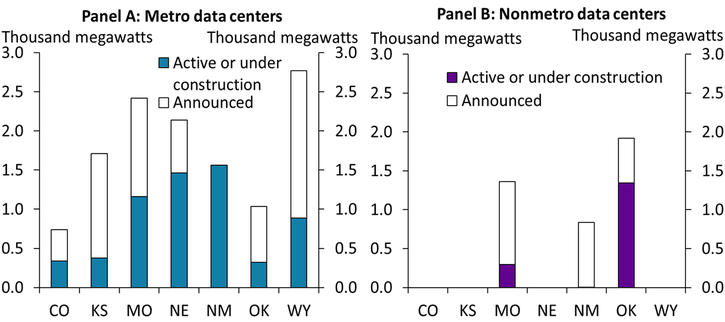
Note: Metro data centers are located in counties included in a metropolitan statistical area as defined by the United States Office of Management and Budget (OMB).
Sources: Aterio and author’s calculations.
Chart 2 shows that nearly all data center computing power currently online or under construction in Nebraska, Oklahoma, and Wyoming is operated by large tech firms—hyperscalers or other major colocator companies. Although data centers built by these firms tend to transmit larger economic benefits to state and local economies, Yue and Zeng (2026) note that this may simply be due to the larger scale associated with these firms. Furthermore, big tech firms also tend to be the primary users of their data centers, perhaps offering more operational stability to communities than developers needing to identify other companies to lease data center space. Looking to the future, more of the announced projects (hollow bars) both across the country and in many Tenth District states are to be built by other developers.
Chart 2: Large tech firms are very active in parts of the Tenth District
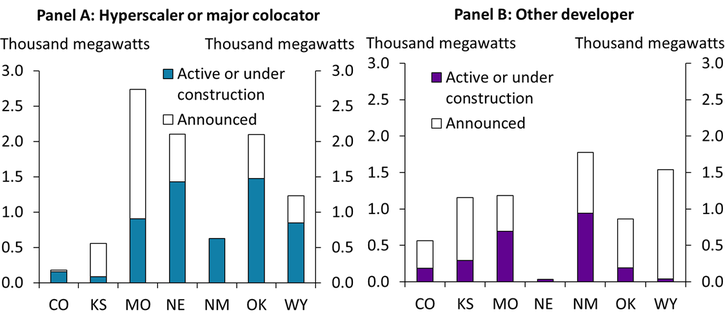
Notes: Hyperscalers here include Amazon, Apple, Google, Meta, Microsoft, and Oracle. Colocators are large data center landlords and here include Coresite, Cyrus One, Digital Realty, Equinix, Iron Mountain, NTT Global Data Centers, QTS Data Centers, and Telehouse.
Source: Aterio.
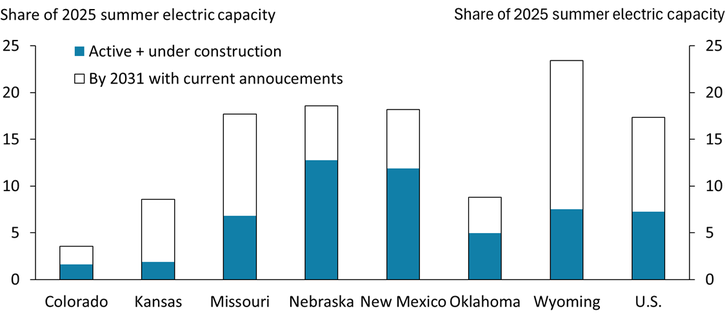
When identifying future construction sites, developers often consider the presence of an existing cluster of data centers and the availability of electricity (in addition to projected demand for computing power). In the Tenth District, if all announcements in the pipeline come to fruition, data center activity will remain most substantial in Missouri, Nebraska, New Mexico, and Wyoming. Developers in these states may be seeking to capitalize on favorable development conditions to expand on existing data center clusters or begin new clusters. Chart 3 shows that by 2031, announced data centers will use between 17 and 23 percent of the existing (as of summer 2025) electric capacity. If all announced projects are completed, utilities will likely need to build additional generation capacity to serve new and existing customers and help reduce upward, demand-driven pressure on electricity prices. In percentage change terms, however, announced builds are largest in Tenth District states where the existing data center facilities use a smaller share of existing power. For example, data centers currently amount to about 2 percent of existing electric capacity (blue bars) in Kansas, where relatively few data centers have been activated or are under construction. Within five years, however, if all currently announced Kansas data centers proceed as planned, total electricity use by the sector will increase by more than 350 percent—the largest increase among district states—raising its share of existing electric capacity to nearly 10 percent.
Chart 3: Data center announcements tend to follow existing clusters or find areas with more electricity available
Sources: Aterio, U.S. Energy Information Administration, and author’s calculations.
Government incentives and restrictions are another factor in development decisions for companies seeking to build data center facilities. Government incentives have often been the “tiebreaker” in location decisions and are frequently enacted at the state government level (Bommarito and Bommarito 2026). Nearly all state governments (49) have enacted incentives, including sales and use tax exemptions, property tax abatements, investment tax credits, and economic development grants, which range in scope regarding the size of project required, employment benchmarks, financial generosity, and duration.
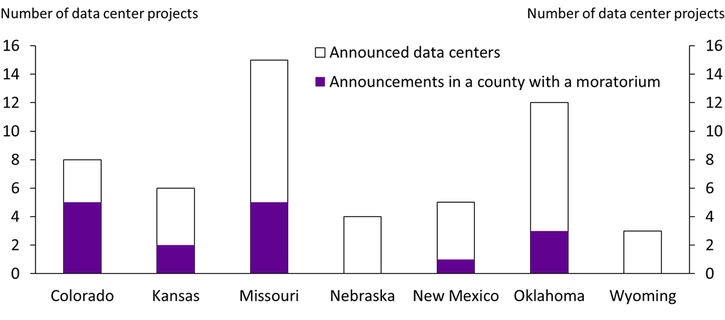
While most states have enacted incentive programs in some form, restrictions on data center construction are applied more unevenly and typically enacted by local (county or city) governments._ Local moratoriums can range from a full ban on construction or restrictions on elements of the project, like size of the facility or source of electricity. In the Tenth District, some local moratoriums follow existing announcements, while other moratoriums are more preemptive. For example, Chart 4 shows that five of the eight announced data centers in Colorado are in a county where a jurisdiction has subsequently passed a moratorium (purple bar)._ In contrast, while more than 15 local governments have passed some form of data center construction moratorium in Nebraska, none of these restrictions are in a county where a project has been announced.
Chart 4: Local moratoriums and announced data center projects are not always neatly aligned
Sources: Aterio, Bommarito (2026), and author’s calculations.
Although data centers have been shown to provide some material benefits to communities in which they are constructed, localities often have concerns about resource utilization or overly generous state incentive programs, sometimes resulting in a local moratorium on construction. Business and consumer demand for products like artificial intelligence models and cloud computing is likely key to the demand for data centers. However, other factors, including the availability of electricity, state incentives, and local moratoriums could also influence new data center development.
Endnotes
-
1 Aterio (n.d.) defines a data center as a “physical facility that houses hardware and systems necessary to store, process, and distribute massive volumes of data and digital information” in a list of frequently asked questions.
-
2 Only two states, New York and Texas, have enacted some form of restriction on data center development at the state government level.
-
3 In Colorado, all data center-related ordinances have been enacted in 2026, with most taking effect over the summer. All announcements have been released as of February 2026 or earlier.
References
Alvarez, Fernando E., David Argente, Joyce Chow, and Diana Van Patten. 2026. “External LinkData Centers and Local Economies in the Age of AI: A Shift-Share Approach.” National Bureau of Economic Research, working paper no. 35194, May.
Aterio. n.d. “External LinkWhat Are Data Centers?” Accessed November 4, 2026.
Bommarito, Michael J. 2026. “External LinkMoratorium Nation: U.S. Infrastructure Moratorium Data.” September.
Bommarito, Jillian, and Michael J. Bommarito II. 2026. “External LinkData Center Policy Across the 50 States: A Survey of Incentives, Land Use, and Energy Regulation.” ALEA working paper, June.
Yue, Daniel, and Yiyang Zeng. 2026. “External LinkThe Local Economic Effects of Data Center Entry.” SSRN, March 30.
John McCoy is an associate economist at the Omaha Branch of the Federal Reserve Bank of Kansas City. The views expressed are those of the author and do not necessarily reflect the positions of the Federal Reserve Bank of Kansas City or the Federal Reserve System.
Author