
Spending on the artificial intelligence (AI) build-out has grown exponentially, fostering a borrowing spree by AI firms. In response to optimism about the new technology, asset valuations across financial markets have risen steeply, heightening concerns that elevated valuations could unwind in a disorderly manner and trigger a broader economic fallout (BIS 2026; Bailey 2026). But beyond the risks of asset repricing, the AI build-out and its financing likely have longer-term implications. The build-out spans a broad range of industries, and its financing occurs through diverse asset classes and novel long-term financing structures that have not yet been stress-tested by an economic downturn. This ecosystem of connected industries and financial structures may be vulnerable to shifts in the economic outlook that are not directly related to the prospects of AI technology and its valuation.
To assess the structural risks of AI financing, we consider the entire value chain of AI firms, including hyperscalers (large-scale cloud service providers), semiconductor manufacturers (chipmakers), energy utilities, industrial firms, neoclouds (computing service providers), and data center operators. Chart 1 shows the shares of AI debt across various financial markets in 2023, the first full year after OpenAI released ChatGPT, and through the second quarter of 2026. The most dramatic increase is in investment-grade bonds, where shares of AI firms’ issuances have risen from 2 percent in 2023 to 10 percent this year (blue bars, left axis). In dollar amounts, year-to-date issuances of investment-grade bonds (green dot, right axis) are $330 billion, already 10 times the issuances for the whole of 2023. In addition to private credit and high-yield bonds, AI debt (specifically, to finance data centers) accounts for a growing share of bank commercial real estate (CRE) loans, real estate investment trusts (REITs), commercial mortgage-backed securities (CMBS), and asset-backed securities (ABS). Notably, lending for the build-out has proliferated outside the banking system. While the share of bank CRE loans for data center construction has risen, these loans still represent a modest volume of overall CRE lending._
Chart 1: Lending to AI firms has expanded in a variety of financial markets
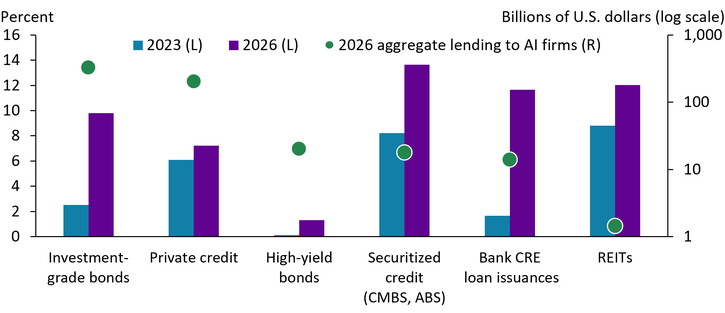
Note: Private credit data are only available through 2025 from Aldasoro, Doerr, and Rees (2026).
Sources: Bloomberg, Board of Governors of the Federal Reserve System, CreditFlow, Nareit, Trepp, J.P. Morgan, MSCI Real Capital Analytics, Bank for International Settlements (BIS), Aldasoro, Doerr, and Rees (2026), and authors’ calculations.
Chart 2 shows that the most highly leveraged entities in the AI ecosystem are special purpose vehicles (SPVs), set up by hyperscalers and semiconductor manufacturers in partnership with private credit firms. Broad guarantees from sponsors allow SPVs to raise debt with a thin equity buffer and finance 90 percent of their assets with debt (Van Nieuwerburgh 2026). Neoclouds, whose novel business models focus entirely on AI technology, follow with a debt-to-asset ratio of 85 percent. Although utilities, industrial firms, and data center operators have debt-to-asset ratios exceeding 50 percent, their business models span beyond AI-related services. Taken together, these relatively highly leveraged sectors account for a market capitalization of just over $3 trillion. Hyperscalers and semiconductors, which represent a combined market capitalization of over $22 trillion, operate with lower leverage levels of 44 and 34 percent, respectively.
Chart 2: Leverage is high for some AI-involved entities
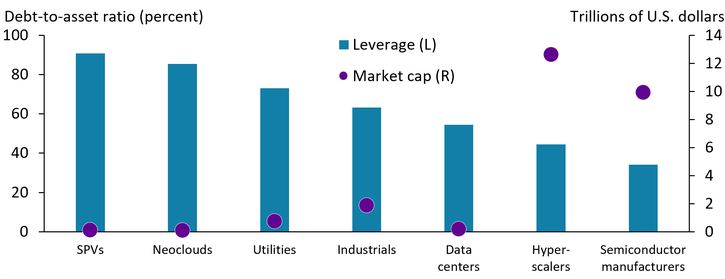
Sources: S&P Global, Bloomberg, Hogan (2026), and authors’ calculations.
When firms heavily finance their investments via debt instead of equity, chances increase that stresses will spill over from the firm or its sector to the broader economy through losses incurred by financial intermediaries. Although hyperscalers and semiconductor manufacturers are less leveraged, their revenues and investments are intertwined with smaller, more leveraged entities, and their reported ratios do not reveal the full extent of their liabilities (Rudegaeir and Santilli 2026). These firms are ultimately responsible for SPV debt through rent payments and residual value guarantees (Van Nieuwerburgh 2026). Neoclouds have secured direct financing from chipmakers and favorable lending terms through hyperscaler guarantees. Even if widespread AI adoption progresses steadily, shifts in asset valuations or disruptions to the business models of these smaller entities can cascade to other entities along the AI value chain._
Additionally, financial risks from leveraged AI firms may be exacerbated when individual institutions hold concentrated positions in the sector. As AI firms have been among the dominant bond issuers recently, investors’ purchases of corporate bonds will inevitably expose them to AI-related debt. Chart 3 shows the volumes of publicly issued corporate bond purchases by institutional investor categories from 2023 through 2026:Q2. Nearly all institution types have increased their purchases of corporate bonds over this period. Mutual funds, exchange-traded funds, and insurance companies have steadily expanded their purchases to remain the largest buyers of corporate bonds. Notably, U.S. depository institutions, which were net sellers of bonds in 2023 and 2024, have purchased significant amounts this year. Other insurers and state and local retirement funds are consistent buyers of corporate bonds._ Besides expanding their holdings of publicly listed bonds, insurers, private credit firms, and pension funds have acquired long-duration bonds through private placements (Goldman Sachs 2026). Accordingly, households that purchase financial assets issued by these institutional investors also become increasingly exposed to AI firms and their prospects (Van Nieuwerburgh 2026).
Chart 3: Financial institutions have expanded corporate bonds purchases in recent years, exposing them to AI debt
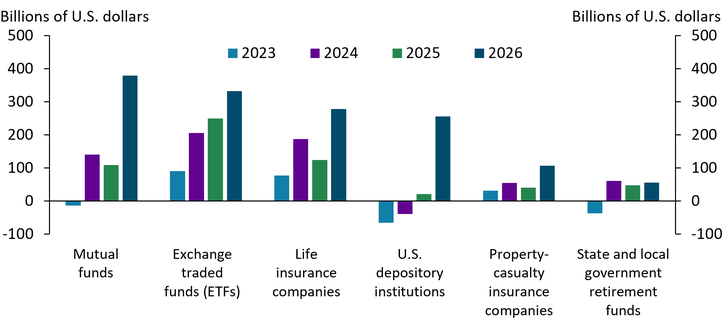
Source: Board of Governors of the Federal Reserve System (Haver Analytics).
Because financing is predominantly long-term, the real and financial assets associated with the AI build-out will undergo revaluations in response to future technological shifts and economic cycles. Chart 4 depicts the weighted-average maturity of AI-related investment-grade bonds issued in 2025 through August 2026. Hyperscalers and utilities have long maturities averaging 16 and 17 years respectively, exceeding the market average of 10 years. These longer maturities suggest the AI build-out will carry enduring consequences for capital providers.
Chart 4: Hyperscalers’ and utilities’ weighted-average maturities exceed the market average
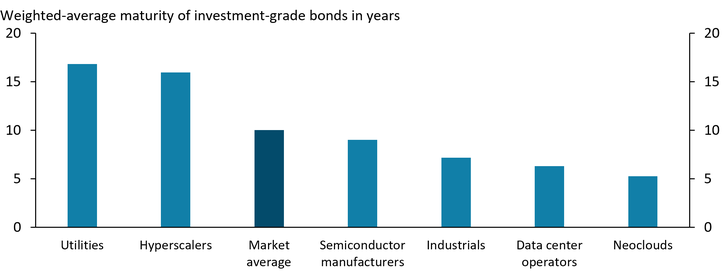
Note: Chart shows weighted-average maturities for bonds issued in 2025 and 2026.
Sources: Bloomberg and authors’ calculations.
The financial innovation and long-term ramifications of the AI build-out mirror the byproducts of historical infrastructure projects. For instance, in the 19th century, the build-out of railways gave rise to the corporate bond market from the 1830s, but strains in financing did not emerge until much later, in 1873 (Calomiris and Ramirez 1996; Richardson and Sablik 2015). The financial architecture associated with the AI build-out presents not only short-term risks but also vulnerabilities that may result in disruptions in the longer term. Although the investment surge may have just begun, the opacity and complexity of emerging financial risks provide a clear case for expanded disclosures and greater transparency by financial institutions and AI firms across the entire value chain.
Endnotes
-
1 Our measures of bank loans to data centers are from MSCI Real Capital Analytics (RCA). Other data sources may provide higher total amounts as the method of identifying data center loans varies across providers. The RCA database consists of purely real estate loans that are tied to the property and independently verified.
-
2 Hyperscalers and chipmakers have also been using the strength of their balance sheets to finance AI labs (like OpenAI and Anthropic) and generate revenues through circular deals (BIS 2026). AI labs are not represented on our charts as they are still privately held and do not publicly disclose financial statements.
-
3 Other institutional buyers include private pension funds, hedge funds, and foreign institutions. Chart 3 focuses on the six largest domestic holders of this asset category.
Article Citation
Sharma, Padma, and Pierce George. 2026. “Beyond Valuations: Long-Term Financial Risks from the AI Build-Out.” Federal Reserve Bank of Kansas City, Economic Bulletin, October 5.
References
Aldasoro, Iñaki, Sebastian Doerr, and Daniel Rees. 2026. “External LinkFinancing the AI Boom: From Cash Flows to Debt.” BIS Bulletin no. 120, January 7.
Bailey, Andrew. 2026. “External LinkFSB Chair’s letter to G20 Finance Ministers and Central Bank Governors: October 2026.” Financial Stability Board, October 8.
BIS (Bank for International Settlements). 2026. “External LinkAnnual Economic Report.”
Calomiris, Charles W., and Carlos D. Ramirez. 1996. “External LinkFinancing the American Corporation: The Changing Menu of Financial Relationships.” National Bureau of Economic Research, historical paper no. 79, February.
Goldman Sachs. 2026. “External LinkHarnessing AI for the Real Economy.” Goldman Sachs Investment Banking.
Hogan, Catie. 2026. “External LinkApollo and Blackstone Just Closed a $35 Billion Private Credit Deal to Finance Anthropic’s Compute Expansion. Here’s What It Means for Micron and Nvidia.” Yahoo! Finance, June 17.
Richardson, Gary, and Tim Sablik. 2015. “External LinkBanking Panics of the Gilded Age.” Federal Reserve History, December 4.
Rudegaeir, Peter, and Peter Santilli. 2026. “External LinkWhy Big Tech’s AI Spending Is $3 Trillion Higher Than It Seems.” Wall Street Journal, August 16.
Van Nieuwerburgh, Stijn. 2026. “External LinkFinancing the AI Buildout.” SSRN, March 19.
Padma Sharma is a senior economist and Pierce George is a research associate at the Federal Reserve Bank of Kansas City. The views expressed are those of the authors and do not necessarily reflect the positions of the Federal Reserve Bank of Kansas City or the Federal Reserve System.
Authors

Padma Sharma
Senior Economist