
During the early to mid-20th century, the United States switched from a primarily tariff-based revenue system to an income-based tax system. Chart 1 uses digitized federal receipts from the Annual Reports of the Secretary of the Treasury to highlight this shift. From 1789 to the early 1900s, almost all U.S. federal revenue was generated by tariffs (light blue area). After the United States entered World War I in 1917, however, a much greater share of U.S. revenue was derived from income-based taxes (purple, green, and dark blue areas).
Chart 1: Income-based taxes have increased both as a percentage of total federal receipts and of GDP
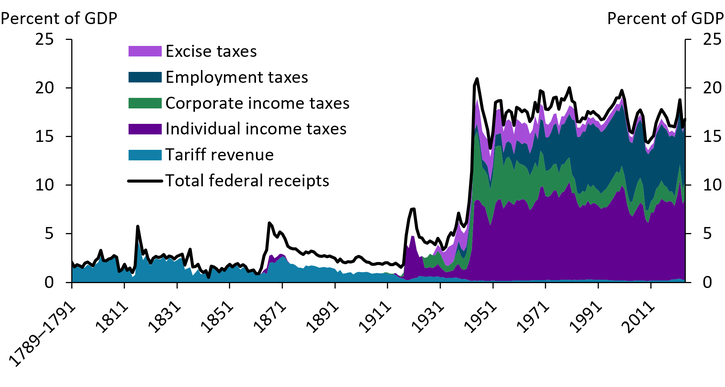
Notes: Total federal receipts are total (gross) receipts until 1980, then net receipts. The fiscal year ends on December 31 from 1789 to 1842, on June 30 from 1843 to 1976, and on September 30 from 1977 through the present. The transition quarter in 1976 from July 1 through September 30 is omitted. Employment taxes are payroll taxes and are primarily Social Security and Medicare taxes.
Sources: U.S. Department of the Treasury, Office of Management and Budget, and MeasuringWorth.
The spike in income tax revenue in 1917 was not the first time the United States had collected income taxes. Although the federal government originally financed itself largely through customs duties and land sales, the outbreak of the Civil War led to a surge in federal spending that could not be supported by customs duties alone._ Congress moved swiftly to introduce an emergency wartime income tax, the first instance of a U.S federal income tax. The Revenue Tax of 1861, revised and replaced the next year, was officially implemented in mid-1862 and lasted nearly 10 years._
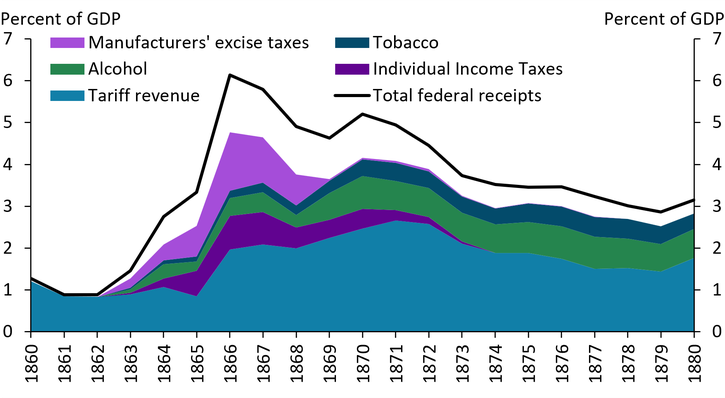
Chart 2 shows that while customs remained the primary method of financing the government during the Civil War era, excise, estate, and income taxes also played a crucial funding role during wartime. Excise taxes were consumption-oriented, like tariffs, and taxed “luxuries” such as alcohol, tobacco, and jewelry. The estate tax, introduced in 1862 alongside the modified income tax, acted as an extension of the income tax on the transfer of estates. After the war, public opinion turned against the income tax, and Congress let both the income and estate tax expire in 1872._ Although excise taxes on some luxuries also expired in 1872, tobacco and alcohol taxes became a persistent part of the U.S. tax system.
Chart 2: Composition of U.S. federal receipts shifted during the Civil War Era, 1860–80
Sources: U.S. Department of the Treasury and MeasuringWorth.
The composition of the labor force at the time also played a role in driving the post-war elimination of the income tax. Although the share of the labor force in agriculture had begun its long-term decline, agricultural production continued to account for a majority of the labor market by 1860, posing challenges for income tax collection (Hill 1894)._ Whereas income from manufacturing was relatively straightforward to calculate and tax, income on farms was nebulous and highly subjective. Indeed, the Civil War income tax was beset from the beginning by concerns over how to assess farm income, an issue that only compounded over time. This issue made the income tax infeasible as a primary means of government finance until the beginning of the 20th century.
As the economy continued to move away from agricultural production, however, proposals to reintroduce the income tax began to resurface, inspiring major debates in the public forum from 1894 to 1913. From 1890 to 1913, the share of the U.S. labor force involved in agricultural production fell from 43 percent to 28 percent. While consumption taxes had been seen as fair when most people worked in a single profession, many began to believe that income taxation was a fairer way to finance the government in a country with a growing variety of non-farm sectors and income sources (Pollack 2013).
In 1894, Congress again passed a new individual income tax, along with the first corporate income tax. However, the tax did not take effect due to a Supreme Court ruling upholding that the income tax, as a “direct tax,” was required by the Constitution to be apportioned by state population. Accordingly, Congress did not implement any income taxes until the 16th Amendment was ratified in 1913. Nevertheless, even after the 16th Amendment permitted income taxation, income tax revenue remained subdued until the United States entered World War I in late 1917, as there was no pressing need to raise revenues beyond what the current tariff system could support until war preparations began. Chart 3 shows that since World War I, individual income taxes and corporate income taxes have made up most of U.S. federal revenue. The war served as a major catalyst and unified the public in supporting a major shift away from a tariff-based financing system to an income-based financing system.
Chart 3: Income taxes increase as a share of federal revenue after 1917
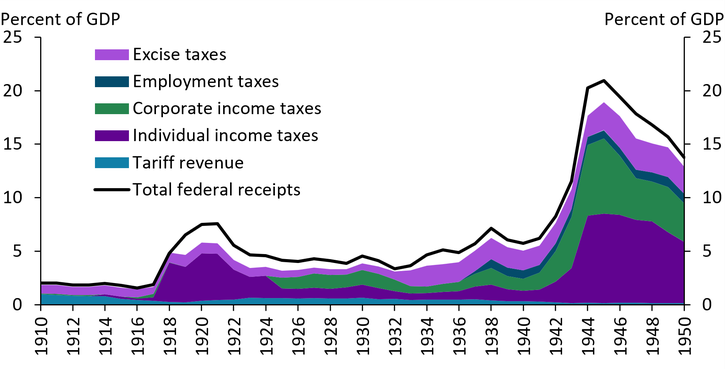
Notes: Separate data are not available for individual income taxes and corporate income taxes for the period 1919 through 1924. Thus, all income and profits tax revenue has been classified as “individual income taxes” for that period. Excise taxes from 1910–28 are estimates obtained by summing up alcohol, tobacco, manufacturers, admissions, telephone, telegraph, radio, and cable facilities, and stamp excise taxes. Total federal receipts are total (gross) receipts.
Sources: U.S. Department of the Treasury and MeasuringWorth.
The switch from tariff-based financing to income-based financing shows how tax reform and labor force composition changes are intertwined. Although the first income tax was adopted during the Civil War, most of the country still worked in agriculture, making a fully income-based tax system infeasible at the time. However, as more of the country moved away from agriculture, and as capital became a larger source of revenue, income tax became the preferred method of finance on the grounds of fairness in government taxation. This long-run shift in the composition of the U.S. economy—together with both public debate over the best form of taxation and a need for more revenue—catalyzed a major shift in the U.S. federal tax system away from tariffs and toward income taxes.
Download Materials
Endnotes
-
1 During the War of 1812, the United States levied taxes on land, dwellings, luxury commodities, and more to fund the war effort. In 1815, Secretary of the Treasury Alexander J. Dallas proposed an income tax to raise additional revenue for the war, basing his income tax system on similar proposals in England and Europe during times of war. However, the war ended before Congress acted on this proposal, and the previously levied internal taxes were repealed following the end of the war in December 1815. For further information on this 1815 proposal, see Ratner (1942), Pollock (2014), and Hill (1894).
-
2 Although this was the first instance of a federal income tax, states and localities had long been using property tax systems that closely resembled income taxation. For further information, see Stantcheva, Landais, and Dray (2023) and Wallis (2000).
-
3 For reference, only 0.2 percent of the population was subject to the income tax in the 1870 renewal. For further information, see Pollack (2014).
-
4 In 1860, 53 percent of the labor force was employed in agriculture. By 1913, that had fallen to 28 percent (Lebergott 1964; 1966).
Article Citation
Vasiljevic, Stephen. 2026. “A Historical Analysis of the Federal Income Tax.” Federal Reserve Bank of Kansas City, Economic Bulletin, September 4.
References
Hill, Joseph A. 1894. “External LinkThe Civil War Income Tax.” Quarterly Journal of Economics, vol. 8, no. 4, pp. 416–452.
Lebergott, Stanley. 1966. “External LinkLabor Force and Employment, 1800–1960,” in Dorothy S. Brady, ed., External LinkOutput, Employment, and Productivity in the United States after 1800. National Bureau of Economic Research.
Lebergott, Stanley. 1964. Manpower in Economic Growth. McGraw-Hill.
Pollack, Sheldon D. 2014. “External LinkThe First National Income Tax, 1861–1872.” Tax Lawyer, vol. 67, no. 2, pp. 1−20.
Pollack, Sheldon D. 2013. “External LinkOrigins of the Modern Income Tax, 1894–1913.” Tax Lawyer, vol. 66, no. 2, pp. 295−330.
Ratner, Sidney. 1942. American Taxation: Its History as a Social Force in Democracy. W.W. Norton & Company Inc.
Stantcheva, Stefanie, Camille Landlais, and Sacha Dray. 2023. “External LinkWealth and Property Taxation in the United States.” National Bureau of Economic Research, working paper no. 31080, March.
Wallis, John Joseph. 2000. “External LinkAmerican Government Finance in the Long Run: 1790 to 1990.” Journal of Economic Perspectives, vol. 14, no. 1, pp. 61–82.
Stephen Vasiljevic is a research associate at the bank. The views expressed are those of the author and do not necessarily reflect the positions of the Federal Reserve Bank of Kansas City or the Federal Reserve System.
Author