
During the 2026 Agricultural Economic Summit titled “The Business of Agriculture Amid Structural Change,” the Kansas City Fed explored long-term forces shaping agricultural decision-making, supply behavior, and industry structure. On August 5, around 50 executives and industry experts representing organizations connected to agricultural production and agribusiness gathered in Omaha to discuss how their respective organizations are responding to structural changes likely to be most significant over the next 10 years. This summary highlights some of the major themes of discussion throughout the event.
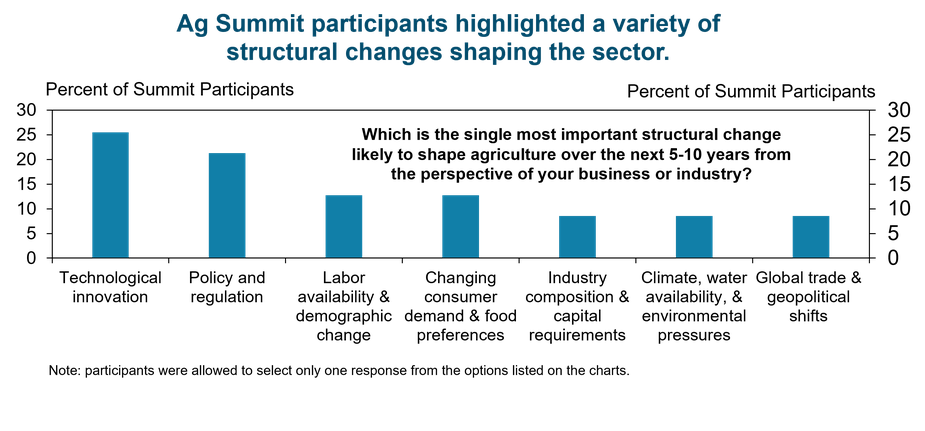
The convergence of multiple factors driving structural changes are shaping the long-term path of agriculture and related industries. Technology and artificial intelligence are improving efficiency as persistent labor shortages and skill gaps continue to challenge the sector. Government policy and geopolitical uncertainty are also key drivers of structural change, adding volatility to markets and complicating long-term planning.
Shifting demographics and consumer preferences—including aging populations, slowing population growth and rising demand for high-protein foods—are pushing the industry toward value-added strategies. Rising capital costs, natural resource constraints, and growing global competition, particularly from Brazil, were highlighted as additional pressures shaping the long-term outlook and the strategic position of businesses.
Technology and innovation are being leveraged to improve efficiency
The rapid advancement of artificial intelligence is expected to provide increased opportunities for technology adoption across the agricultural supply chain and support the pursuit of cost reductions and efficiency. In both crop and livestock production, the implementation of autonomous systems and more data-driven decision making are increasingly being used to improve productivity. Similarly, artificial intelligence is being incorporated by agribusinesses into everything from seed genetics to marketing and administrative tasks.
Labor availability remains a challenge
Persistent labor scarcity in many regions and gaps in technical skills and other qualifications could remain an ongoing challenge across the sector. For agricultural producers, the availability of workers can be particularly scarce due to rural demographic trends and willingness of the local workforce to pursue more demanding agricultural occupations. With the recent acceleration in technologies, the labor force across the sector is also increasingly lacking the appropriate knowledge for roles requiring advanced understanding of data analysis, computer programing and emerging mechanical and technical innovations.
Government policy is driving structural change and shaping decision making
Government policy intersects with major factors driving structural change such as global demand, technology, trade, and geopolitics. Policy and geopolitical uncertainty along with differing policies across states and countries has contributed to volatility in agricultural markets. The heightened and persistent uncertainty has complicated decision making and made it more difficult for businesses to respond to emerging shocks. Given the recent uncertainty surrounding many policies important for agriculture, and the overall significance of the potential policy impacts, many businesses have devoted more resources to policy advocacy to try and advance outcomes that might be most advantageous.
Demographic trends and consumer preferences are changing the demand outlook
Aging populations and slower population growth in many regions of the world are key factors shaping the long-term demand outlook for agricultural products. Slower population growth often does not support a strategy that had existed in previous years of continuously increasing production volumes to feed a world population that had been growing more quickly. The outlook for demand has also been affected by an expanded adoption of GLP-1 pharmaceuticals and consumer preferences shifting substantially toward higher protein foods. The production model of past decades focused on expanding supplies through increased volume is misaligned with these evolving demographic-driven demand patterns and the sector may need to shift toward a more value-added strategy.
Increased capital costs are shaping investment decisions
The agricultural sector is becoming increasingly capital intensive and elevated costs for machinery, infrastructure and land are shaping decision making. Investment decisions across the sector are likely to remain strategic and focused on improving efficiency. Higher capital costs and the potential for a larger divide in the level of efficiency across businesses or farming operations could also increase the pace of consolidation. Increased consolidation may be particularly challenging for smaller farming operations, agribusinesses and lending institutions in addition to significant regional effects that result from business restructuring.
Climate, water and broad environmental pressures remain important
Natural resources will play a crucial role in shaping farm business decisions. The availability of a steady water supply, pest and disease prevention, and affordable energy will be important for the long-term path of costs and production constraints. Rising energy and water costs pose a particularly significant threat to the profitability of U.S. farming operations in the coming years.
Global trade and geopolitical shifts remain a tenuous factor
Export markets remain a critical source of demand for U.S. agricultural production and the outlook is uncertain alongside geopolitical tensions and increasing global competition. The short and long-term prospects of key U.S. trading partnerships remain clouded and ongoing global conflicts have added instability to agricultural markets. At the same time, Brazil is likely to continue becoming increasingly competitive in international markets for many farm commodities that are significant in the U.S.
The views expressed are those of the authors and do not necessarily reflect the positions of the Federal Reserve Bank of Kansas City or the Federal Reserve System.