
“This is your Fed.”
That message from Kansas City Federal Reserve President Jeff Schmid set the tone during a visit to Denver in late February, where he met with business leaders and toured a modular home manufacturing facility to better understand the region’s economy.
For Schmid, outreach is not simply public engagement. Conversations with business owners, workers and community leaders help the Federal Reserve understand economic conditions across the Tenth District and bring real-world perspectives into discussions about monetary policy and financial stability.
“We try to understand what’s happening in each of our communities,” Schmid said. “Those insights help inform how we think about the broader economy.”
During the visit, Schmid participated in a fireside conversation with the Economic Club of Colorado before touring Vederra Modular, where multi-family housing units are built in a factory setting before being transported to building sites. Together, the discussions highlighted how local economic activity connects to broader national trends.
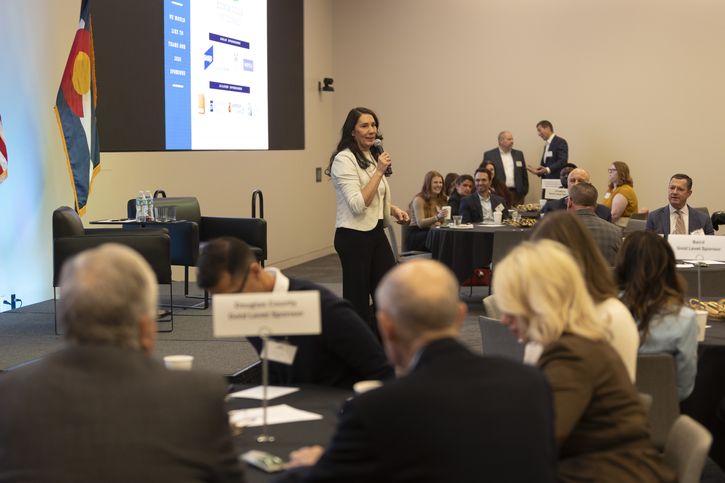
Courtney Kanouff, executive director of Economic Club of Colorado, presents at a February 2026 meeting in Denver, Colorado.
Housing innovation and affordability challenges
Housing was a central topic during Schmid’s visit with community and business leaders. Across much of the Mountain West, population growth has increased demand for housing while supply has struggled to keep pace. To better understand those dynamics, Schmid and Kansas City Fed staff toured Vederra Modular, where homes – duplexes, townhouses, and apartment complexes – are built inside a 140,000-square-foot manufacturing facility before being transported to construction sites.
The factory approach reflects a growing effort in the construction industry to improve efficiency and reduce costs.
Nathan Peterson, CEO of Vederra Modular, said modular construction can significantly shorten building timelines.
“A modular project might be about 60 percent of the construction schedule of a traditional build,” Peterson said. “Depending on the market, cost savings can be anywhere from 15 to 20 percent.”
Those efficiencies can be particularly important in areas where labor costs are high or construction seasons are limited, such as mountain communities.
Peterson said his company also is exploring ways to use technology, including artificial intelligence tools that help optimize factory operations and labor efficiency.
“If we can provide housing that is 20 percent below the cost of traditional modular construction, we’ve really done something to contribute to the housing solution,” he said.
Understanding housing supply and affordability is critical for evaluating the health of local economies, Fed officials say.
Rachael Surmick, a community development advisor with the Kansas City Fed, said national housing shortages seen today partly reflect a slowdown in construction following the Great Recession.
“We stopped building enough housing 10 to 15 years ago, and that’s impacting available inventory today,” said Surmick, who is based at the Bank’s Omaha Branch. “The decisions we make now will influence housing availability and affordability years down the road.”
Rising costs are affecting households across income levels, particularly those with lower and moderate incomes.
Ariel Cisneros, a Denver-based lead community development advisor for the Kansas City Fed, said many households are struggling to keep pace with the cost of living.
“Household income is not always keeping up with the rising costs,” Cisneros said. “We're hearing about the increase to homeowners' insurance over the last few years along with increased property taxes affecting affordability. That affects low-income and middle-income families that have less financial cushion for these increases.”
Taken together, these pressures – including rising insurance costs and property taxes, among others – are reshaping what affordability means across income levels, making it all the more important for Federal Reserve leaders to hear directly from the communities experiencing these shifts firsthand.
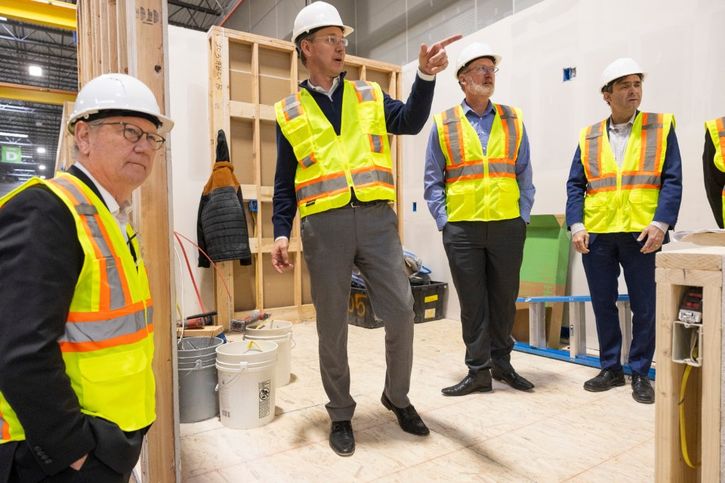
A group from the Kansas City Fed tours Vederra Modular headquarters in Denver, Colorado.
Listening to regional economies
The Federal Reserve Bank of Kansas City serves a region spanning seven states and roughly half a million square miles. In addition to its headquarters in Kansas City, the Bank operates branch offices in Denver, Oklahoma City and Omaha. Those offices gather economic insights from local businesses, workers and community organizations that help inform research, data analysis and national discussions about economic conditions.
The Denver Branch monitors economic conditions across Colorado, Wyoming and northern New Mexico. Those areas include rapidly growing metro regions as well as rural communities with distinct economic challenges.
Nick Sly, vice president, economist, and Denver Branch executive, said those differences made regional outreach essential.
“Colorado, Wyoming, and northern New Mexico really represent multiple different economies,” Sly said. “You have to be connected to those individual communities to understand the opportunities and the challenges they face.”
Information gathered through outreach visits feeds into the Federal Reserve’s broader economic monitoring. Business and community insights contribute to reports such as the Beige Book, which summarizes regional economic conditions across the country.
Regional research also helps inform the Fed’s understanding of economic trends. A recent Rocky Mountain Economist report produced by the Denver Branch found that Colorado has seen faster growth in affordable housing financed through Low-Income Housing Tax Credits than the national average over the past 15 years, although new development could slow in the near term.
From local conversations to national decisions
For Schmid and other Federal Reserve leaders, outreach across the district plays an important role in understanding how economic conditions are evolving on the ground.
Those insights help inform discussions around monetary policy, the supervision and stability of banks, and the Federal Reserve’s role in maintaining a secure and reliable payments system.
Sometimes that understanding begins in a conference room, during a discussion with business and community leaders or through careful review of economic data.
Other times it begins somewhere less expected.
Like on the floor of a factory, where homes are being assembled piece by piece, and where the challenges and innovations shaping the economy are often easiest to see.
The views expressed are those of the authors and do not necessarily reflect the positions of the Federal Reserve Bank of Kansas City or the Federal Reserve System.