
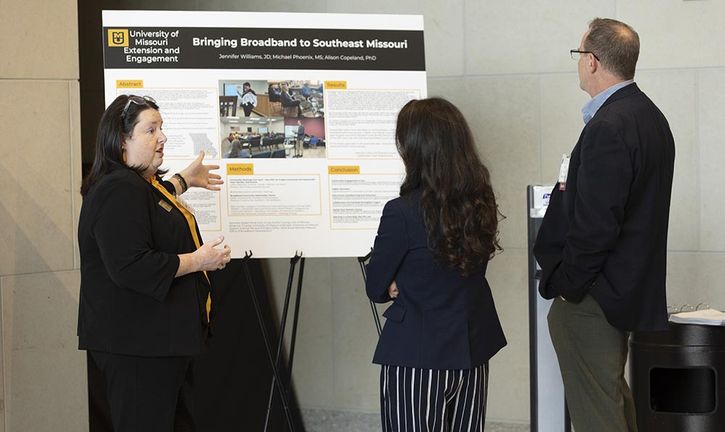
University of Missouri Extension Engagement Specialist Jennifer Williams described how her office in Van Buren, Missouri, works to expand broadband access. Photo by Gary Barber
It’s hard to imagine how someone could fully participate in the economy without online access to work, school, banking, news, media and other activities that connect us in society.
This access gap, like many others, underscores why qualitative and quantitative research are essential for assessing and addressing the access needs of communities that Reserve Banks serve.
In September, the Kansas City Fed hosted a three-day Digital Access Research Forum, jointly organized with the Atlanta, Cleveland, Dallas, New York, and Philadelphia Federal Reserve banks. The event gathered academics, researchers, community development practitioners, and policymakers to discuss various topics related to digital access research, including:
- Program evaluation and outcomes measurement
- Benefits of digital access interventions in communities
- Economic and labor-market implications
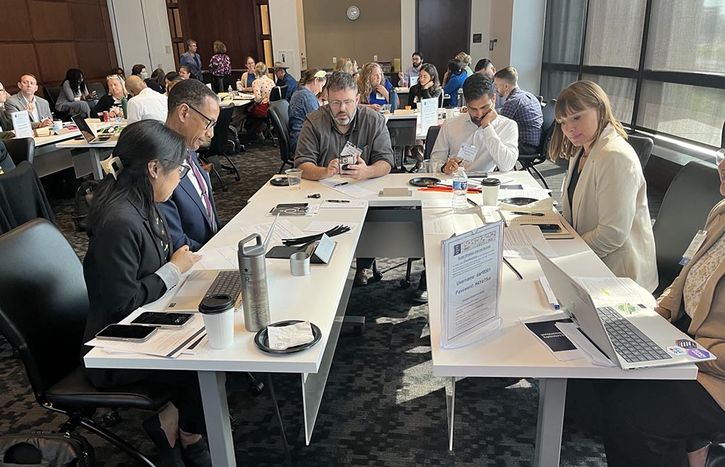
Digital Access Research Forum attendees participated in a workshop labeled “Storytelling: How to Use Data to Tell Your Story.” The workshop was led Anne O'Shaughnessy, assistant vice president and communications director for Fed Communities, and Pang Randolph, communications officer for the REACH Healthcare Foundation.
About the forum
On Sept. 16, pre-forum workshops led by Federal Reserve System staff and local practitioners offered hands-on learning experiences to help attendees explore data sources, facilitation and research methods for effective community development programming and outreach. Participants in these workshops included data analysts, digital practitioners, community development program leaders, anchor institutions, state broadband officials and policymakers.
Over the 12 months preceding the forum, Kansas City Fed Community Development Advisor Marisa Martinez led collaboration with partners from across the Federal Reserve System. With additional input from an external advisory committee of researchers and practitioners, forum organizers launched a national call for presentations, from which 25 submissions ultimately were selected to present. The event drew roughly 150 attendees from coast to coast. Approximately 40% of attendees were researchers/academics, 34% were community development practitioners, 19% were policymakers or funders, and the remaining participants were Federal Reserve staff.
Martinez said that hosting the forum brought together researchers and practitioners to discuss how best to measure the size and scope of digital access issues, and how to research the most effective solutions.
“Connecting research and data with practitioners and policymakers is crucial in community development,” Martinez said. “The partnering Reserve Banks and planning team prioritized this by hosting pre-forum workshops focused on capacity building in data collection, analysis and storytelling. As one facilitator stated about the pre-forum workshops, ‘Data makes you credible and stories make you memorable.’”
Topics covered during forum sessions on Sept. 17 and 18 included emerging digital access datasets, measuring the impact of digital inclusion interventions, the economic benefits of broadband expansion and affordability in rural communities, the role of broadband in rural economic growth and development, and defining underserved households in digital payment services.
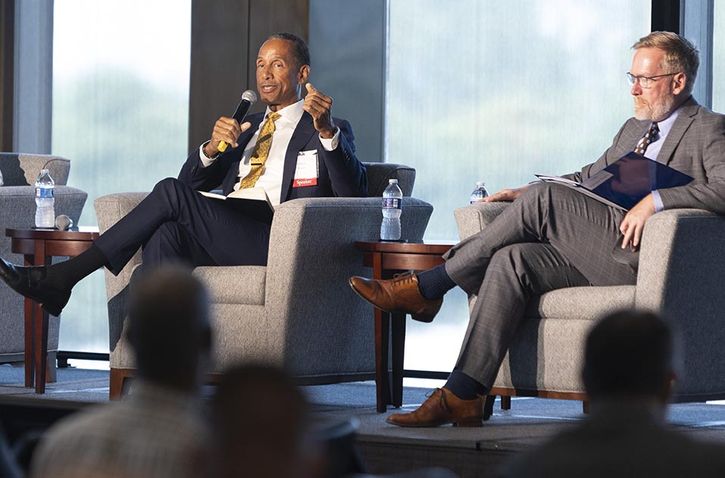
A panel during the forum included (from left) Otho Kerr III, director of Strategic Partnerships and Community Impact Investing at the Federal Reserve Bank of New York, and Jeremy Hegle, Kansas City Fed vice president and Community Affairs officer. Photo by Gary Barber
Why digital access is important
As digital and technological advancements accelerate, maintaining effective communication among stakeholders is crucial for expanding access, particularly for lower-income communities.
“These technological changes have a significant impact on employment, banking, healthcare, and social interactions, underscoring the need for ongoing research into issues of affordability and access,” said Kansas City Fed Vice President and Community Affairs Officer Jeremy Hegle. “This is why the work in digital access is important and continues to be a focus area across the Federal Reserve Bank System.”
The views expressed are those of the authors and do not necessarily reflect the positions of the Federal Reserve Bank of Kansas City or the Federal Reserve System.