
Productivity gains and larger planted areas worldwide have expanded corn and soybean supplies over time. The USDA projects that U.S. corn and soybean yields have risen more than 20 percent from 2010 to 2025, along with a 10 percent increase in corn acreage and a 2 percent increase in soybean acreage. Chart 1 shows that similar gains in productivity and acreage in net exporting countries, such as Brazil, and importing countries, such as China, have doubled global corn and soybean supplies over the past 30 years.
Chart 1: Global production and inventories for corn and soybeans have increased over the years
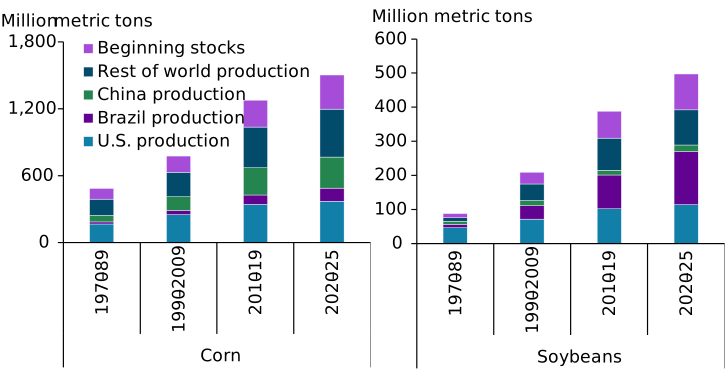
Note: Chart shows average production and beginning stocks in different time periods.
Sources: USDA and authors’ calculations.
In the United States, expanding corn and soybean supplies have been partly absorbed by a greater use of crops for biofuel as well as rising exports. Chart 2 shows that over the past 30 years, the sharpest growth in corn demand has come from ethanol production. Much of this growth occurred after Congress passed the final version of the Renewable Fuel Standard (RFS) in 2007, which required gasoline and diesel refiners to acquire a quota of biofuels (Carter, Rausser, and Smith 2017; Lark and others 2022). The RFS and other subsidy programs that promote biofuels also boosted demand for soybean oil, a byproduct of soybean crushing used in biofuel production._ At the same time, increased exports helped absorb corn and soybean supplies. The right side of Chart 2 shows that average soybean exports doubled between the 1990–2009 period and the 2010–25 period as China’s demand for soybeans surged.
Chart 2: Growth in biofuel production and exports has driven demand for U.S. corn and soybeans
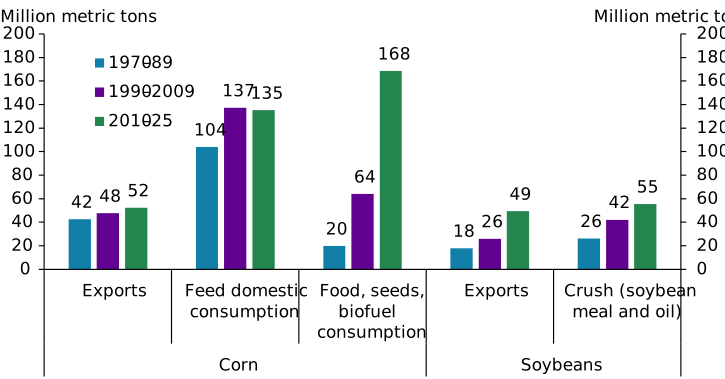
Note: A bushel of soybeans (60 pounds) produces around 11 pounds of soybean oil.
Sources: USDA and authors’ calculations.
However, export demand is unlikely to grow enough to absorb the expected increase in crop supplies moving forward. Although the United States has expanded corn and soybean exports since the early 2000s and secured major trading partners such as Mexico, its overall share of global trade has declined (Chart 3). Improvements in infrastructure have allowed other exporters to capture large shares of key markets such as China, Japan, and the European Union. Brazil, for example, sharply increased soybean exports to China and has replaced the United States as China’s largest soybean source. Looking ahead, trade disputes and intensifying competition from other exporters could further limit export growth as a driver of U.S. crop demand (Adjemian, Smith, and He 2021; Steinbach, Yildirim, and Zurita 2024).
Chart 3: The United States has lost overall market share in export markets
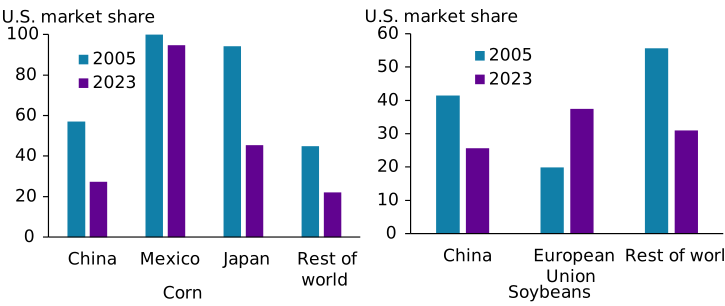
Note: Shares for European Union and rest of world include intra-trade.
Sources: Food and Agriculture Organization (FAO) and authors’ calculations.
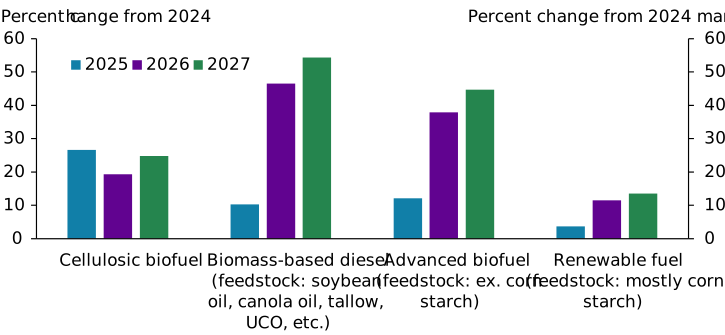
Instead, proposed changes to biofuel policy are likely to be the main driver of demand growth for corn and soybeans going forward. Chart 4 shows proposed changes to the RFS quotas for biomass-based diesel and advanced biofuel (which relies heavily on soybean oil) and renewable fuel (which uses corn ethanol), alongside other fuel types. If approved, the 2026–27 quota for biomass-based diesel would increase by 50 percent from its 2024 levels, while also increasing quotas for renewable fuel (corn ethanol) and advanced biofuels (biofuels other than corn ethanol with high greenhouse gas reductions). In addition, proposed changes to the RFS would count foreign inputs toward biofuel mandates at half the rate of North American inputs, boosting demand for domestic feedstock such as corn and soybeans. The Environmental Protection Agency (EPA) estimates that biodiesel producers would need, on average, an additional 250 million gallons per year to meet the RFS mandate—equivalent to more than 5 million metric tons of crushed soybeans, or roughly 4 percent of current U.S. soybean production (EPA 2025)._
Chart 4: Proposed changes in RFS volume obligations by the EPA
Sources: EPA and authors’ calculations.
Recent changes to the federal per-gallon income tax credit for clean fuel producers, known as the Clean Fuel Production Credit (45Z), will further encourage refineries and processors to use North American feedstock. The One Big Beautiful Bill Act (OBBBA) extended the 45Z provision through 2029. Only production using feedstock from the United States, Canada, or Mexico qualifies for the credit, which can reach up to $1 per gallon. In addition, the OBBBA adjusted calculations of the environmental benefits of biofuels to exclude indirect land-use penalties, which could favor crop producers and further boost demand.
In the past year, U.S. crop producers have faced tight profit opportunities amid an oversupply of crops relative to demand. Rising competition and recent trade disputes may further weaken export markets for corn and soybeans. However, biofuel production offers potential alternative sources of demand. Recent proposed and enacted federal biofuel policies are likely to create new demand for U.S. corn and soybean crops, partially absorbing production and supporting prices.
Download Materials
Endnotes
-
1 Other major non-federal programs include state subsidy programs aimed at decreasing carbon intensity in transportation. California’s Lower Carbon Fuel Standard is one of the largest of these programs.
-
2 We converted 250 million gallons of biomass-based diesel (BBD) equivalent using a conversion of 7.7 pounds of soybean oil per gallon equivalent and 18.3 percent soybean yield for soybean crush.
Article Citation
Scott, Francisco, and Ayesha Cooray. 2025. "Biofuel Policies Are Likely to Drive Future Demand for U.S. Corn and Soybeans." Federal Reserve Bank of Kansas City, Economic Bulletin, September 26.
References
Adjemian, Michael K., Aaron Smith, and Wendi He. 2021. External Link“Estimating the Market Effect of a Trade War: The Case of External LinkSoybean Tariffs.” Food Policy, vol. 105, December.
Carter, Colin A., Gordon C. Rausser, and Aaron Smith. 2017. “External LinkCommodity Storage and the Market Effects of Biofuel Policies.” American Journal of Agricultural Economics, vol. 99, no. 4, pp.1027–1055.
EPA (U.S. Environmental Protection Agency). 2025. “External LinkRenewable Fuel Standard (RFS) Program - Standards for 2026 and 2027: Draft Regulatory Impact Analysis.” June.
Lark, Tyler J., Nathan P. Hendricks, Aaron Smith, Nicholas Pates, Seth A. Spawn-Lee, Matthew Bougie, Eric G. Booth, Christopher J. Kucharik, and Holly K. Gibbs. 2022. “External LinkEnvironmental Outcomes of the U.S. Renewable Fuel Standard.” Proceedings of the National Academy of Sciences, vol. 119, no. 9.
Steinbach, Sandro, Yasin Yildirim, and Carlos Zurita. 2024. “External LinkPotential Implications of Trade Policy Shifts After the 2024 U.S. Presidential Election for the Agri-Food Sector.” Food Policy, vol. 129, November.
USDA (U.S. Department of Agriculture). 2025. “External LinkWorld Agricultural Supply and Demand Estimates (WASDE-663).” U.S. Department of Agriculture, August 12.
Francisco Scott and Ayesha Cooray are economists at the Federal Reserve Bank of Kansas City. The views expressed are those of the authors and do not necessarily reflect the positions of the Federal Reserve Bank of Kansas City or the Federal Reserve System.
Authors

Francisco Scott
Senior Economist