Q: Before becoming Oklahoma City Branch executive, you were a senior economist with a focus on agriculture. How has that experience helped shape your approach to your current role?
As an economist in a Branch, I reported directly to Omaha Branch Executive Nate Kauffman for 10 years. When I moved to Oklahoma in 2020, I worked alongside former Oklahoma City Branch Executive Chad Wilkerson for five years. I also have had the opportunity to work with former Denver Branch Executive Alison Felix and current Denver Branch Executive Nick Sly on different projects throughout my time at the Bank. I was fortunate to see how these leaders have done the job effectively but in their own ways. Therefore, coming into this role, I felt like I had good knowledge of the role and responsibilities but also felt confident to put my own spin on it where applicable.
Also, while in my previous role, I had the opportunity to complete a System Leadership Exchange with the Board of Governors, where I served for a year as a special advisor on agricultural and rural issues for then-Governor Michelle Bowman (now vice chair for Supervision). When my year ended, Vice Chair Bowman asked me to continue to serve as her advisor, which I have now done for about four years. This work gave me a broader view of the Federal Reserve System and a better understanding of the Board of Governors. It also has helped me make stronger connections throughout the System that help inform my approach in this role.
In my previous role, I also had responsibilities related to our Tenth District Survey of Agricultural Credit Conditions. This experience was important because the Oklahoma City Branch is responsible for our District’s business surveys, including surveys for manufacturing, services, energy, and the Beige Book. Megan Williams, Associate Economist and Senior Manager at the Oklahoma City Branch, leads our survey efforts, but I work with her to provide oversight and to generate ideas for how to use the data for research and for supporting our policy process.
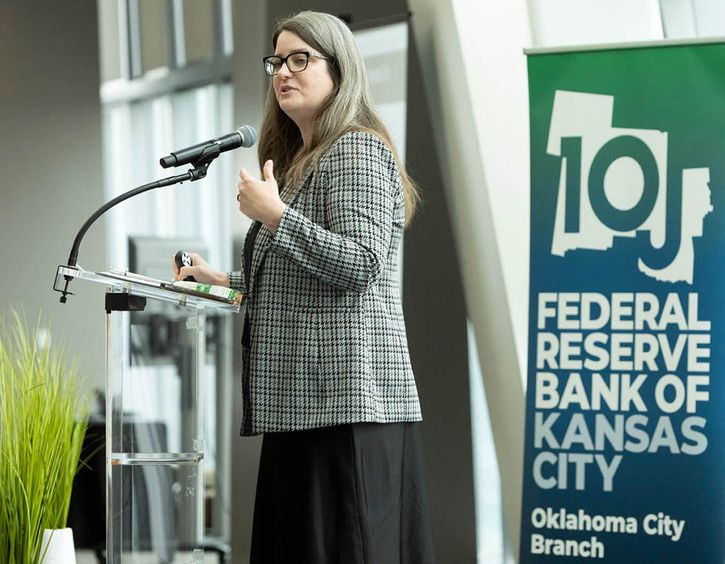
Q: How would you describe the overall mission of the Oklahoma City Branch and its staff?
At the Federal Reserve Bank of Kansas City, we are united under a shared mission of serving the public to promote economic and financial stability through leadership and performance excellence. We serve a large District that covers seven states, including Oklahoma. The Federal Reserve cannot serve the public effectively unless we understand the public. Also, it is in the public’s interest to understand their economy and their Central Bank. Staff at the Oklahoma City Branch carry out the mission of our Bank for the people of Oklahoma by developing connections, researching economic developments, and supervising banks in the state.
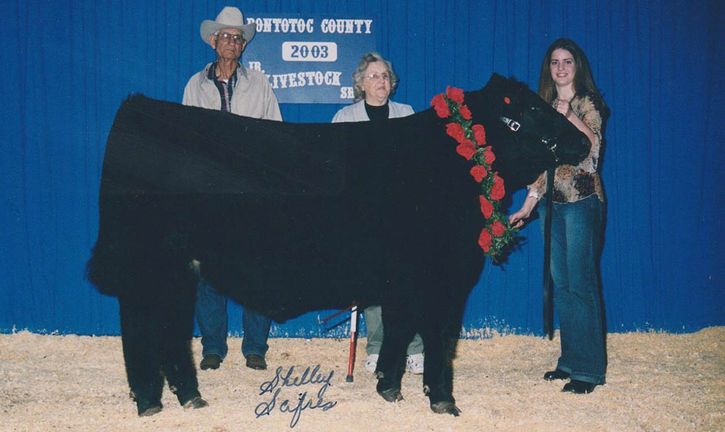
Sixteen-year-old Cortney Cowley and her grandparents, Chester and Erra Timmons, with Cowley’s show steer, “Gus,” at a livestock show in Pontotoc County, Oklahoma. Photo courtesy of Cortney Cowley
Q: What impact have your roots in Ada, Oklahoma—including agricultural experiences as an FFA student—had on your career journey?
My roots and my experiences growing up in Ada had everything to do with my career journey. My grandfather was a cattle rancher, and my family was always connected to agriculture in some way. My first job was hauling hay with my dad. I loved being on the farm with my grandparents and always knew that I wanted a career that kept me connected to agriculture. My involvement in FFA only reinforced this desire and gave me the tools to be more prepared. I served as a chapter and then state officer in Oklahoma, and my supervised agricultural experience program was Agriscience. These experiences helped me develop leadership and research skills that I still use today.
Q: Based on your research experience and your time in Oklahoma, how would you describe some of the most important and unique aspects of the state’s economy?
Oklahoma is the world’s largest small town. By some measures, such as the share of the state’s population that lives in rural areas, we are one of the largest rural states in the country. To understand the economy in Oklahoma, you have to understand the rural economy, which includes oil and gas, agriculture, community banking and small businesses as economic drivers.
Also, the state’s economy is as diverse as its people and its landscape. In fact, did you know that Oklahoma has more ecoregions per mile than any other state in the United States? I learned that in a soil science course during my undergraduate education at Oklahoma State University. Oklahoma's ecological diversity is related to its varied climate, terrain, geology, soil, and land use. In Oklahoma, you can be on sand dunes, salt plains, forests, and mountains all in the same day. Our landscape makes us unique and is one reason why tourism is an important component of our state’s economy.
Q: What are some of your thoughts on engagement with communities, businesses and experts across Oklahoma?
Engagement across Oklahoma is a core component of how we carry out our mission at the Branch. Outreach and engagement help us take in forward-looking information and identify trends. Data is very important for our policy deliberations, but it often comes with a lag. It is often the anecdotal information from contacts that helps us see what is coming. Engagement also is an important way that we share our research and insights on the economy, so the flow of information is two ways.
Q: What do you see as perhaps the least-understood aspects of the economy as a whole?
From my perspective, one of the least-understood aspects of the economy is food prices, which are often linked closely with agricultural commodity prices. My colleagues and I have done a lot of work to understand food prices, and prices rose so rapidly in the aftermath of the pandemic. We have found that, in recent decades, commodity prices actually have limited influence on food prices, which tend to be driven more by costs along the supply chain, such as labor and rent.
Q: How do you see the Fed’s economic education programs having an impact?
Economic education is very important for promoting financial literacy and empowering students to take part in the economy. Students who understand how the economy works have the potential to make better financial decisions. Economic education also helps us teach students the tools that are available to help them be financially stable and independent. To facilitate this work at the Oklahoma City Branch, we host a Student Board of Directors and partner with organizations around the state that have economic education and financial literacy programing. We also provide free economic and personal finance resources for educators, bankers and consumers.
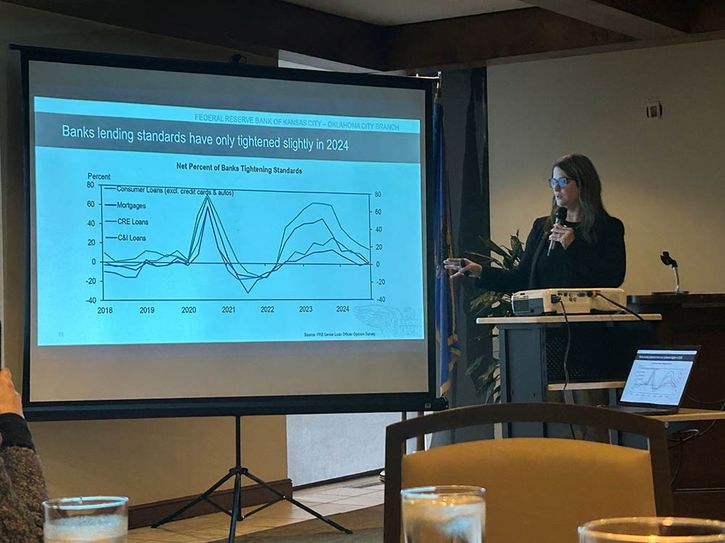
Earlier this year, Cortney Cowley provided an economic update in Tulsa for the Oklahoma chapter of the Risk Management Association.
What is a potential risk to the economy that you are watching?
I tend to think of the economy in three categories: the macro economy, the Oklahoma economy and the agricultural economy. One development I am watching in the macro economy is the shifting trade environment. In the Oklahoma economy, I am watching oil prices. In agriculture, low crop prices are weighing on the current economy, but I am also thinking about the longer-term implications of historically low cattle inventories.
What are some of your hobbies and interests?
My greatest joy is my family. My husband, Jeremy, and I have 8-year-old twins. My son loves sports, and my daughter enjoys dance, cheer and Paralympic track and field. We also live on a small acreage northwest of Oklahoma City where we raise miniature Hereford cattle and have two horses and one rambunctious Aussie Doodle. When I have free time outside of work, I enjoy hobby farming and my kids’ activities. I also enjoy reading, writing stories for children and volunteering for our church, school and FFA programs across the state.
With sports being such a big part of life in Oklahoma, do you have any particular team allegiances?
Absolutely! As a two-time graduate of Oklahoma State University, I am loyal and true to America’s brightest orange. Go Pokes!
The views expressed are those of the authors and do not necessarily reflect the positions of the Federal Reserve Bank of Kansas City or the Federal Reserve System.