
Long before economic trends appear in reports or policy discussions, they show up in everyday decisions: how families spend, save, and plan for the future.
Helping people understand those choices is the work that earned Gigi Wolf Neil, director of education at the Federal Reserve Bank of Kansas City, national recognition from the National Association of Economic Educators (NAEE). Neil received the silver award – which recognizes outstanding contributions to economic and financial education through exemplary curriculum development – from NAEE for her lesson plan, “External LinkConfidence in Community: The Growth of Black Banks and Businesses,” which highlights the historical and economic impact of Black-owned financial institutions and businesses.
“Receiving this recognition from NAEE is truly meaningful for me, both personally and professionally,” Neil said. “Since it was awarded after an in-depth review by my peers in economic education from across the country, I feel honored and validated in my work.”
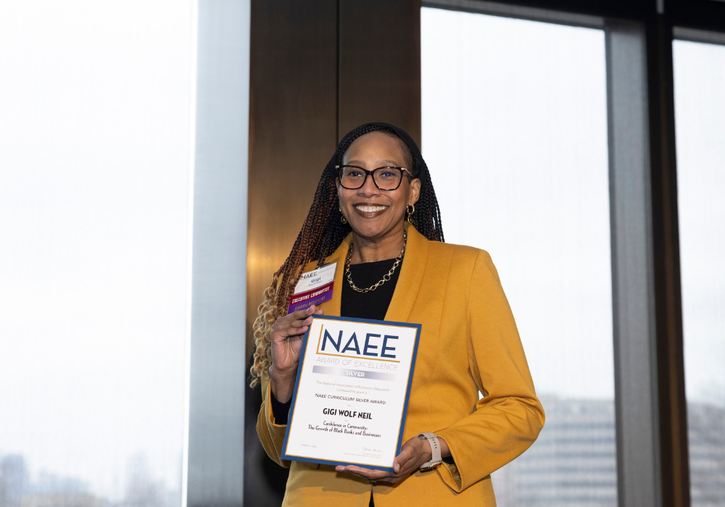
Gigi poses with her award. Photo by Gary Barber.
Economic education supports an important part of the mission of the Federal Reserve System by helping individuals better understand how economic forces shape financial opportunities and decision making.
Neil said her work developing educational resources in personal finance and economics helps teachers and students better understand the economy, the role of the Federal Reserve, and how financial choices can affect individuals and communities.
“By helping current and future consumers better understand the workings of our economy and the Fed’s responsibilities, as well as providing tools on managing their finances, I believe we as economic educators foster more informed and resilient communities,” she said.
Partnerships with organizations such as NAEE help extend the reach and impact of that work. Through collaboration with economic educators across the country, the Federal Reserve helps ensure educators have access to high-quality materials that make economic concepts accessible and relevant in the classroom.
Neil hopes the lessons she develops help students and educators see the connection between economic ideas and everyday decisions.
“I hope that through my work, students and educators gain a clearer understanding of economic concepts that impact their daily lives,” she said. “Economics and personal finance are all about choices – whether we’re deciding what to buy, where to spend, or when to save. Each decision influences our own financial situation and also the broader economy.”
When those decisions are repeated across households and businesses, they collectively shape economic conditions on a larger scale.
For Neil, the drive to continue the work comes from the impact economic education can have on our daily lives and decision making.
“What keeps me motivated is the opportunity to serve our community in ways that have a lasting effect — far beyond a single lesson or program,” she explained. “The resources we provide contribute to the well-being of individuals and our communities overall.”
Looking ahead, Neil said she hopes to continue developing economic education programs and curriculum while exploring new ways to reach educators and students the Bank serves.
“With each lesson, workshop, and interaction, I feel like I am building a legacy for both myself and the Bank — one that extends throughout our district and beyond.”
The views expressed are those of the authors and do not necessarily reflect the positions of the Federal Reserve Bank of Kansas City or the Federal Reserve System.