
In the fourth quarter, interest rates decreased for all small business lending,_ consistent with the declining rate environment. Outstanding loan balances increased when compared to the same period in 2024 and the previous quarter. New small business loans also increased quarter-over-quarter, but declined year-over-year.
With over $71 billion in small business loans reported, the 143 survey respondents indicated that credit standards tightened and credit quality declined, continuing a long-term trend. Interest rate floor spreads continued to tighten, coming closer to parity. Loan demand decreased slightly, while application approval rates for midsized banks_ increased by 10% year-over-year. Over the next 12 months, respondents, on net, indicated the most likely factors to have an impact on loan demand are interest rates and cost of labor.
Chart 1: Outstanding Small Business (SB) Loans Increase
Skip to data visualization tableNote: Items are calculated using a subset of 104 respondents that completed the FR 2028D for the last five quarters surveyed. As of 2024:Q4, the instructions were updated for Call Report, Schedule RC-C Part I, item 4. Commercial and Industrial Loans.
Sources: Call Report, Schedule RC-C Part I, items 4. Commercial and Industrial Loans and 12. Total Loans and Leases Held for Investment and Held for Sale, and FR 2028D, items 5.b and 6.c.
| Quarter-Over-Quarter | Total Loans | C&I Loans | SB Loans |
|---|---|---|---|
| 2025:Q1 | -0.2 | -1.3 | 0.3 |
| 2025:Q2 | 0.8 | -4.9 | 0.3 |
| 2025:Q3 | 1.3 | -1.0 | -0.01 |
| 2025:Q4 | 2.2 | 1.1 | 0.3 |
| Year-Over-Year 2025:Q4 | 4.1 | -6.0 | 1.0 |
When compared to the fourth quarter of 2024, outstanding small business loans increased by 1% and total loans increased by 4.1%. The year-over-year increase in small business loans was driven by increases at small and midsized banks, while large banks reported a slight decrease. Quarter-over-quarter, small business loans increased 0.3% and total loans increased by 2.2%. The year-over-year and quarter-over-quarter increases in small business loans were driven by increases in variable rate loans, while fixed rate loans decreased.
Chart 2: New Small Business Loans Decrease Year-Over-Year
Skip to data visualization tableNote: Items are calculated using a subset of 104 respondents that completed the FR 2028D for the last five quarters surveyed. All loan types referenced in Chart 2 refer to small business lending.
Source: FR 2028D, items 7.b and 8.c.
| Quarter-Over-Quarter | Total New SB Loans | New SB Term Loans | New SB Credit Lines |
|---|---|---|---|
| 2025:Q1 | -9.6 | -2.4 | -20.9 |
| 2025:Q2 | 2.0 | -1.8 | 9.3 |
| 2025:Q3 | 2.4 | -0.9 | 8.2 |
| 2025:Q4 | 2.0 | 2.2 | 1.8 |
| Year-Over-Year 2025:Q4 | -3.7 | -3.0 | -4.7 |
When compared to the fourth quarter 2024, total new loan balances decreased by 3.7%, with a 3% decrease in new term loans and a 4.7% decrease in new credit lines. The decrease in total new loan balances was reported by all bank sizes, primarily driven by declines in the first quarter of 2025. Quarter-over-quarter, total new loan balances increased by 2%, with a 2.2% increase in new term loans and a 1.8% increase in new credit lines.
Chart 3: Median Credit Line Usage Declines Slightly
Skip to data visualization tableNote: Usage refers to the proportion of the outstanding balance relative to the total committed amount (i.e. credit used vs credit available).
Source: FR 2028D, items 6.b and 6.c.
| Quarter | Fixed | Variable | Total |
|---|---|---|---|
| 2021:Q1 | 44.09 | 33.74 | 35.38 |
| 2021:Q2 | 49.63 | 32.00 | 35.67 |
| 2021:Q3 | 47.83 | 36.33 | 37.55 |
| 2021:Q4 | 46.48 | 35.68 | 36.76 |
| 2022:Q1 | 47.91 | 35.62 | 36.22 |
| 2022:Q2 | 47.92 | 36.83 | 37.56 |
| 2022:Q3 | 50.07 | 36.67 | 37.90 |
| 2022:Q4 | 49.57 | 35.15 | 36.29 |
| 2023:Q1 | 50.88 | 34.44 | 36.43 |
| 2023:Q2 | 51.06 | 34.55 | 38.00 |
| 2023:Q3 | 48.28 | 34.83 | 38.17 |
| 2023:Q4 | 50.13 | 36.54 | 37.79 |
| 2024:Q1 | 51.65 | 36.47 | 38.28 |
| 2024:Q2 | 52.06 | 38.05 | 39.63 |
| 2024:Q3 | 52.05 | 38.15 | 39.62 |
| 2024:Q4 | 48.08 | 37.28 | 40.60 |
| 2025:Q1 | 50.25 | 38.81 | 41.88 |
| 2025:Q2 | 53.49 | 38.32 | 40.95 |
| 2025:Q3 | 53.41 | 37.45 | 41.35 |
| 2025:Q4 | 50.86 | 38.56 | 40.14 |
Quarter-over-quarter, median credit line usage decreased slightly from 41.4% to 40.1%. Median usage of fixed rate lines of credit declined to 50.9%, while usage of variable rate lines of credit increased to 38.6%.
Variable rate lines continue to constitute a larger portion of credit lines issued by banks, with respondents indicating they made up about 91% of total credit line usage.
Chart 4: Median Interest Rates Decrease for New Term Loans
Skip to data visualization tableNote: Items are calculated using a subset of 104 respondents that completed the FR 2028D for the last five quarters surveyed. Urban banks make up about 90% of the subset of respondents.
Source: FR 2028D, item 7.c.
| Quarter | Rural Fixed New Term Loans | Rural Variable New Term Loans | Urban Fixed New Term Loans | Urban Variable New Term Loans |
|---|---|---|---|---|
| 2024:Q4 | 7.62 | 7.5 | 7.36 | 7.91 |
| 2025:Q1 | 7.84 | 7.90 | 7.45 | 7.85 |
| 2025:Q2 | 7.64 | 7.50 | 7.21 | 7.8 |
| 2025:Q3 | 7.43 | 7.42 | 7.08 | 7.83 |
| 2025:Q4 | 7.14 | 7.19 | 6.75 | 7 |
Quarter-over-quarter, median interest rates on new term loans decreased across all loan categories. Variable rates offered at rural banks were the highest at 7.2%, while fixed rates offered at urban banks remained the lowest at 6.8%. The largest decrease quarter-over-quarter and year-over-year were for variable rates offered at urban banks, declining by 83 and 91-basis points, respectively._ The reported rate decreases outpaced the decline in the 5-year U.S. Treasury Yield over the same period._
Chart 5: Median Interest Rates on New Lines of Credit (LOC) Decrease
Skip to data visualization tableNote: Items are calculated using a subset of 104 respondents that completed the FR 2028D for the last five quarters surveyed. Urban banks make up about 90% of the subset of respondents.
Source: FR 2028D, item 8.d.
| Quarter | Rural Fixed New LOC | Rural Variable New LOC | Urban Fixed New LOC | Urban Variable New LOC |
|---|---|---|---|---|
| 2024:Q4 | 7.05 | 7.61 | 7.29 | 8 |
| 2025:Q1 | 8.00 | 8.35 | 7.17 | 8 |
| 2025:Q2 | 7.16 | 7.76 | 7.14 | 8.07 |
| 2025:Q3 | 7.38 | 7.63 | 6.97 | 7.91 |
| 2025:Q4 | 7.36 | 7.50 | 6.65 | 7.09 |
Median interest rates on new lines of credit decreased across all loan categories in the fourth quarter 2025, in alignment with the declining rate environment. The largest decreases were at urban banks, with a 32-basis point decrease in fixed rates and an 81-basis point decrease in variable rates. Year-over-year, the largest decrease was for variable rates offered at urban banks at 91-basis points.
Chart 6: Interest Rate Floor Spreads Decrease
Skip to data visualization tableNote: Spread refers to the distance between the weighted average nominal interest rate and the weighted average interest rate floor. As of 2025:Q3, there was a methodology change impacting the calculation of median spread for term loans and lines of credit.
Sources: FR 2028D, items 5.c, 5.h, 6.d, 6.g
| Quarter | Median Term Loan Spread | Median LOC Spread |
|---|---|---|
| 2024:Q4 | 248.8 | 302.45 |
| 2025:Q1 | 243.10 | 306.6 |
| 2025:Q2 | 249.55 | 304.65 |
| 2025:Q3 | 256.25 | 292.45 |
| 2025:Q4 | 232.15 | 235 |
Median interest rate floor spreads decreased quarter-over-quarter, with a 57-basis point decrease in line of credit spreads and a 24-basis point decrease in term loan spreads. Year-over-year, median line of credit spreads decreased 67-basis points while median term loan spreads decreased 17-basis points. As interest rate floor spreads continue to tighten, banks may experience an increase in refinancing activity from borrowers seeking more competitive terms.
Chart 7: All Bank Sizes Report Continued Increases in Credit Line Usage
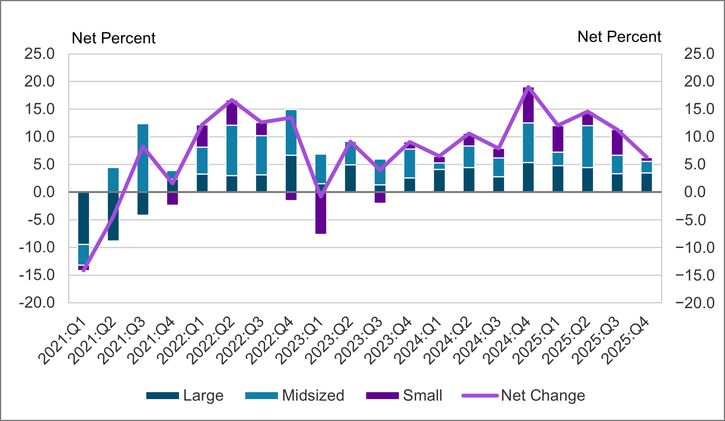
Note: Chart 7 shows diffusion indexes for credit line usage. The diffusion indexes show the difference between the percentage of banks reporting decreased credit line usage and those reporting increased credit line usage. Net percent refers to the percent of banks that reported having increased usage (“increased somewhat” or “increased substantially”) minus the percent of banks that reported having decreased usage (“decreased somewhat” or “decreased substantially”).
Source: FR 2028D, items 9 and 10.
In the fourth quarter of 2025, 16% of respondents reported a change in credit line usage. About 6% of respondents, on net, indicated that credit line usage increased, down from 11% last quarter.
On net, all bank sizes reported an increase in credit line usage for the ninth straight quarter. All banks that reported an increase cited changes in borrower’s business revenue or other business specific conditions as a somewhat or very important reason.
Chart 8: Respondents Report Slight Decline in Loan Demand
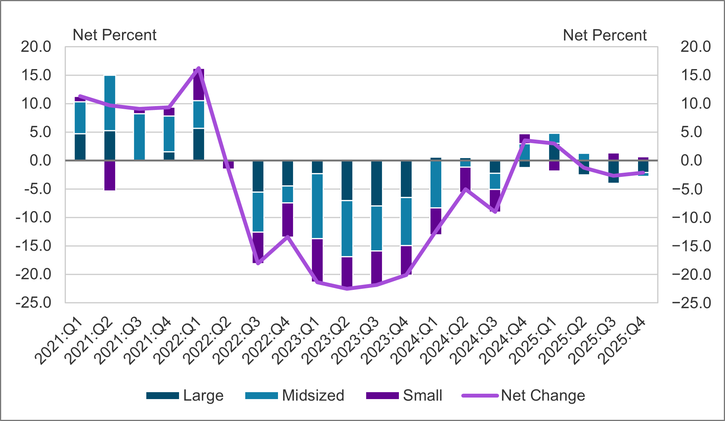
Note: Chart 8 shows diffusion indexes for loan demand. The diffusion indexes show the difference between the percentage of banks reporting weakened loan demand and those reporting stronger loan demand. Net percent refers to the percent of banks that reported having stronger loan demand (“moderately stronger” or “substantially stronger”) minus the percent of banks that reported having weakened loan demand (“moderately weaker” or “substantially weaker”).
Source: FR 2028D, item 11.
About 29% of respondents reported a change in small business loan demand in the fourth quarter of 2025. On net, about 2% of respondents indicated weaker loan demand, driven by large banks. This is the third consecutive negative net response after reported growth in the fourth quarter of 2024 and the first quarter of 2025.
The marginally weaker loan demand is consistent with the External LinkJanuary 2026 Federal Reserve Senior Loan Officer Opinion Survey (SLOOS) where C&I loan demand was reported to have remained basically unchanged for small firms (annual sales of less than $50 million).
Chart 9: Overall Credit Quality Continues to Decline
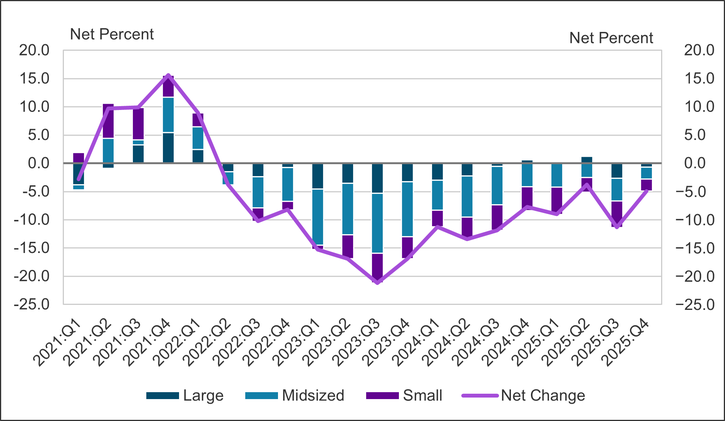
Note: Chart 9 shows diffusion indexes for credit quality of applicants. The diffusion indexes show the difference between the percentage of banks reporting a decline in credit quality and those reporting improvement in credit quality. Net percent refers to the percent of banks that reported improving credit quality (“improved somewhat” or “improved substantially”) minus the percent of banks that reported declining credit quality (“declined somewhat” or “declined substantially”).
Source: FR 2028D, items 18 and 19.
About 5% of survey respondents, on net, reported a decrease in applicant credit quality. This is the 15th consecutive quarter in which a net decrease was reported.
Of the respondents reporting a change in credit quality, whether an increase or decrease, 53% cited the debt-to-income level of business owners as a very important reason. Other commonly cited reasons include personal wealth of business owners and liquidity position of business owners.
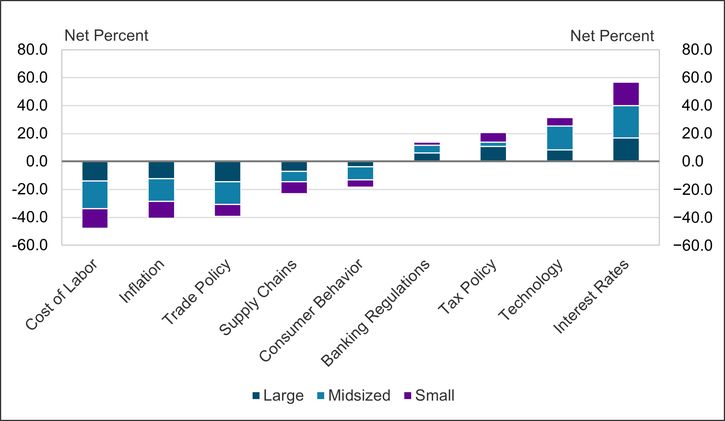
Chart 10: Cost of Labor and Interest Rates Expected to Impact Small Business Loan Demand
Source: FR 2028D, Special Question.
When asked to rate the impact several factors could have on small business lending over the next 12 months, respondents, on net, indicated that interest rates were the most likely factor to have a positive impact, while cost of labor was the most likely factor to have a negative impact. Trade policy was the factor with the largest change in sentiment quarter-over-quarter, with 39% of respondents, on net, believing it will have a negative impact, compared to 60% last quarter.
Chart 11: Loan Approval Rates Increase for Midsized Banks Year-Over-Year
Skip to data visualization tableSource: FR 2028D, items 12.a and 13.
| Quarter | Small | Midsized | Large |
|---|---|---|---|
| 2021:Q1 | 90 | 88 | 51 |
| 2021:Q2 | 94 | 90 | 47 |
| 2021:Q3 | 71 | 85 | 50 |
| 2021:Q4 | 81 | 87 | 51 |
| 2022:Q1 | 83 | 77 | 51 |
| 2022:Q2 | 83 | 80 | 52 |
| 2022:Q3 | 87 | 87 | 48 |
| 2022:Q4 | 86 | 69 | 48 |
| 2023:Q1 | 87 | 68 | 50 |
| 2023:Q2 | 84 | 67 | 48 |
| 2023:Q3 | 88 | 68 | 52 |
| 2023:Q4 | 89 | 66 | 49 |
| 2024:Q1 | 93 | 73 | 49 |
| 2024:Q2 | 85 | 71 | 46 |
| 2024:Q3 | 92 | 70 | 45 |
| 2024:Q4 | 90 | 69 | 44 |
| 2025:Q1 | 87 | 76 | 45 |
| 2025:Q2 | 86 | 76 | 45 |
| 2025:Q3 | 88 | 82 | 41 |
| 2025:Q4 | 89 | 79 | 40 |
Compared to the fourth quarter of 2024, application approval rates increased by 10% for midsized banks, while approval rates declined by 4% for large banks and 1% for small banks. Quarter-over-quarter, application approval rates decreased for both midsized and large banks, while small banks had a slight increase.
About 72% of respondents indicated borrower financials as the most common reason for denying a loan. Other commonly cited reasons were credit history and collateral.
Chart 12: Respondents Continue to Tighten Credit Standards
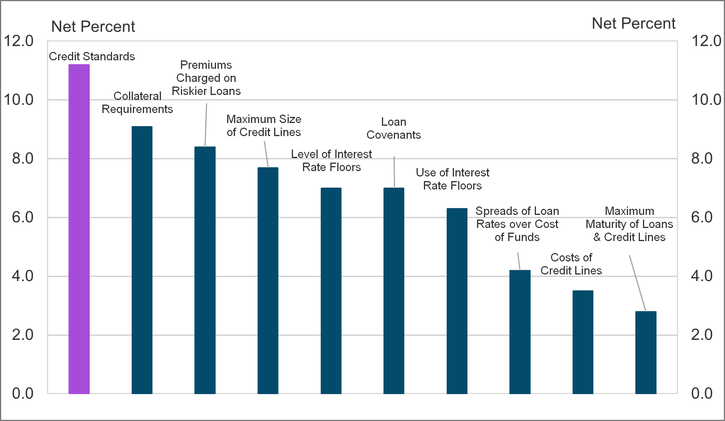
Note: Chart 12 shows diffusion indexes for credit standards (purple bar) and various loan terms. The diffusion indexes show the difference between the percentage of banks reporting tightening terms and those reporting easing terms. Net percent refers to the percent of banks that reported having tightened terms (“tightened somewhat” or “tightened considerably”) minus the percent of banks that reported having eased terms (“eased somewhat” or “eased considerably”).
Source: FR 2028D, items 14, 15, 16 and 17.
About 11% of respondents, on net, reported tightening credit standards (purple bar) in the fourth quarter of 2025. This continues the long-term trend of tightening credit standards throughout the past four years and is consistent with the tightening credit standards reported in the External LinkJanuary 2026 Federal Reserve Senior Loan Officer Opinion Survey (SLOOS).
On net, respondents indicated that all loan terms tightened. About 75% of respondents cited less favorable or more uncertain economic outlook as a somewhat important or very important reason for tightening. Another frequently cited factor was the worsening of industry-specific problems.
Other contributors to the release include Alli Baranski, Lauren Bennett, Sophie Burge, Maurice Freese, and Stefan Jacewitz.
Endnotes
-
1 Small business lending refers to commercial and industrial lending to organizations generally defined as having less than $5 million in gross annual revenue, unless otherwise noted.
-
2 Small banks have total assets of $1 billion or less, midsized banks have total assets between $1 billion and $10 billion and large banks have total assets greater than $10 billion.
-
3 Urban and rural classification is determined exclusively by the bank’s head office location and External LinkUS Census Population data.
-
4 Source: FRED, Market Yield on U.S. Treasury Securities at 5-Year Constant Maturity, Quoted on an Investment Basis
The views expressed are those of the authors and do not necessarily reflect the positions of the Federal Reserve Bank of Kansas City or the Federal Reserve System.
Authors

Daniel Harbour
Assistant Vice President