Introduction
Thank you for joining me today. It is an honor to be in the beautiful state of New Mexico, and in Albuquerque, one of the largest cities in the seven-state region that makes up the Federal Reserve’s Tenth District.
The Federal Reserve’s regional structure, with 12 independent and locally rooted district banks spread across the country, is one of the most defining features of the nation’s central bank. These regional banks, including the Kansas City Fed, work alongside the Board of Governors, located in Washington, D.C., to set monetary policy and influence interest rates across the entire economy. This system of regional input in setting monetary policy, which is unique to the United States, ensures that a wide variety of voices and views, including yours, inform some of the most important economic decisions in our country.
From Kansas City and our offices in Denver, Omaha, and Oklahoma City, the Bank engages with local communities, listening and collecting insights and data that shape policy. I personally find speaking to individuals about their economic lives to be one of the most enriching parts of my job, and I take every opportunity I can to travel throughout the district.
Speaking of travel, I would like to bring your attention to a new Kansas City Fed publication. Just yesterday we released “The Byways Report: The Scenic Route to Rural Prosperity.”_ I encourage you to look it up on our website, KansasCityFed.org. This extensive report looks at the importance of byways tourism to our region’s economy. Our hope is that the report also offers useful insights so that local development officials might learn from the success of others. Tourism is an important industry in many of the rural regions in the Tenth District, and byways are important conduits for that industry. This report is just one example of how the Fed invests in understanding the regional economy, while also contributing to the region’s economic success.
The timing of the report coincides with the 100th anniversary of Route 66, one of the most recognized byways in the world and an important link tying together four of the seven states in our District. Locally, at 18 miles, Central Avenue in Albuquerque is the longest continuous stretch of Route 66 in any urban area along the entire 2,500-mile length of the highway. To many, Route 66 is the epitome of Americana, with its wide-open spaces interrupted only by unique and distinctive local communities, each exceptional in its own way. This is the story of America, a set of distinct regions and economies, linked together to form a more powerful whole. The fundamental importance of regionalism to the nation’s development and ultimate strength continues today in the structure of the Federal Reserve. We are your bank, and we work every day to make sure you have a voice in the nation’s economic policy.
I will now turn to what I am hearing and seeing in the economy. But I very much look forward to hearing about what you are seeing during Q&A time following my remarks.

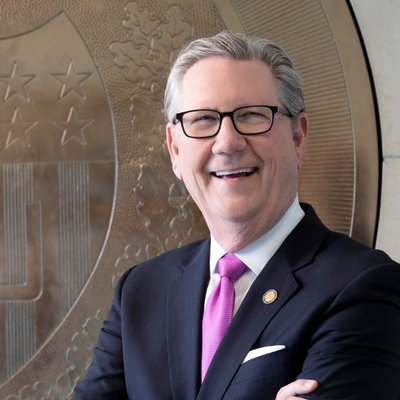
Kansas City Fed President and CEO Jeff Schmid outlined his perspectives on monetary policy and the Federal Reserve's balance sheet during remarks delivered this morning to the Economic Forum of Albuquerque in Albuquerque, N.M.
Economic Outlook
The economy enters 2026 with considerable momentum. Gross Domestic Product (GDP) expanded by 4.4% in the third quarter of 2025, and data for the end of the year show continued strength. Consumer spending and AI-related investments underpin much of this growth. Based on what I’m hearing from contacts, I am hopeful that the economy will outperform again this year. What are the implications of this strong growth outlook for inflation and monetary policy?
When it comes to the outlook for inflation, not all growth is created equal. Growth led by increased supply, perhaps on account of advances in productivity, can boost output and lower inflation. That’s a winning combination. In contrast, demand-led growth can increase output but often at the cost of higher inflation. Simply put, supply-driven growth is disinflationary. Demand-driven growth is not. With inflation running above the Fed’s target for nearly five years now, the distinction matters when thinking about the correct course for monetary policy. In setting monetary policy, one of the most important questions we face is whether growth is being led by a jump in the capacity of the economy to supply goods and services or by a burst of demand for those same goods and services.
In approaching this question, I will first look at supply developments before turning to demand. Recent productivity trends suggest that the strong growth we are seeing is at least partly supply driven. Despite above-average economic growth in 2025, the pace of hiring was depressed. In other words, firms were ramping up output but not payrolls. By doing more with less, businesses have found ways to boost productivity. In fact, output per hour, a measure of labor productivity, grew faster in the third quarter of 2025 than in any quarter from 2010 to 2019.
A natural question is whether this increase in productivity reflects early returns on AI. Nearly every business I speak with is eager to experiment and learn how to leverage this new technology. However, the link between AI and recent increases in productivity is not clear. While productivity growth has been stronger in industries more intensively using AI, analysis by my staff finds that this relationship is fairly weak._ Instead, it appears that other factors may be playing a bigger role in boosting productivity.
One contributor to the recent rise in productivity is a falloff in labor market churn. As we emerged from the pandemic, historically high employee turnover reduced productivity. Firms spent resources recruiting and training workers, only to lose them a short while later. More recently, my contacts broadly agree that we are now in a low-hire/low-fire/low-quit labor market. One positive from this lack of churn is higher productivity, as employees gain skills and become more efficient with experience. While these recent productivity gains are encouraging, it is not clear if productivity will continue to grow at this pace or if the recent pickup reflects one-time gains from lower turnover.
Demand has also played an important role in driving the recent step up in growth. Business investment has been strong in recent quarters, owing in large part to the AI buildout. While these investments could eventually lead to sustained productivity gains, the current phase of the AI buildout is boosting demand for equipment and materials.
Consumer demand has also been solid. Wealth gains have likely contributed to the resilience of consumer spending. Overall household net worth relative to income remains near its all-time high. Increases in wealth lead households to spend more of their income and save less, consistent with the decline in the personal savings rate over the past year. However, these wealth effects have also likely contributed to the unevenness of spending across households. Business contacts broadly report that many low- and middle-income households are straining to keep pace with inflation and that the strength of demand is disproportionately being driven by high-income households.
Notwithstanding this unevenness, the outlook for overall demand is strong. Changes in tax policy will likely boost disposable income for many households, which should further support, and perhaps even broaden, consumer spending. Fiscal tailwinds—together with the strength of overall household balance sheets and the ongoing AI-buildout—are likely to lead to continued strong demand growth.
Returning to my earlier question: Is growth being led by supply or demand? With so many competing but intertwined developments, it can be hard to tell. But we do have one reliable indicator that can cut through all the confusion and provide a quick answer. That is inflation. Overall, with inflation still running hot, it appears that demand is outpacing supply across much of the economy. I remain open to the possibility, and I’m even optimistic, that AI and other innovations will eventually lead to a non-inflationary, supply-driven growth cycle. However, based on the current rate of inflation, we are not there yet.
Monetary Policy
The job of monetary policy is to keep inflation near 2% and the labor market at full employment. With demand outpacing supply and inflation running closer to 3% than 2%, I see it as appropriate to maintain a somewhat restrictive policy stance. Restrictive monetary policy can help slow demand growth, giving supply time to catch up and alleviate inflationary pressures.
With the cumulative rate cuts carried out since 2024, the federal funds rate is now well off its post-pandemic high and arguably no longer restraining activity all that much, if at all. As I’ve said before, I think it is best to judge whether interest rates are restrictive or accommodative based on how the economy performs. With growth showing momentum and inflation still hot, I’m not seeing many indications of economic restraint.
I therefore supported the Federal Open Market Committee’s decision to hold rates steady in January. In my view, further rate cuts risk allowing high inflation to persist even longer. During the pandemic there was much talk about transitory inflation or one-time shocks to prices, language that has reemerged as economists debate the effect of higher tariffs on U.S. prices. It seems to me that price pressures do not arise as either intrinsically persistent or transitory. Rather it is the actions of monetary policy that determine whether a price shock is transitory or not. Though it was before my time on the FOMC, I see this as a major takeaway of the pandemic inflation. A price shock is ultimately transitory on account of the Fed’s actions, and not some internal dynamic independent of the central bank. We must remain focused on our headline inflation objective, otherwise I believe there is a real risk that inflation will get stuck closer to 3% than 2% in the long run.
The Fed’s Balance Sheet
While most discussions of monetary policy center on interest rates, the Federal Reserve’s balance sheet is another important and increasingly discussed aspect of policy. The Fed’s balance sheet matches the Fed’s assets—primarily Treasuries and mortgage-backed securities (or MBS)—with the Fed’s liabilities—primarily the dollar bills in your pocket and bank reserves, which are the deposits of commercial banks at the Fed. Prior to the pandemic, the balance sheet stood at about $4.2 trillion and then more than doubled to about $9 trillion by 2022 as the FOMC responded to financial market dysfunction and the pandemic recession with large purchases of Treasuries and MBS. From June 2022 up until December of last year, the FOMC was shrinking the Fed’s balance sheet, which today stands at $6.5 trillion.
In December, the FOMC once again began growing its balance sheet. However, I want to quickly dispel any notion that the resumption of balance sheet growth is a form of policy easing or that the FOMC has finished the process of lessening its impact on financial markets. The bottom line is that although balance sheet growth has resumed, the FOMC continues to wind down its mortgage portfolio and is reducing the maturity of its Treasury holdings. As I will discuss, this ongoing work is critical in my view to ensure that the Federal Reserve reduces its footprint in financial markets.
As I said, up until December the Fed was decreasing its balance sheet and running off its holdings of Treasuries and MBS. Why not shrink back to the pre-pandemic size? The minimum size of the Fed’s balance sheet is determined by demand for the Fed’s liabilities. Currency and bank reserves are the two largest liabilities on the Fed’s balance sheet. Demand for U.S. currency has grown significantly since 2019, and that alone requires a larger balance sheet. Much of this growth is organic, meaning as the economy grows more money is needed to meet the liquidity needs of households and businesses.
Demand for reserves has also grown over time. Like currency, a larger economy necessitates more reserves in order to settle and clear payments between banks. That said, if you look at reserves as a share of bank assets, it appears that there has been an increase in reserve demand beyond what growth in the financial system alone would predict. Said differently, reserves are taking up much more space on bank balance sheets today than they did just prior to the pandemic.
With so many reserves, it might come as a surprise then to hear that the decision to resume growing the balance sheet was based on meeting the liquidity needs of financial institutions. Late last year there were emerging signs of reserve shortages. Banks were paying a premium for overnight liquidity, putting upward pressure on interest rates. By growing the balance sheet, the FOMC can add reserves to the banking system and maintain firm rate control as well as support the flow of liquidity through the financial system.
While I supported the decision to begin growing the balance sheet and increasing bank reserves, I want to make two important points regarding that decision. First, while reserve demand is surprisingly high now, I think there are opportunities to reduce reserve demand over time, especially as the regulatory environment and payments technologies continue to evolve. Guiding towards a lower level of reserves is not only feasible in my opinion, but something that should be pursued to allow for a smaller balance sheet. Second, though we are again growing the balance sheet for liquidity purposes, we are continuing to reduce our footprint in other ways. We continue to wind down our mortgage portfolio, and we have started to reduce the maturity of our Treasury holdings.
In my view, winding down our mortgage holdings is critical to ensuring that the Fed minimizes its footprint in financial markets. As it stands today, the Fed’s footprint in mortgage markets is too large. Since 2022, the FOMC has reduced its MBS portfolio by about $700 billion, from about $2.7 trillion to $2 trillion. While that is good progress, the Committee remains far from its longer-run objective of a primarily-Treasury portfolio. The Fed’s MBS portfolio still accounts for roughly 20 percent of the agency MBS market.
Many have suggested that by purchasing mortgage securities, the Fed has picked winners and losers in the economy by allocating credit to particular sectors. I am sympathetic to that position. The circumstances that led to MBS purchases—first in 2008 and then again in 2020—have long passed. Mortgage markets are liquid and functioning. Therefore, even as we are growing the overall balance sheet, it is important that we continue to reduce our mortgage holdings.
A second aspect of our footprint that requires attention is the duration of our Treasury portfolio. The average maturity of our Treasury holdings today is well above the average maturity of Treasuries outstanding. The Fed’s long-duration balance sheet distorts the price of duration and flattens the yield curve. This was by design during prior rounds of quantitative easing aimed at driving down longer-term interest rates. However, it is my view that in normal times the Fed’s balance sheet should not influence the shape of the yield curve. The balance sheet growth initiated in December is reducing this distortion by concentrating new purchases in Treasury bills. In shortening the average maturity of our holdings, the FOMC is continuing to reduce the influence of the Federal Reserve’s balance sheet on longer-term interest rates.
Fed Independence
In closing, let me explain why I think reducing the footprint of our balance sheet matters within the context of Fed independence. By independence, I mean the ability to set interest rates in pursuit of our dual-mandate objectives without political considerations. History has shown that a central bank focusing solely on its mandates delivers better economic outcomes.
Outside of an economic emergency, this independence has historically resulted in the Fed setting short-term interest rates and the U.S. Treasury determining the maturity structure of government debt. As I have said before, if the Fed maintains a large, long-duration balance sheet—one comprised partly of mortgage securities—we risk intertwining the roles of the Fed and Treasury. This can blur the lines between monetary and fiscal policy and threaten the Fed’s independence. The more the lines between monetary and fiscal policy become blurred, the greater risk that the Fed’s balance sheet is no longer viewed as solely a tool of monetary policy.
Maintaining the independence of monetary policy is essential for the economy’s long-term success. Sound monetary policy supports economic and financial stability, sustained economic growth, and rising living standards. The United States has the greatest economy in the world. Sustainably achieving our dual-mandate objectives is the best thing the Fed can do to ensure the continued prosperity of our nation.
Endnotes
-
1 See: “The Byways Report: The Scenic Route to Rural Prosperity.”
-
2 Nida Cakir Melek and Sydney Miller. “A New U.S. Productivity Chapter? What Industry Data Says About AI.” Kansas City Fed Economic Bulletin. Forthcoming.
The views expressed are those of the authors and do not necessarily reflect the positions of the Federal Reserve Bank of Kansas City or the Federal Reserve System.
Author