
The rise of artificial intelligence (AI) has the potential to transform many economic activities, including how firms set their prices. Indeed, many firms are likely already using AI-enabled algorithms to set their prices. However, measuring the use of pricing algorithms (henceforth “AI pricing”) can be challenging, as firms do not publicly report whether they use AI pricing.
One workaround is to look at firms’ public job postings to see if they are hiring for roles involved in AI price-setting. Building on our research in Adams and others (2026), we analyze the near-universe of public job postings data provided by Lightcast to construct a new measure of firms’ use of AI pricing. Specifically, we classify job postings in this dataset as AI pricing jobs if they (1) meet the criteria for an “AI job” based on the classification in Acemoglu and others (2022), and (2) contain the keyword “pricing” in the job posting._
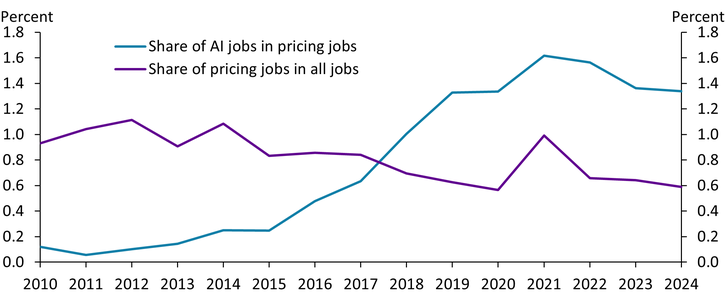
Overall, AI pricing has risen substantially over the past decade. Chart 1 documents recent U.S. trends in pricing jobs from 2010 to 2024 and shows that the share of AI pricing jobs (blue line) increased more than tenfold over this period. This increase in the AI share of pricing jobs occurred while pricing employment as a whole declined. From 2010 to 2024, the share of all pricing jobs in total jobs (purple line) decreased by more than one-third.
Chart 1: While the number of pricing jobs has shrunk overall, the share of AI pricing jobs has increased
Sources: Lightcast and authors’ calculations.
What sectors use AI to set prices? Chart 2 shows that while cumulative increases in AI jobs (purple bars) are relatively concentrated in a few industries, increases in AI pricing jobs (blue bars) are more broad-based._ AI pricing is correlated with more general AI use; unsurprisingly, the information sector—which includes big technology firms such as Uber and Amazon—has both the most AI jobs and the second-most AI pricing jobs of any industry. However, many industries that use little AI in general, such as construction, transportation/warehousing, and arts/entertainment, also use disproportionately more AI for price setting.
Chart 2: AI pricing jobs have been distributed more broadly across industries than AI jobs in general
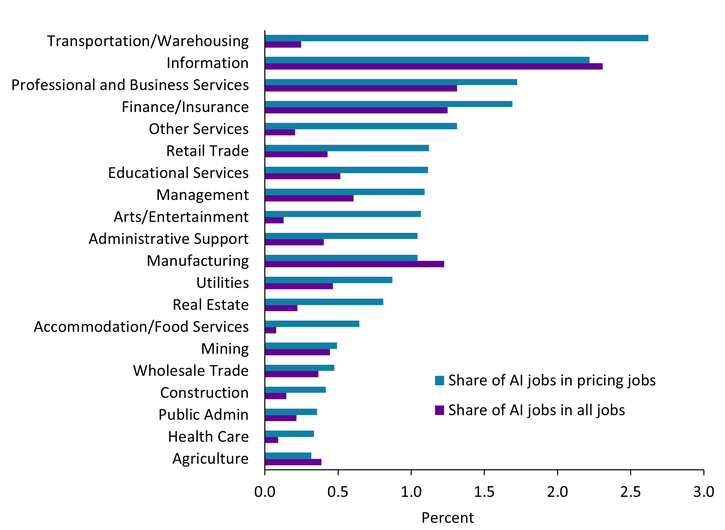
Note: Industry statistics are the cumulative percentage changes in the share of AI pricing jobs (blue) and the share of all AI jobs (purple) from 2016 to 2024.
Sources: Compustat (WRDS), Lightcast, and authors’ calculations.
Moving beyond industry makeup, Chart 3 shows that firms that are heavy users of AI pricing—as measured by their share of AI pricing jobs—are often larger than firms that have not adopted AI pricing. In particular, the chart shows the relationship between firms’ sales in 2010 (plotted on the horizontal axis) and whether they adopted AI pricing from 2010 to 2023 (adopters are in blue, and non-adopters are in purple). The differences in AI pricing take-up between smaller and larger firms are substantial: Firms that were larger in 2010 at the advent of the technology were much more likely to subsequently adopt AI pricing. We hypothesize that this is related to scale-economy effects, as large upfront costs for AI technologies could limit AI usage among smaller firms.
Chart 3: Firms that were larger in 2010 were more likely to adopt AI pricing from 2010 to 2023
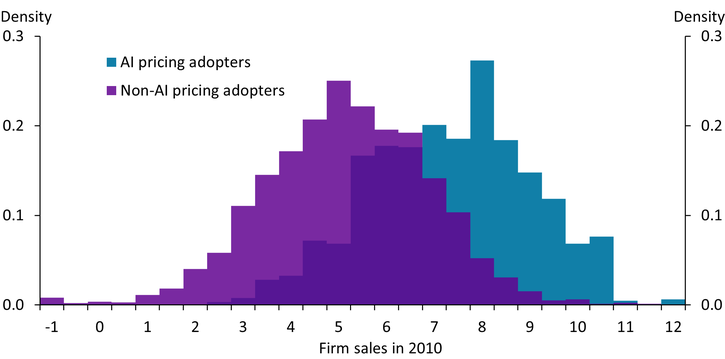
Notes: Horizontal axis is log(sales) in 2010. Vertical axis measures the number of firms.
Sources: Compustat (WRDS), Lightcast, and authors’ calculations.
These differences in adoption of AI pricing lead to differences in firms’ financial outcomes. We document these differences by linking job posting data to accounting records in the Compustat database (for additional details, see Adams and others 2026). After a business begins using AI pricing technology, it tends to experience large changes in its finances. Specifically, we find that a 1 percentage point increase in a firm’s ratio of AI pricing jobs to total pricing jobs predicts cumulative growth in sales by over 1 percent during the sample period. Some of this increase is due to scale, and some of it is due to profitability: The 1 percentage point increase is associated with nearly 3 percent cumulative growth in employment, as well as 0.3 percent cumulative growth in markups.
AI pricing is on the rise. We document that larger firms are more likely to adopt AI pricing and that firms that have adopted the technology have also grown larger and become more profitable. These patterns may be explained by the fixed costs of adoption, which discourage small firms from using the technology, but allow large firms using AI pricing to reap the benefits of falling computation and data costs over time. When firms use AI for price discrimination, it makes them larger and more profitable, as seen in the data. This has implications for consumer welfare, but also monetary policy: If firms are more sensitive to changes in demand, they may be more responsive to monetary tightening and easing.
Endnotes
-
1 Acemoglu and others (2022) classify job postings as AI-related when the posting contains a keyword from their list of AI-related skills, such as “machine learning” and “neural networks.” To verify this method, we compare our constructed measure for the few firms that do publicly release their AI pricing plans, such as Uber.
-
2 The top 20 firms posting the most AI pricing jobs feature many types of companies, including Deloitte (number 1), Johnson & Johnson (2), JPMorgan Chase (7), General Motors (14), and UnitedHealth (17).
Article Citation
Adams, Jonathan J., Zheng Liu, and Sydney Miller. 2026. "Who Uses AI for Pricing?" Federal Reserve Bank of Kansas City, Economic Bulletin, January 7.
Jonathan Adams is a senior economist and Sydney Miller is a research associate at the Federal Reserve Bank of Kansas City. Zheng Liu is a senior policy advisor and director of the Center for Pacific Basin Studies at the Federal Reserve Bank of San Francisco.
References
Acemoglu, Daron, David Autor, Jonathon Hazell, and Pascual Restrepo. 2022. “External LinkArtificial Intelligence and Jobs: Evidence from Online Vacancies.” Journal of Labor Economics, vol. 40, no. S1, April.
Adams, Jonathan, Min Fang, Zheng Liu, and Yajie Wang. 2026. “External LinkThe Rise of AI Pricing: Trends, Driving Forces, and Implications for Firm Performance.” Journal of Monetary Economics, vol. 157, January.
The views expressed are those of the authors and do not necessarily reflect the positions of the Federal Reserve Bank of Kansas City or the Federal Reserve System.
Authors

Jonathan J. Adams
Senior Economist
