
On November 21, 2025, Tyson Foods filed a notice of mass layoffs with the Nebraska Department of Labor detailing plans to close a meatpacking plant in Lexington, Nebraska._ The plant closure, which took place on January 20, 2026, affected more than 3,200 workers in Dawson County. Mass layoffs typically involve plant or facility closures and have occurred regularly over decades. However, research indicates that layoff effects are often more severe in smaller, economically concentrated communities (Vom Berge and Schmillen 2022). Indeed, the closure in Dawson County—with a total population of approximately 25,000 people—represents one of the most substantial layoff events in the past 25 years after accounting for the size of the local community.
Chart 1 shows the most significant mass layoff events since 2000 in counties with populations under 50,000, measured by the share of the county’s labor force affected by the layoff. The Lexington plant closure (purple bar) affected over 23 percent of the county’s labor force, making it the largest mass layoff by workforce share in similarly sized counties since a 2017 plant closure in Fairfield County, South Carolina.
Chart 1: Mass layoff events have been large in several smaller counties in recent years
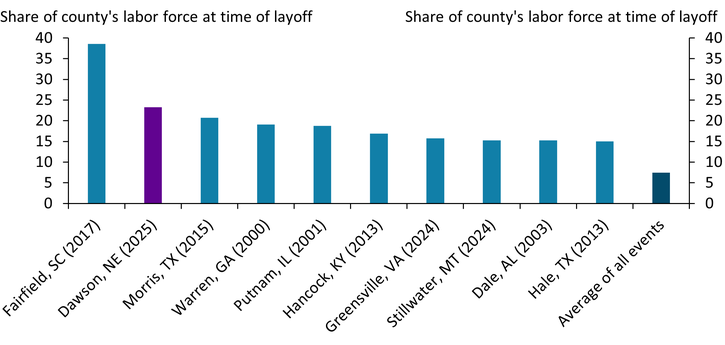
Note: Events include Worker Adjustment and Retraining Notifications (WARN) of at least 500 layoffs in counties with a population below 50,000 at the time of notification.
Sources: Warntracker.com and author’s calculations.
People who lose their jobs in a mass layoff face immediate income loss and uncertain reemployment prospects. Workers unable to relocate after layoffs experience earnings declines and may face additional negative outcomes, including increased mortality (Jacobson, LaLonde, and Sullivan 1993; Sullivan and Von Wachter 2009). These workers also face greater difficulties in finding another job as the local labor pool expands, potentially leading some workers to leave the labor force entirely (Caplin and Leahy 1994).
In addition to the direct effects on individuals, mass layoffs have generated significant indirect effects on regional economies. Foote, Grosz, and Huff Stevens (2019) demonstrate that in the United States, a layoff equivalent to 1 percent of a county’s labor force led to a 0.19 percentage point reduction in labor force size and increased net out-migration by 0.08 percentage points. Gathmann, Helm, and Schoenberg (2020) show that in Germany, mass layoffs by one firm coincided with pronounced and persistent employment reductions by other firms within the same industry. Smaller communities may struggle to recover from these effects relative to larger ones. Vom Berge and Schmillen (2022) suggest that agglomeration—that is, economic activity co-locating in a relatively confined location—can shield communities from the worst effects of a mass layoff event. They propose that regions with robust, interconnected economic ecosystems may better absorb job losses and help displaced workers find alternative employment. However, smaller communities with less developed economic ecosystems are less protected from these negative consequences.
Consistent with this research, Chart 2 shows that the mass layoffs introduced in Chart 1 negatively affected net domestic migration, employment, and labor force size in their counties. In the year following a layoff event, employment dropped by 1.2 percent, the size of the labor force declined by 1.7 percent, and net domestic migration decreased from approximately 2,000 individuals moving from the county to more than 5,000 individuals moving from the county. While these indicators partially recovered over time, they did not recover to their pre-layoff level within three years.
Chart 2: Small counties face other negative economic effects following a mass layoff event

Note: Chart is an aggregation of counties with a population of less than 50,000 where a WARN notice of at least 500 occurred and where employment data exists +/− three years from the layoff event.
Sources: U.S. Bureau of Labor Statistics (Haver Analytics), U.S. Census Bureau, and author’s calculations.
The size of the recent layoff in Lexington, Nebraska, is likely to have large, negative economic consequences for Dawson County over the next several years absent new development. Chart 3 illustrates the potential future effects on both the unemployment rate and net out-migration, estimated using coefficients from the work of Foote, Grosz, and Huff Stevens (2019). The left bars show that the unemployment rate in Dawson County could potentially rise from an average of 2.9 percent in 2025 to more than 27 percent over the next three years. This increase in unemployment is due to both a slight decrease in the size of the labor force and a total decrease in employment of nearly 4,000. The right bars of Chart 3 show that net migration out of the county could also further fall by about 2 percent over the next three years. The additional net migration reflects both a slight increase in the number of people moving away due to the plant closure (from an average of 1,349 between 2022–24 to 1,375 in three years) and a decrease in the number of people moving to the county (from an average of 1,085 between 2022–24 to 1,081 in three years). Foote, Grosz, and Huff Stevens (2019) suggest that a vast majority of people moving from a county undergoing a mass layoff will move to a non-neighboring county or entirely out of state. Other meatpacking plants in communities like North Platte that neighbor Dawson County may ameliorate some, but likely not all, of these moves to distant locations.
Chart 3: Potential economic effects from Tyson layoff in Dawson County, Nebraska

Notes: Latest estimates for employment and labor force are 2025 averages. Latest estimates for migration use 2013–22 averages. In addition to the coefficient estimating the contraction of the labor force (−0.19) following mass layoff events from Foote, Grosz, and Huff Stevens, Chart 3 also employs the coefficient estimating the decrease in employment (−1.2) to estimate the expected unemployment rate.
Sources: U.S. Bureau of Labor Statistics (Haver Analytics), Internal Revenue Service, and author’s calculations.
It is important to stress that the figures in Chart 3 are estimates based on analysis of many mass layoff events in locations of various sizes. The observations from Chart 2 suggest that the potential, dramatic rise in unemployment in Dawson County might be an upper limit. In similarly small counties, layoff events instead resulted in a larger contraction in the labor force, thereby technically limiting the increase in the unemployment rate. Although the specific statistical effect of the mass layoff in Lexington is uncertain at this time, unemployment is expected to rise, the labor force is expected to contract, and net out-migration is expected to increase.
Mass layoff events are disruptive regardless of location: Individuals face income and employment disruptions, and the economies of entire communities can suffer as well. However, research indicates that mass layoffs in smaller, less economically diverse counties typically produce more significant and persistent negative outcomes—particularly, a reduced labor force, decreased employment, and increased out-migration. Developments in Lexington may be important to monitor as policymakers consider how to best mitigate the worst effects of mass layoffs, particularly in other small counties that are similarly economically concentrated.
Endnotes
-
1 See Tyson’s Work Adjustment and Retraining Notification letter External Linkhere.
Article Citation
McCoy, John. 2026. “Mass Layoffs Can Disproportionately Disrupt Small Communities.” Federal Reserve Bank of Kansas City, Economic Bulletin, February 18.
References
Caplin, Andrew, and John Leahy. 1994. “External LinkMass Layoffs and Unemployment.” National Bureau of Economic Research, working paper no. 4766, June.
Foote, Andrew, Michel Grosz, and Ann Huff Stevens. 2019. “External LinkLocate Your Nearest Exit: Mass Layoffs and Local Labor Market Response.” National Bureau of Economic Research, working paper no. 21618, October.
Gathmann, Christina, Ines Helm, and Uta Shoenberg. 2020. “External LinkSpillover Effects of Mass Layoffs.” Journal of the European Economic Association, vol. 18, no. 1, pp.427–468.
Jacobson, Louis S., Robert J. LaLonde, and Daniel G. Sullivan. 1993. “External LinkEarnings Losses of Displaced Workers.” American Economic Review, vol. 83, no. 4, pp. 685–709.
Sullivan, Daniel, and Till von Wachter. 2009. “External LinkJob Displacement and Mortality: An Analysis Using Administrative Data.” Quarterly Journal of Economics, vol. 124, no. 3, pp. 1265–1306.
Vom Berge, Philipp, and Achim Schmillen. 2023. “External LinkEffects of Mass layoffs on Local Employment—Evidence from Geo-Referenced Data.” Journal of Economic Geography, vol. 23, pp. 509–539.
John McCoy is an associate economist at the Omaha Branch of the Federal Reserve Bank of Kansas City. The views expressed are those of the author and do not necessarily reflect the positions of the Federal Reserve Bank of Kansas City or the Federal Reserve System.
Author