
Job gains in the U.S. slowed in 2025, due to both supply and demand factors. Although employment is growing at a steady pace in Oklahoma, hiring has slowed recently to historic lows, reflecting reduced labor market churn. This edition of Oklahoma Economist uses data from the Kansas City Fed's manufacturing and services surveys to examine the underlying causes of this hiring slowdown. It finds that business cycle factors so far have contributed more than structural reductions in labor needs. Specifically, many Oklahoma firms cite demand-based factors like low growth expectations and economic uncertainty as their top restraint on hiring, while fewer businesses cite the inability to find workers than in the past. Further, very few survey respondents reported using AI as a substitute for hiring, but some use it as a complement to increase the productivity of existing workers. Despite constrained hiring activity, most firms are not actively reducing headcount, and the state’s unemployment rate remains low, indicating that the labor market remains relatively stable.
Oklahoma firms anticipate steady employment on net amid low sales expectations and uncertainty
Job gains have softened in the past year, at least partially due to labor supply factors. An aging population and more recent declines in immigration have slowed population and labor force growth, which can lower the number of jobs added in the economy (Mercan 2025). While U.S. employment growth consistently slowed throughout 2025, Oklahoma saw stronger growth before cooling in the latter half of the year (Chart 1, left panel).
Despite continued job gains, the state’s hires rate continued to fall in 2025, reflecting reduced turnover in the labor market. Lower turnover typically reflects a less dynamic labor market in which businesses feel less pressure to compete for talent and workers feel less confident switching jobs. Hiring stayed below pre-pandemic levels in 2025 (Chart 1, right panel). The hiring rate represents the total number of monthly additions to a company’s payroll as a percentage of their total number of employees. Oklahoma’s rate has typically remained higher than the national average, and, like employment, has tended to move with oil prices and drilling activity. In 2022 when commodity prices were elevated, the hiring rate in Oklahoma peaked at just over 5.5%, more than a percentage point higher than the national average. In the second half of 2025, however, the hires rate in Oklahoma fell sharply to 3.1%, ending the year below the national average.
Chart 1: While employment growth stayed steady in Oklahoma, new hires fell in 2025.
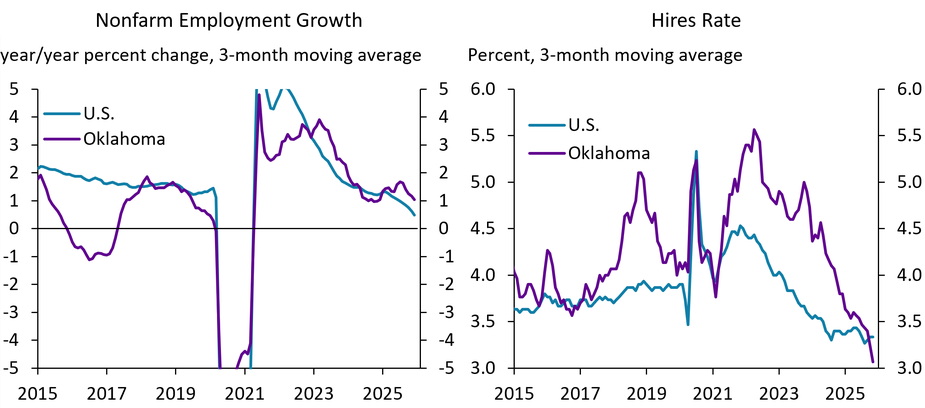
Note: Employment growth reflects the 2025 data vintage and does not incorporate benchmark revisions, Missing October 2025 hires data are linearly interpolated.
Source: U.S. Bureau of Labor Statistics (Haver Analytics)
Looking ahead, survey data indicate that hiring in Oklahoma may not pick up substantially in 2026. Chart 2 presents data from special questions that were included in the November 2025 Services and Manufacturing Surveys. The left panel shows only a net 16% of firms in Oklahoma expected to increase employment in the next 12 months, the third lowest reading in the last decade. In addition, the right panel shows a larger share of firms (about 70%) was expecting broader employment levels to decline or remain unchanged over the next year.
Chart 2: Kansas City Fed survey data further reflect low hiring in Oklahoma.
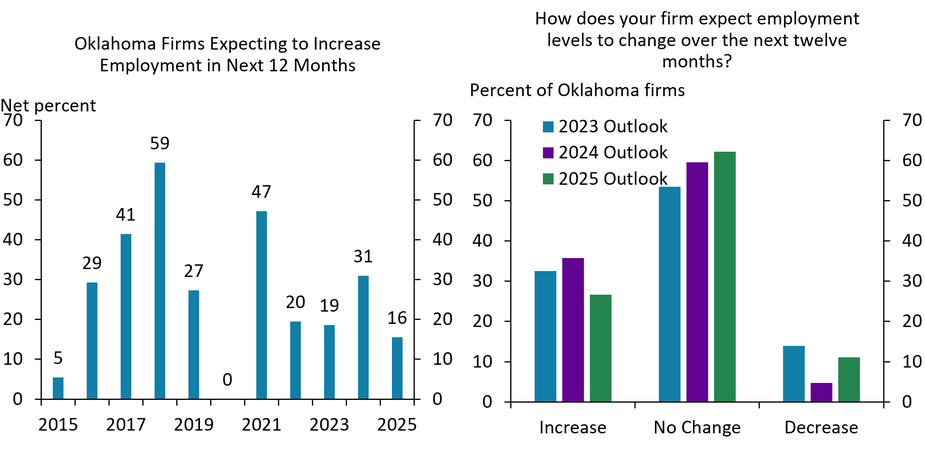
Note: The net percent on the left panel shows the percentage of firms expecting an increase in employment minus the percentage expecting a decrease. Questions asked in November of each year.
Source: Kansas City Fed Manufacturing and Services Surveys
Insights from survey respondents can help explain the factors contributing to the current low hiring environment. Slower hiring can typically be explained either by a reduction in firms’ demand for new workers or a reduction in the supply of adequately skilled workers available. In November 2025, nearly a third of Oklahoma firms surveyed reported low expected sales growth as their top hiring restraint going forward, while nearly a fifth cited uncertainty (Chart 3, green bars). The current concerns differ from previous episodes when the hiring rate decreased in the state. When hiring was low in November 2019, over 30% of businesses surveyed in the state reported their inability to find skilled workers as their top hiring restraint, while fewer expressed concern over low sales or uncertainty. More recently, the share of firms reporting demand-based factors for lower hiring increased from November 2024 to November 2025, while the share of firms citing worker shortages fell to just 16%. Their decreased concern about finding skilled workers likely reflects a shift from the fast-paced hiring coming out of the pandemic to a market in which firms are more selective in hiring amid economic uncertainty.
Chart 3: More firms cite low growth expectations and uncertainty as the top factor restraining hiring.
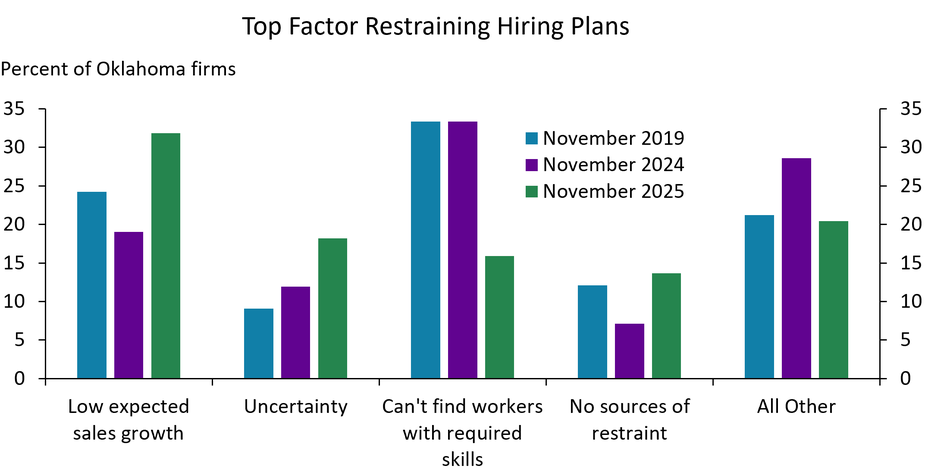
Note: All other factors include current staff being underutilized, high labor costs, keeping operating costs low, and financial position deteriorating.
Source: Kansas City Fed Manufacturing and Services Surveys
While the cyclical factors mentioned above have contributed to the slowdown in hiring, most firms do not cite artificial intelligence (AI) or other structural changes as factors lowering hiring. Rather than changes in labor demand due to fluctuations in the business cycle, demand can change structurally if technological advancements or process efficiencies increase worker productivity (the amount of output produced per hour worked). However, nearly two-thirds of businesses surveyed in January reported little to no structural change in their labor demand over the past year, while 14% reported increased demand (Chart 4, left panel). Further, most firms surveyed in Oklahoma reported that AI is not part of their labor strategy (Chart 4, right panel). While 38% of businesses said they use AI as a complement to workers to increase productivity, only 5% reported it is a substitute for labor in difficult hiring conditions. Therefore, some firms may currently use AI to increase efficiency and output but are still reluctant to use it to replace workers.
Chart 4: Most firms report little structural changes in labor demand, and do not see AI as a substitute for labor.
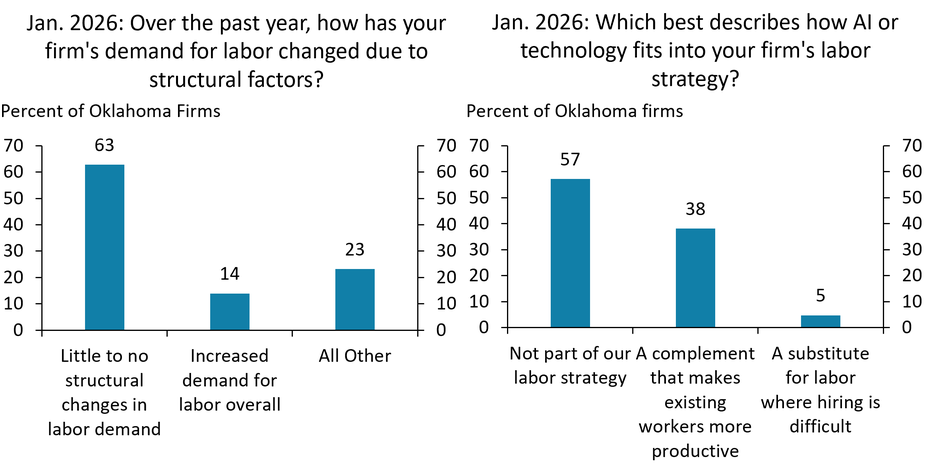
Note: All other responses in the left panel include “Shifted demand toward different skills or roles” (9% of firms), “Reduced demand for labor due to process or organizational changes” (7%), “Uncertain/still evaluating impacts” (7%), and “Reduced demand for labor due to automation of AI adoption” (0%).
Source: Kansas City Fed Manufacturing and Services Surveys
The low-hiring environment has moderated wage gains
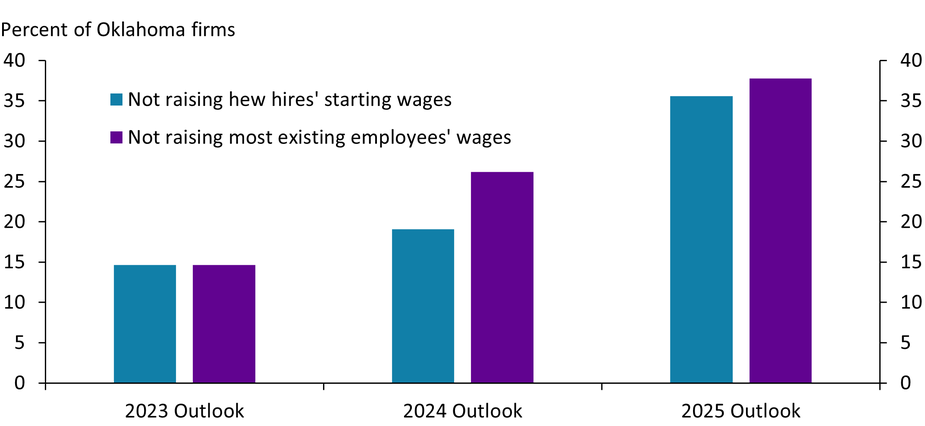
As firms’ demand for new labor has fallen, wage gains for both new and existing employees have softened. The current “low-hire, low-fire” labor market in the U.S. and Oklahoma has resulted in less churn and reduced competition for workers among firms. Accordingly, fewer survey respondents in Oklahoma reported plans to raise wages in 2026 compared to previous years. In 2023, only 15% of firms in the state reported they would not raise wages for the following year for new hires or most existing employees. By November 2025, over a third of firms reported they did not intend to raise wages heading into 2026 (Chart 5).
Chart 5: Fewer firms are raising wages as hiring slows.
Note: Questions asked in November of each year.
Source: Kansas City Fed Manufacturing and Services Surveys
Despite modest hiring, most firms are not reducing headcount, and the state’s unemployment rate remains low
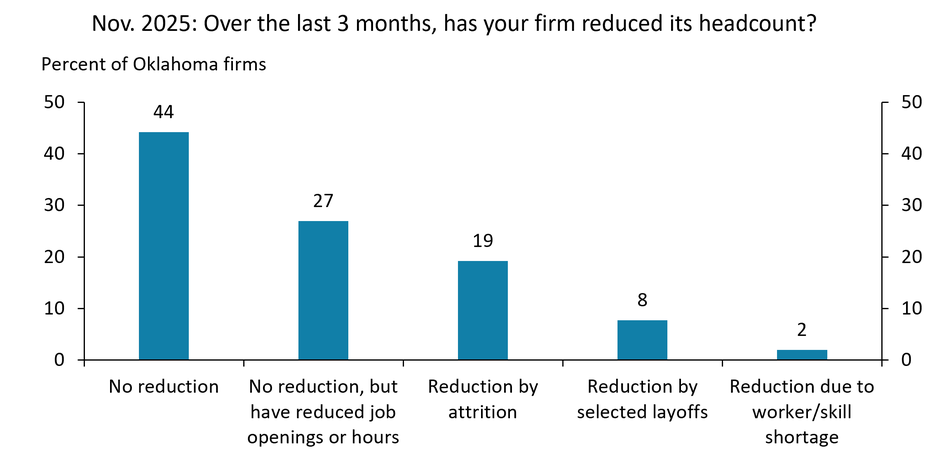
Employment levels remain steady, although some businesses have reduced employee hours or decided not to backfill vacated positions. In November 2025, a combined 71% of firms surveyed did not reduce headcount in the past three months, but 27% did decrease employee hours or job openings instead (Chart 6). Most of the firms that reduced headcount in the latter part of 2025 did so through attrition rather than direct layoffs. Therefore, although hiring is low compared to historical norms, most firms are maintaining their employment levels and potentially reevaluating specific roles as they are vacated.
Chart 6: Most firms are still not reducing headcount, but some are not backfilling open positions.
Note: The reduction by attrition category includes the responses “We have not attempted to replace workers who have left the firm” and “We have reduced the number of open positions without filling them.”
Source: Kansas City Fed Manufacturing and Services Surveys
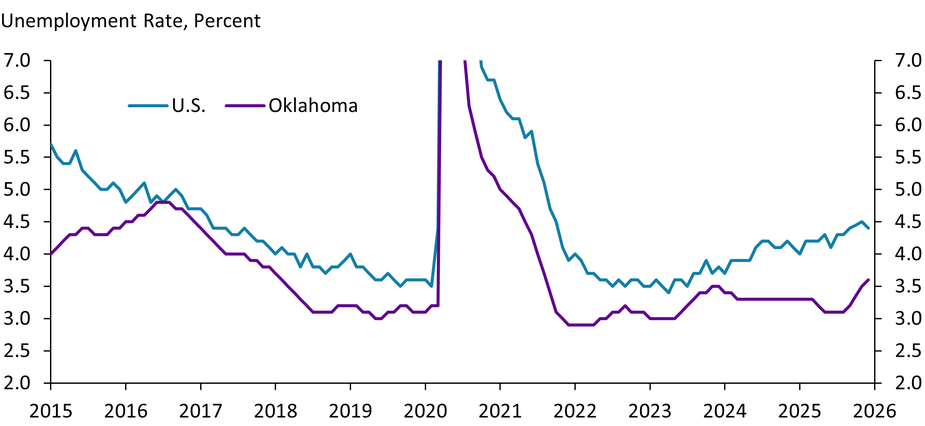
Oklahoma’s unemployment rate provides further evidence that its labor market remains stable despite low churn. The state’s unemployment rate is typically 0.5-1 percentage points lower than the nation, on average. More recently, even as the U.S. unemployment rate has increased, Oklahoma’s remained closer to its levels of the past two years, around 3.6% in December 2025 compared to 4.4% in the U.S. (Chart 7). Although unemployment in the U.S. and Oklahoma has stayed low, the increase in the national rate could indicate that labor demand is weakening relative to labor supply, or that a rising share of the labor force is looking for a job but can’t find one. Although Oklahoma’s unemployment rate has ticked up recently, its relative stability over the past two years suggests that firms’ demand for labor has largely kept pace with the size of the labor force in the state so far.
Chart 7: Despite less hiring, Oklahoma’s unemployment rate has stayed low.
Note: Missing October 2025 data are linearly interpolated.
Source: U.S. Bureau of Labor Statistics (Haver Analytics)
Summary and Conclusions
Oklahoma’s labor market remains healthy despite some cooling. Employment growth in Oklahoma has slowed slightly alongside a sharp decline in the state’s hiring rate. However, Oklahoma’s job market remains relatively steadier compared to the broader United States. Looking forward, most Oklahoma firms reported they do not expect to increase employment in 2026, due, in large part, to uncertainty and an expected cyclical slowdown in sales growth. So far, structural factors such as broader AI and technology adoption have not contributed as much to the cooling of the labor market, as more firms report a reluctance to adopt AI or use it as a complement rather than a substitute for existing labor. Declining labor demand has resulted in fewer wage gains for workers, but most firms have yet to reduce headcount and the state’s unemployment rate remains low, indicating Oklahomans continue to remain employed even in a less dynamic labor market.
References
Federal Reserve Bank of Kansas City. January 2026. External LinkManufacturing and Services Surveys.
Federal Reserve Bank of Kansas City. November 2025. External LinkManufacturing and Services Surveys.
Mercan, Yusuf. 2025. “External LinkDeclining Immigration and an Aging Population Are Reducing Breakeven Employment Growth.” Federal Reserve Bank of Kansas City, Economic Bulletin, October 15.
The views expressed are those of the authors and do not necessarily reflect the positions of the Federal Reserve Bank of Kansas City or the Federal Reserve System.
Authors

Cortney Cowley
Assistant Vice President and Oklahoma City Branch Executive