
The Low-Income Housing Tax Credit (LIHTC) program is one of the primary financing mechanisms for encouraging private investment in affordable rental housing. Established by the Tax Reform Act in 1986, the program has facilitated the construction and rehabilitation of nearly 3.2 million housing units nationwide. The important caveat to housing tax credits is that property managers must keep a fraction of the developed units priced for affordable housing concerns. These affordability restrictions extend through a 15-year federal compliance period, with individual states then taking responsibility for monitoring and enforcing affordability restrictions for a further extended period.
In this edition of the Rocky Mountain Economist, we highlight that Colorado has outpaced the U.S. in the growth of affordable housing units developed using LIHTC-based financing. Notably, the local and national trajectories began to differ about 15 years ago. The implication is that the share of affordable housing units currently exiting their federal compliance period is relatively smaller in Colorado compared to the nation. Preservation efforts of affordable housing advocates, requirements of state housing authorities, and other land use restriction agreements will constrain incentives to transition LIHTC-financed units to market rental rates even when the federal compliance periods close. Despite the faster pace of growth in affordable housing over the past 15 years, the number of new rental units coming online in Colorado appears poised to slow in the near term.
Housing Developments Using LIHTC-Based Financing
The LIHTC program can reduce the cost of capital or close funding gaps needed to support the development of housing. Developers are awarded tax credits by state housing agencies and sell them to investors—typically financial institutions, corporations, or investment funds—to garner upfront equity capital, reducing the developers’ debt burden. Investors can claim the tax credits over a 10-year period if a portion of the rental units in the housing development are offered at below-market rates to income-qualifying households over a 15-year federal compliance period. Investors that are financial institutions can also earn credit toward their Community Reinvestment Act requirements by providing housing to low-income households. Altogether, this structure creates a public-private partnership that aligns the interests of investors seeking tax benefits with the public policy goals of expanding affordable housing.
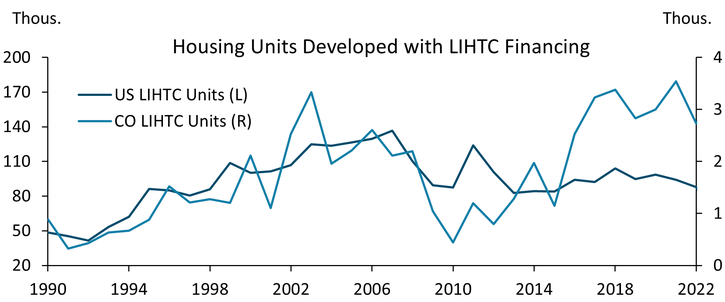
The number of housing units developed with LIHTC financing grew steadily across the United States and in Colorado during the first 15 years of the program’s existence. Chart 1 shows the number of designated affordable housing units developed in projects funded by LIHTC investments since 1990 as reported by the Department of Housing and Urban Development (HUD).i The pace of growth in housing development was initially similar in Colorado (light blue line) and the United States (dark blue line) between 1990 to 2005.ii Although the federal compliance period for affordability restrictions is 15 years after housing is placed in service, state-specific rules and land-use agreements typically extend these restrictions to a 30-year period. The similar pace of growth in LIHTC housing development in the United States and Colorado through the late 1990s, now approaching 30 years ago, means that Colorado’s current outlook for a peak in the number of housing units exiting local compliance periods over the next five years looks similar to the nation’s.
Chart 1: Growth in LIHTC-funded housing development differs between the United States and Colorado
Sources: HUD and authors’ calculations.
Between 1990 and 2020, LIHTC-funded affordable housing units placed in service each year add up to a cumulative number of approximately 2.9 million developed across the United States, with 52,000 units developed in Colorado.iii Only a portion of the units in any housing development have affordability restrictions, so the total number of actual housing units developed with LIHTC financing is even larger: 3.2 million across the United States and 58,000 in Colorado.
Over the past two decades, however, state and national trends in the development of LIHTC-funded housing units began to diverge. While both Colorado and the nation as a whole experienced ongoing development in LIHTC-funded housing, national growth in the number of units developed decelerated. In contrast, LIHTC-based housing development in Colorado regained momentum in 2010 during the recovery from the 2007–08 global financial crisis and even accelerated over the last decade. Colorado’s faster growth in housing development coincides with faster growth in the state’s population via high levels of in-migration from other parts of the country.
The downward trend in new housing development in the United States since 2010—now just past the 15-year federal compliance period—implies that state-specific restrictions to preserve affordability have become more pertinent outside of Colorado. Chart 2 compares the annual flows of newly developed LIHTC units (blue lines) to units reaching the end of their initial federal compliance periods (purple lines) for both the United States (Panel A) and Colorado (Panel B).iv The United States experienced negative net flows over the past five years on average (green bars), meaning more units are exiting the federal compliance period and transitioning to state monitoring and enforcement on net. These negative net flows result from the national deceleration in LIHTC-funded housing development that began 20 years ago. In contrast, Colorado maintained positive, albeit modest, net flows of housing units into federal compliance periods in recent years. Colorado’s acceleration in LIHTC-funded housing development over the past decade results in a smaller share of existing housing units currently reaching the end of their federal compliance periods.
Chart 2: Net flows of housing units into and out of compliance periods in Colorado differ from the United States
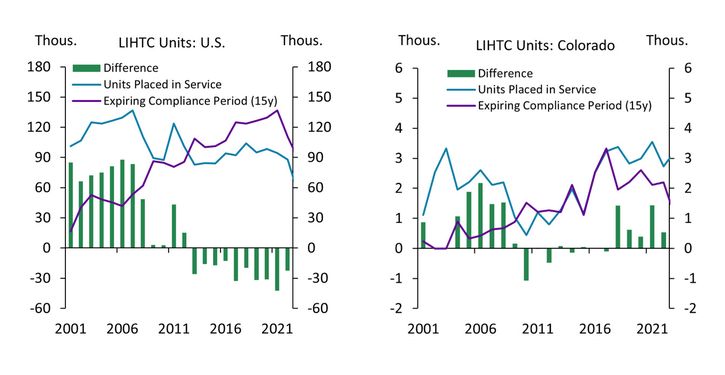
Notes: “Compliance period” refers to the 15-year federal compliance period. Other state or local restrictions may also apply and extend beyond 15 years.
Sources: HUD and authors’ calculations.
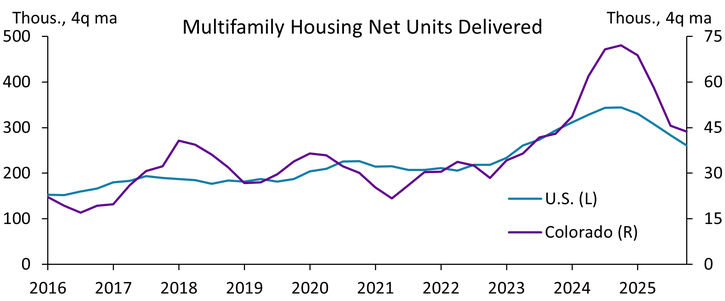
The surge in housing development in Colorado may subside this year. The number of multifamily housing units delivered—whether for affordable housing development or for general market-rate development—fell at the end of last year to a level not seen in almost a decade. Chart 3 shows the net number of housing units delivered (units constructed less those taken out of the market) in Colorado (light blue line) and the United States (dark blue line) since 2015 using data reported from CoStar Realty Information, Inc. The precipitous decline in local housing development brings the pace of growth back in line with the national growth rate.
Chart 3: Housing development poised to slow in Colorado
Sources: CoStar Realty Information, Inc
Looking Ahead
The distinct trend in Colorado’s affordable housing development over the last decade appears to be converging to nationwide trends, at least in the near term. The recent surge in the number of housing units delivered has saturated the market, which is tempering investors’ willingness to support further development currently. The surge in housing development was particularly outsized for Colorado. Whether the pace of housing development in Colorado will normalize to the relatively faster rate of the past decade or to something closer to the national trend over the medium term remains unclear.
___________________
i Information on individual LIHTC housing properties nationwide are available from the Department of Housing and Urban Development (HUD) here: External LinkLow-Income Housing Tax Credit (LIHTC): Property Level Data | HUD USER
ii HUD generally reports both the year of the allocation of tax credits and the year affordable housing units were placed in service for each individual development project. However, for 2.8 percent of the LIHTC projects reported, only the allocation date is available. The median time between the allocation date and the placed-in-service date across the rest of the sample is one year. For those projects reporting only the allocation date, we impute the placed-in-service date as one year after the allocation and calculate the end of compliance periods from that date.
iii Information about individual projects are often reported with a lag and continuously updated. Recognizing that data from the last two years is still being compiled, we focus on data prior to 2023.
iv Owners of low-income housing properties can seek a new allocation of tax credits once federal compliance periods close. In those instances, the property may enter a new compliance period. We report information that is agnostic as to the actions of property owners (resyndication, qualified sale, etc.) and simply accounts for the end of the initial federal compliance period after 15 years.
The views expressed are those of the authors and do not necessarily reflect the positions of the Federal Reserve Bank of Kansas City or the Federal Reserve System.
Authors

Nicholas Sly
Vice President, Economist, and Denver Branch Executive

David Rodziewicz
Advanced Economics Specialist