Americans’ ongoing love of a road trip can help small towns build their economies, according to a new report from the Federal Reserve Bank of Kansas City.
External Link“The Byways Report: The Scenic Route to Rural Prosperity” frames the issue through the 100th anniversary of Route 66, the epic 2,448-mile road trip that crosses eight states from Chicago to Los Angeles. Four of those states – Missouri, Kansas, Oklahoma and New Mexico – lie in the Tenth Federal Reserve District, which the Kansas City Fed serves. While focused on Route 66 in Oklahoma, the report includes interviews with national experts on rural development and byways tourism, as well as the experiences of people creating various byways around the U.S.
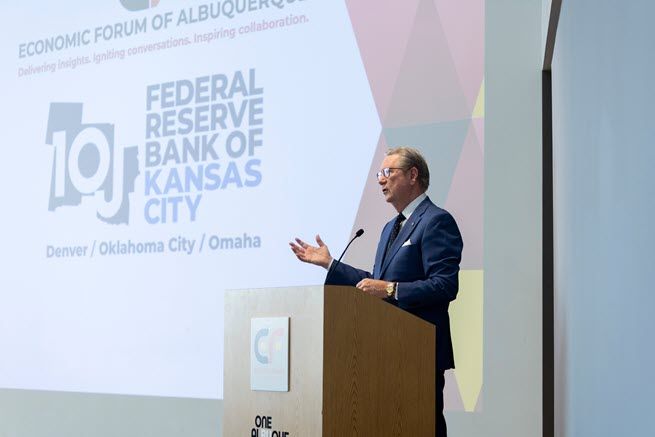
Jeff Schmid, president of the Kansas City Fed, speaks at the Economic Forum of Albuquerque. At 18 miles, Albuquerque's Central Avenue is the longest continuous stretch of Route 66 in any urban area.
Kansas City Fed president Jeff Schmid introduced the report in a External Linkspeech at the Economic Forum of Albuquerque on February 11, 2026. “Tourism is an important industry in many of the rural regions in the Tenth District, and byways are important conduits for that industry,” Schmid told the group. “This report is just one example of how the Fed invests in understanding the regional economy, while also contributing to the region’s economic success.”
Schmid noted that the regional structure of the nation’s 12 Reserve Banks shared strengths with byways like Route 66. “To many, Route 66 is the epitome of Americana, with its wide-open spaces interrupted only by unique and distinctive local communities, each exceptional in its own way,” Schmid said. “This is the story of America, a set of distinct regions and economies, linked together to form a more powerful whole. The fundamental importance of regionalism to the nation’s development and ultimate strength continues today in the structure of the Federal Reserve. We are your bank, and we work every day to make sure you have a voice in the nation’s economic policy.”
A fresh, appreciative look can unlock economic possibilities
The National Travel Center found that a byway can feasibly generate between $250,000 and $450,000 per mile per year in visitor spending, when it meets these conditions: it features heritage and cultural locations; offers visitors plenty of places to visit and opportunities to spend money; includes destination-distinctive accommodations and local cuisine; and is well-promoted.
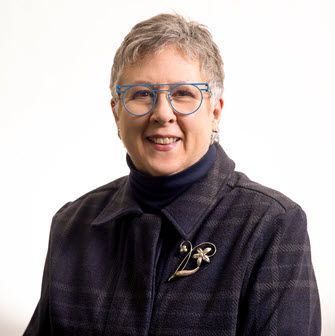
“The major theme and biggest surprise for me was that long-time residents of small towns often can’t see what might draw visitors,” said Jennifer Wilding, community engagement advisor at the Kansas City Fed and the report’s author. “Newer or younger residents have helped others see their town with fresh, appreciative eyes. When that happens, it opens an array of possibilities.”
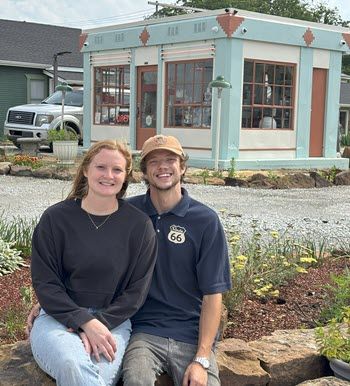
Tori and Eli Chenoweth, in their early 20s, have already renovated two historic gas stations in Miami, Oklahoma. The Hudson station, built in the 1920s, now houses their shaved ice stand, the Frozen Elephant.
Byways tourism is especially suited for rural areas and small towns
For these four reasons, byways tourism is especially well-suited to small towns and rural areas:
- There are often miles between small towns, usually in the countryside, where the road beckons. They call them “scenic” byways for a reason.
- Towns can create their own byway based on their specific regional heritage and assets. Regions have created byways around themes from butterflies to bluegrass, barn quilts to wineries, Amish culture to the Underground Railroad, and more.
- No one town must carry all the weight. In fact, a byway works best when each town plays to its strengths. One town may have a renovated motel, another has a museum or hiking trail, another a brewery or local cuisine and so on.
- The things a town does to entice visitors also make life better for residents. A byway can be the catalyst to improvements that help the town feel and be more prosperous.
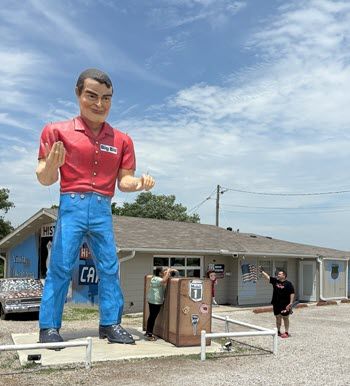
Big Bill stands guard outside the Hi-Way Cafe near Vinita, Oklahoma. Giants are a tradition along Route 66.
Storytelling brings the people and places to life
“The Byways Report” uses a storytelling approach to show how communities, often assisted by state leaders and regional organizations, have used byways to draw visitors and build rural prosperity. Stories feature young entrepreneurs preserving the past in Miami, Okla.; the Cherokee Nation telling its story and a vintage café creating memorable experiences in Vinita, Okla.; a group of creative residents bringing new life to Route 66 in Clinton, Okla.; a retired artist using art as economic development in tiny Sayre, Okla.; and other stories from Oklahoma, Willa Cather country in Red Cloud, Neb., and the Crooked Road Music Trail in Virginia.
“I was born and raised in a small town and still have a deep love and appreciation for rural places,” said Cortney Cowley, assistant vice president and Oklahoma City branch executive. “However, I often feel a sense of frustration when I read reports about how to ‘fix’ rural communities. Do they have their challenges? Yes, but so do non-rural areas. Reading ‘The Byways Report’ warmed my country heart and intrigued my economist brain. Turning the pages felt like traveling along Route 66 with Jennifer. As she highlights, the stories found in rural America are worth celebrating. These stories remind us of the beauty of small places and the benefits of taking the scenic route.”
Readers will find links to technical resources
“The Byways Report” also highlights an array of technical resources that can help states, regions and towns leverage route-based tourism as part of their efforts to build rural prosperity. It shares ten themes, based on interviews, for those wanting to strengthen or start a byway, including embracing entrepreneurism as an economic strategy, preserving the history and heritage of the town, thinking in terms of collaboration not competition, making space for many stories to be told, and reaching out to destination marketing and regional development organizations for support.
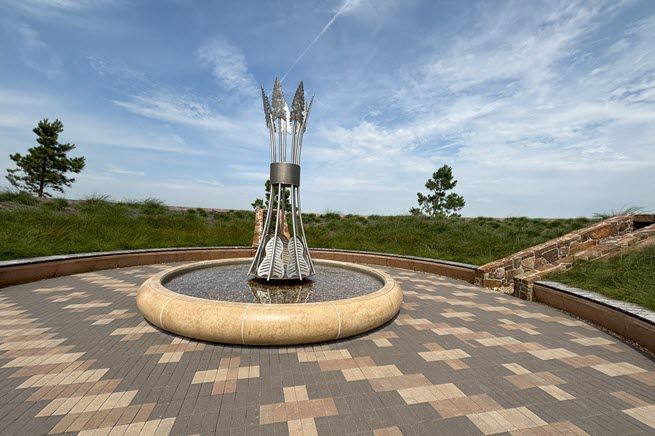
Route 66 traverses the 14 counties owned by the Cherokee Nation. The tribe, which considers cultural tourism an important economic development tool, located its new Cherokee Nation Anna Mitchell Cultural and Welcome Center on Route 66 in Vinita, Oklahoma.
As part of its work to support financial stability and to learn how those who live in the Tenth District experience the economy, the Kansas City Fed connects with communities in its region to promote economic development, access to credit and public understanding.
For more information on “The Byways Report: The Scenic Route to Rural Prosperity,” to download the report or request a free printed copy, External Linkvisit here.
As the regional headquarters of the nation’s central bank, the Kansas City Fed and its branch offices in Denver, Oklahoma City and Omaha serve the seven states of the Tenth District: Colorado, Kansas, Nebraska, Oklahoma, Wyoming, northern New Mexico and western Missouri.
The views expressed are those of the authors and do not necessarily reflect the positions of the Federal Reserve Bank of Kansas City or the Federal Reserve System.
Author