
Top image: Marisa Martinez and Becky Kropf from the Federal Reserve Bank of Kansas City Community Development and Engagement Department on a site tour at Amethyst Place. (From left to right, Becky Kropf, Lauren Clifton-Thompson, Sarah Knopf-Amelung, Ashley Rudd, and Marisa Martinez.)
I joined the Federal Reserve Bank of Kansas City as a community advisor in spring 2024, bringing decades of experience to a role that offered me a fresh perspective on community work. This new vantage point inspired my research into today's community development landscape. Over the past eighteen months, I've facilitated more than 100 roundtables, discussions, and interviews with diverse stakeholders—nonprofit leaders, bankers, funders, and public officials—who collectively identified key challenges and growth opportunities in community development.
Understanding how people experience the economy is crucial for effective policymaking. The Federal Reserve analyzes comprehensive quantitative data on variations in income, wealth, employment, and other factors to understand their economic implications. However, real-time conversations with community members provide equally valuable insights into emerging trends. By combining rigorous data analysis with direct community engagement, we develop a more complete and nuanced picture of current economic conditions. This report connects themes that, when viewed holistically, have significant implications for the entire community development field.
Seeking elements of a healthy community development ecosystem
This project sought to identify elements of a healthy community development ecosystem—defined as a network of connected groups and people who work to improve lives, solve local problems, and reach common goals. This simple definition guided all my conversations.
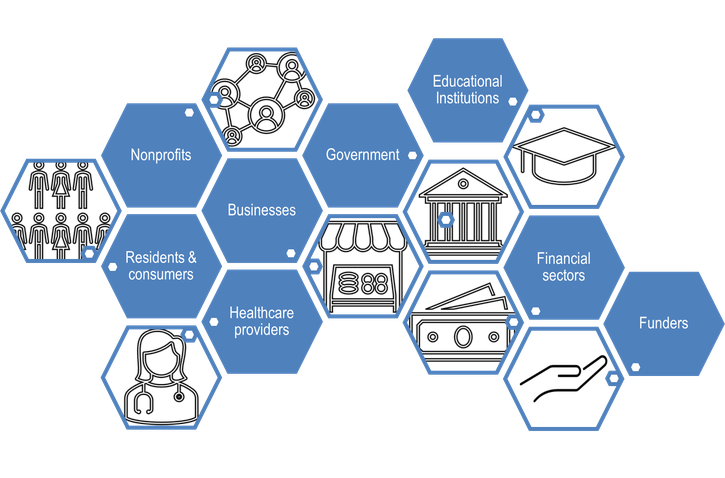
The graphic shows the types of community development stakeholders who were included in conversations.
When asked about qualities that help a community development ecosystem thrive, participants identified recurring challenges that offer opportunities for action:
- Using clear communication
- Navigating complex work
- Using data purposefully
- Developing responsive training
- Prioritizing workforce wellness
Using clear communication
Vague terms create confusion. They make it hard to set goals, track progress, or define success—especially in partnerships. Stakeholders often disagree about what words like "ecosystem," "access to capital," "financial education," and "affordable housing" truly mean.
One community leader explained how different interpretations of the word “gentrification” led organizations to pursue conflicting strategies, sometimes resulting in disinvestment and fewer capital investment opportunities. Their organization addressed this by creating a clear definition for its anti-displacement strategy, helping them identify displacement factors and focus on redevelopment without displacement.

Similarly, participants described the term “access to capital” as a catch-all that often overshadows the broader challenges entrepreneurs face. One practitioner argued that focusing only on capital neglects other crucial aspects of business development, calling capital "the gas that gets them there" rather than the complete solution. She avoided using this term because focusing only on capital investment missed other elements that are important throughout an entrepreneur's business journey.
Participants cited “financial education” as another problematic blanket term. While most contacts agreed on its importance, they defined and approached it differently. Approaches ranged from teaching budgeting, credit, and banking to guiding individuals toward specific goals, such as homeownership. Increasingly, organizations seek a deeper understanding of the behavioral aspects of personal finance and their long-term impact on household finances. These require committed engagement and specialized resources.
Navigating complex work
Participants emphasized that community development challenges are interconnected. For example, addressing affordable housing requires a coordinated strategy that links to issues such as workforce development, transportation, health access, and education.
During one roundtable, participants suggested creating what they called “ecosystem navigators,” experienced practitioners who align goals, increase transparency, and share knowledge. They also suggested formalizing partnerships through mergers or acquisitions, though they approached this idea with caution.
All contacts agreed that no single solution exists. Successful community development partnerships need shared purpose, relationship management, flexibility, innovation, and patience.
Using data purposefully
Participants recognized data as vital for decision making, reporting, and program evaluation. However, they described managing data as both necessary and overwhelming.
Many cited challenges in accessing and analyzing data, expressing frustration over the time and expertise required. Practitioners reported often feeling overwhelmed by too much data. This made it hard to prioritize metrics and led to analysis paralysis. Some worried that focusing too much on numbers could hide important stories and lived experiences.

Participants also expressed concern about survey fatigue. They said organizations poorly coordinate surveys, which often extract from rather than collaborate with communities. This was particularly true for areas that researchers have repeatedly studied but insufficiently addressed. Participants repeatedly asked, “Who needs this data and why?”
Participants advocated for a more intentional, community-centered approach to information management. They suggested:
- setting clear analytical priorities
- establishing boundaries for sufficient data
- involving end-users early in the interpretation process
They stressed the importance of combining qualitative narratives with quantitative measurements to ensure lived experiences remain central.
Developing responsive training
While many training opportunities exist, participants noted they often miss current challenges. They argued that effective training must fit specific contexts, adapt to changing needs, and be accessible. Key training, they said, needs to include:
- Trauma-informed practice,
- Grant writing,
- AI and data literacy,
- Cybersecurity,
- Community Reinvestment Act requirements, and
- Capacity building.
Some contacts wanted more training on how to conduct community needs assessments, since good development work starts with knowing local strengths and problems. One-size-fits-all training misses unique local situations. Given the Federal Reserve Banks' role as a bank regulator overseeing Community Reinvestment Act (CRA) compliance, participants saw technical topics such as CRA compliance as opportunities for actionable, accessible training. They believed that clearer regulatory explanations could help organizations use regulations more effectively.

Participants' most significant feedback emphasized grounding training in real-world scenarios and peer exchange. This, they said, promoted ongoing learning and adaptability. Participants also valued peer-to-peer learning and collaborative problem-solving over standardized training. They stressed the need for continuous support to build and maintain capacity.
Prioritizing workforce wellness
Participants identified workforce wellness as essential across all sectors. Contacts indicated that it encompassed mental and physical health as well as financial well-being. Nonprofit and small-business contacts frequently reported staff burnout, compassion fatigue, and isolation - all made worse by limited resources and heavy workloads.

They said many organizations neglected financial wellness due to limited resources. This places extra burdens on staff, who face rising living costs, student loan debt, and economic uncertainty.
To address these issues, nonprofit leaders and small business owners suggest sharing back-office resources for mental health and financial planning, such as access to financial advisors and practical savings tools. They also called on funders and policymakers to support employee wellness initiatives.
Conclusion
Despite significant challenges, community development practitioners can make meaningful progress by:
- Defining vague terms clearly and setting explicit expectations to build strong partnerships
- Recognizing that community development creates the foundation for meaningful change despite its complexity
- Using data purposefully to support communities, not just data collectors
- Designing training with peer learning, practical application, and ongoing support
- Prioritizing workforce wellness for organizational effectiveness
This project underscores a fundamental principle that guides the Federal Reserve's approach: understanding how people experience the economy is crucial for effective policymaking. While comprehensive quantitative data on income, wealth, employment, and other factors provide essential economic insights, real-time conversations with community members reveal equally valuable perspectives on emerging trends.
As one participant wisely noted, "Community work is about people first." By addressing the priorities identified in this report and maintaining this dual approach of data-informed and community-centered practices, we can significantly improve the effectiveness and impact of community development initiatives, ultimately creating stronger, more resilient communities.
The views expressed are those of the authors and do not necessarily reflect the positions of the Federal Reserve Bank of Kansas City or the Federal Reserve System.
Author