
Center for Agriculture and the Economy
Leveraging expertise from the Kansas City Fed, the Center provides timely analysis of industry developments and conducts ongoing research on the agricultural economy.
Population Has Declined in Farming Dependent Counties Since the Pandemic
April 16, 2026
By John McCoy
Since 2020, farming-dependent counties were the only major county typology where population growth has been negative. There has, however, been significant variation in population growth across farming dependent counties. The most sluggish county, Tallahatchie Co., Mississippi, lost more than 1,700 residents from 2020 to 2025 (15% of its population). Over the same time frame, Jerome Co., Idaho gained more than 2,000 people (8% of its population). Maintaining population is crucial for many reasons, including ensuring the steady supply of local labor, preserving local tax bases, and sustaining demand for goods and services provided by local businesses. Counties with notable declines could be more exposed to potential economic challenges.
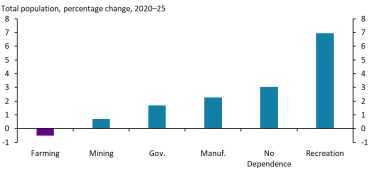
Note: County dependencies are mutually exclusive and defined by External Linkthe USDA. Counties with “no dependence” are not reliant on any industry in particular.
Sources: USDA, Census Bureau, and Federal Reserve Bank of Kansas City staff calculations
Find additional Insights on Agricultural and Rural Economies.
Research and Information
Agricultural Finance
Research and articles tracking trends in agricultural finance.
Insights on Ag and Rural Economies
Concise analysis on agricultural and rural economic trends.

Agricultural Data and Indicators
Data on economic and financial conditions in agriculture.
Agriculture Research Hub
All of the Kansas City Fed's research and resources on agriculture and related topics.
System Resources
Links to research and resources on agriculture and rural topics from throughout the Federal Reserve System.
Latest Research and Updates
Agriculture
-
Strong Farm Loan Demand Supports Ag Bank Earnings | -
Growth in Farm Lending Activity Persists | -
Firm-Level Pass-Through of Supply Chain Disruptions: Insights from the U.S. Beef Market | -
Disparate Conditions in Crop and Livestock Sectors Evident in Credit Conditions | -
Omaha Branch holds Economic Forum | -
Federal Reserve Bank of Kansas City Launches Center for Agriculture and the Economy |
Agricultural Finance
-
Larger Operating Loans Boost Farm Lending Activity in 2025 | -
Farmland Values Remained Strong in 2025 | -
Strong Farm Loan Demand Supports Ag Bank Earnings | -
Growth in Farm Lending Activity Persists | -
Farmland Values Remain Firm Despite Deterioration in Farm Finances | -
Tighter Liquidity and Improved Earnings at Agricultural Banks |
The Kansas City Fed's Continuing Commitment to Agriculture
Through regular surveys, analysis and connections across the industry, the Kansas City Fed has had a longstanding focus on U.S. and global agriculture. Leveraging this expertise, the Center for Agriculture and the Economy serves as a resource within the Federal Reserve System by providing timely analysis of industry developments and conducting ongoing research on the agricultural economy. The Kansas City Fed is committed to understanding developments in the agricultural economy and gathering perspectives from rural America in order to include them in discussions on the national economy.
The Kansas City Fed's Ag Connection
Agriculture is central to the Kansas City Fed’s 10th District’s economy, from farm production and food manufacturing to agricultural banking and finance. Through its regular surveys, analysis and connections across the industry, the Kansas City Fed has had a longstanding focus on the U.S. and global agricultural economy. At the same time, connecting with stakeholders and ag industry professionals through events, round tables and conversations is critical to the Bank’s work.